

Korean grammar app

Korean grammar
Now it clicks

Finally understand Korean grammar—one small step at a time. Learn particles, verb endings and sentence patterns with clear explanations, native-speaker audio and practice. For iPhone, iPad and Android.

Download free — try the first 10 topics with full audio & exercises

No account required · Unlock the rest anytime with a one-time purchase

4.3 / 5Learner rating
Inside the appSee the rule. Use the rule.
Korean Topic 11: present-tense verbs, the 아요 ending and the example 남동생은 자요?
Korean sentence-building exercise for The train is going, with Korean word tiles Explore the exercises

Real iPhone screenshots. Tap either preview to enlarge.

185step-by-step grammar topics
3,200+examples with audio
Particles & verbsexplained in context
One purchaselifetime course access
Try it hereExample 1 / 3

이에요 or 예요? Try it yourself

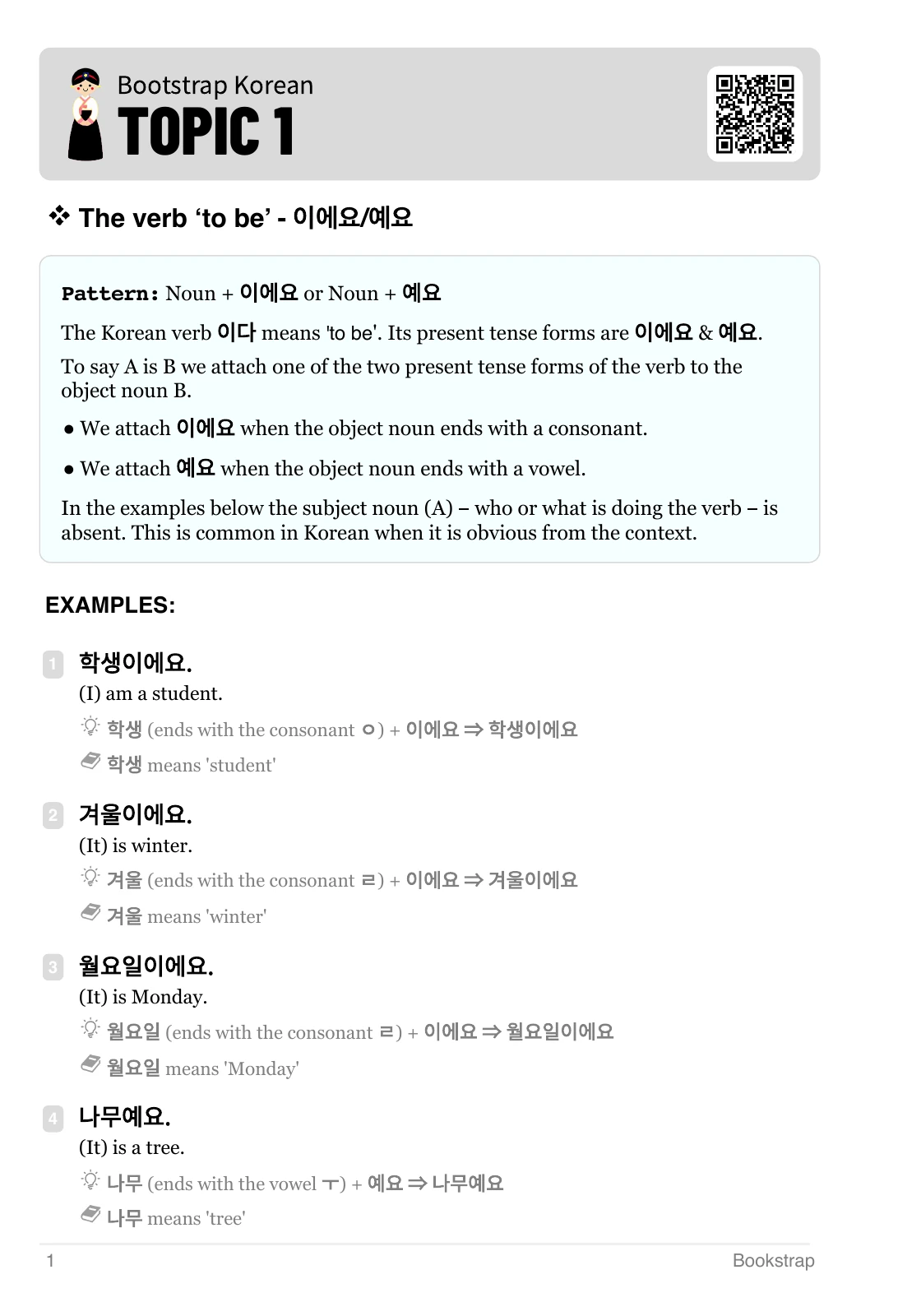
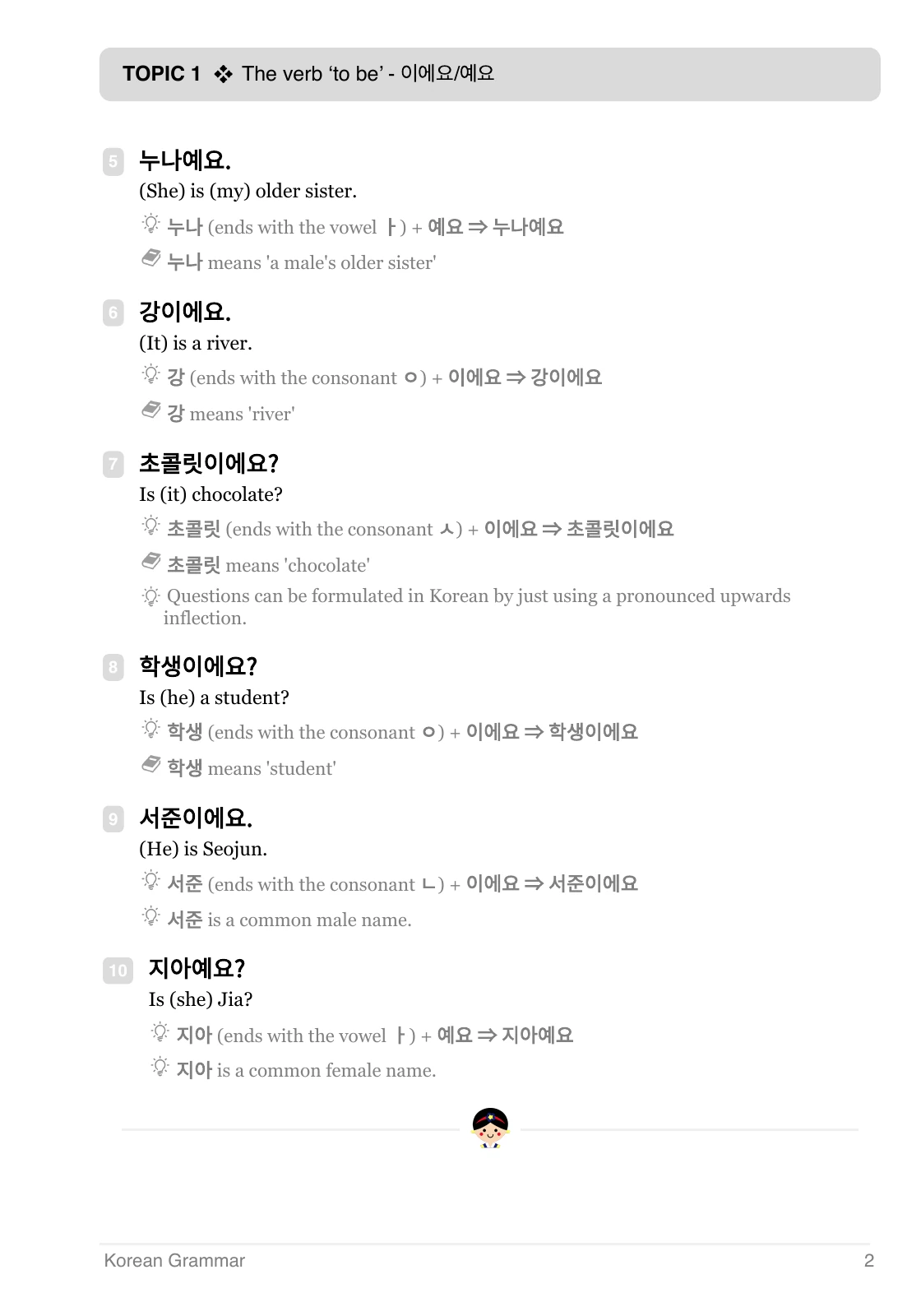
Topic 1 · The verb “to be”

학생이에요.

(I) am a student.

학생 + 이에요 → 학생이에요

학생 means “student” and ends with the consonant ㅇ. Add 이에요 after a consonant: 학생이에요. The subject is left out when it is clear from context.

Understand the pattern

A website lesson using real course examples. See the app ↗

Make the connection

Korean grammar
one small step at a time

185 self-contained topics give you a clear path through the grammar. Start with your first Korean sentence, then build through 은/는 and 이/가, tenses and particles to causatives, honorifics, reported speech and the formal 습니다 style.

01 / UNDERSTAND

Build on what you know

Each topic explains one grammar point in plain English, then builds on what came before. Add new patterns in small, manageable steps and learn at your own pace.

02 / HEAR

Learn vocabulary in context

Explore 3,200+ annotated examples, each with native-speaker audio and an English translation. Notes explain how the grammar works and what new words mean, so your vocabulary grows alongside it.

03 / PRACTISE

Put each pattern into practice

Use interactive exercises to practise the Korean grammar you have just learned. Choose the right form, build sentences and connect the explanation to an answer you can produce yourself.

Inside Bootstrap Korean Grammar

See how the learning happens

Korean app previews. Select a screen to take a closer look.
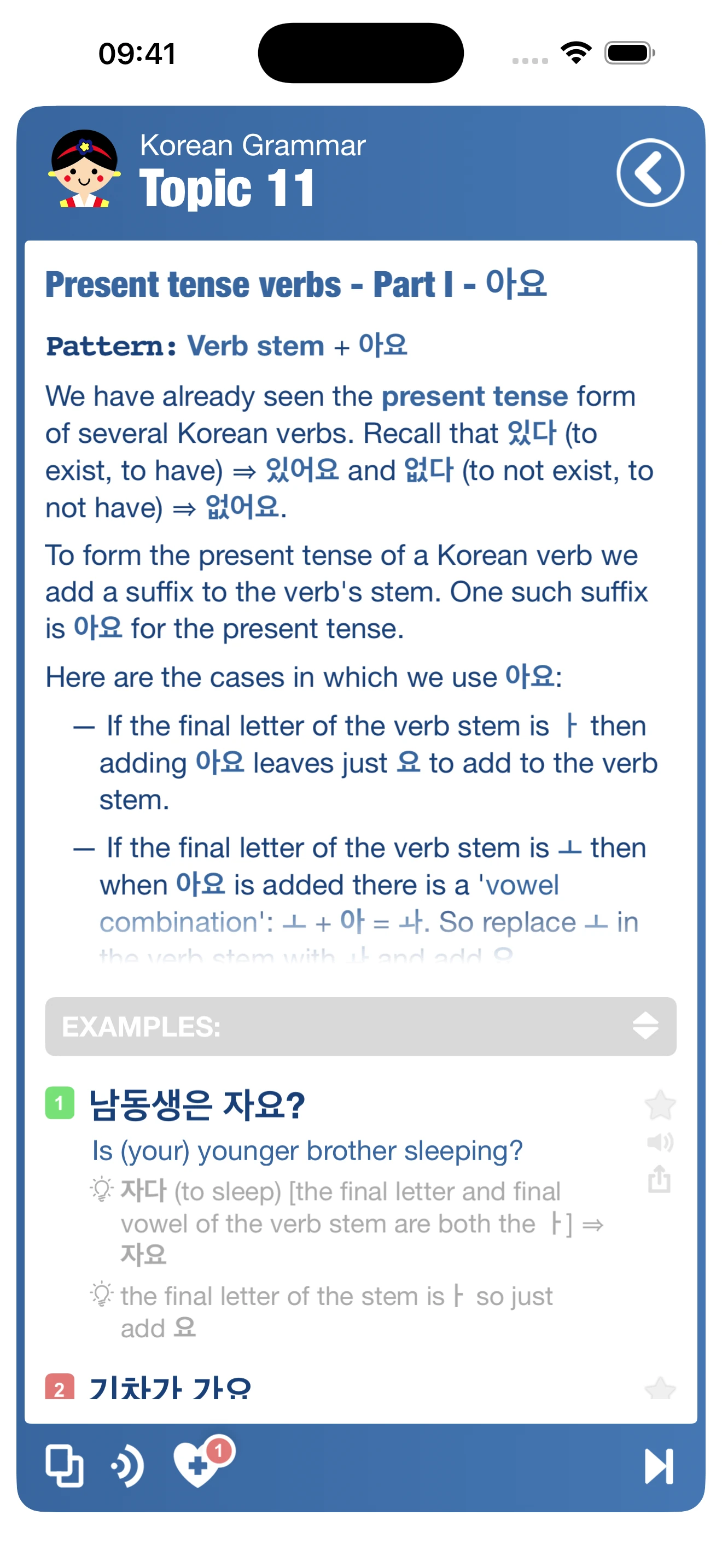
  • Korean Topic 11: present-tense verbs, the 아요 ending and the example 남동생은 자요?
    01

    Understand the rule

    Topic 11 explains Korean present-tense verbs ending in 아요, with examples, translations and grammar notes.
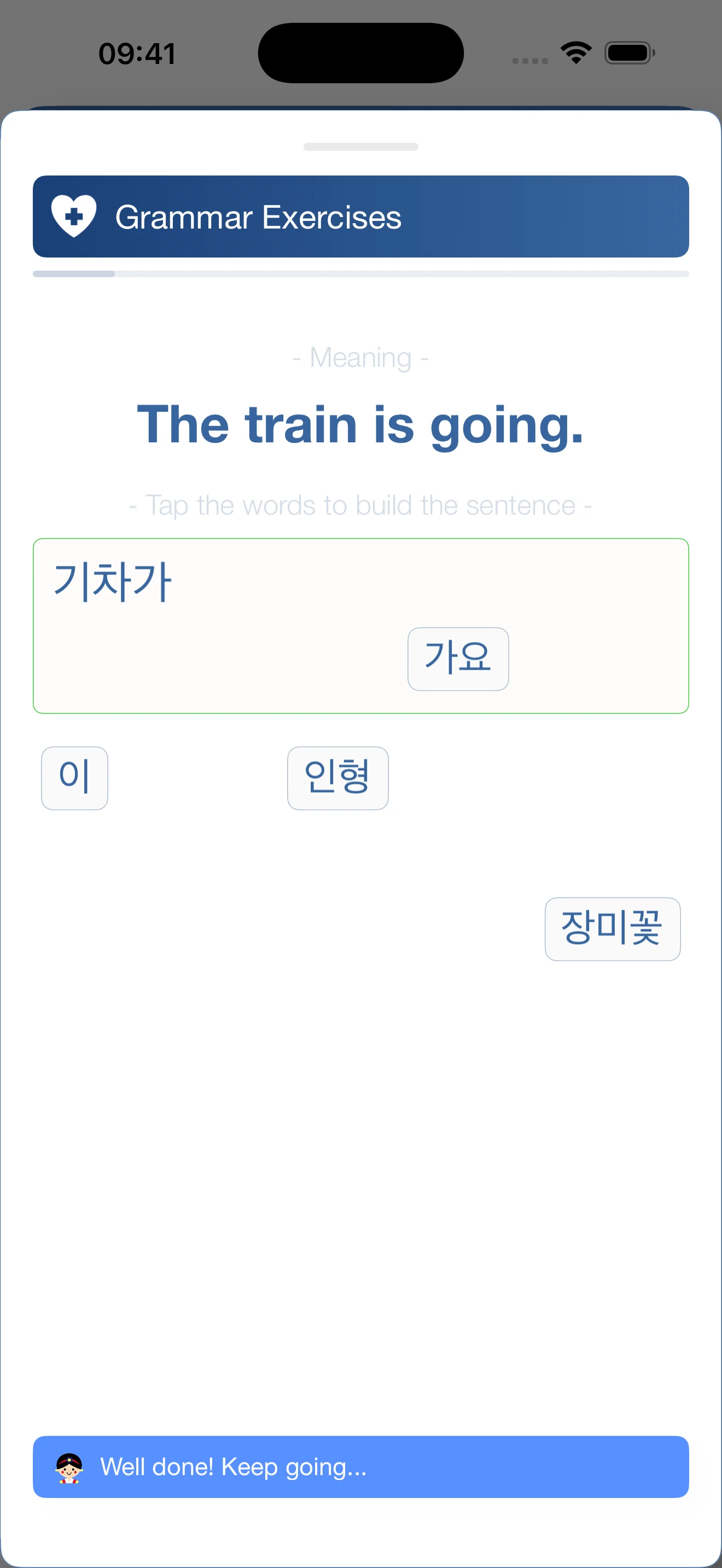
  • Korean sentence-building exercise for The train is going, with Korean word tiles
    02

    Build a Korean sentence

    Use the English meaning as your guide and tap the words to build 기차가 가요 — The train is going.
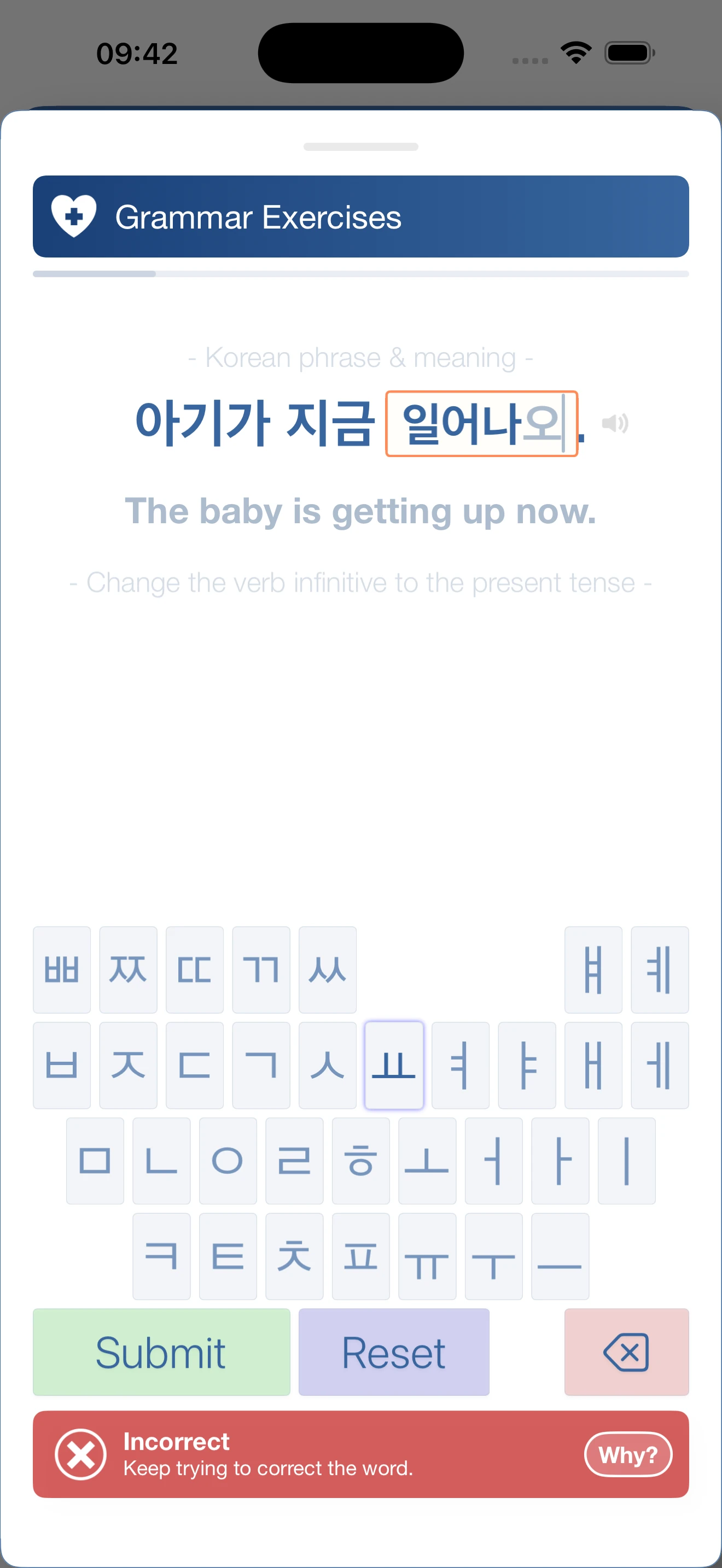
  • Korean typing exercise with an on-screen keyboard and feedback for 아기가 지금 일어나요
    03

    Type the correct form

    Practise changing a verb to the present tense using the Korean keyboard. Check your answer and try again when needed.
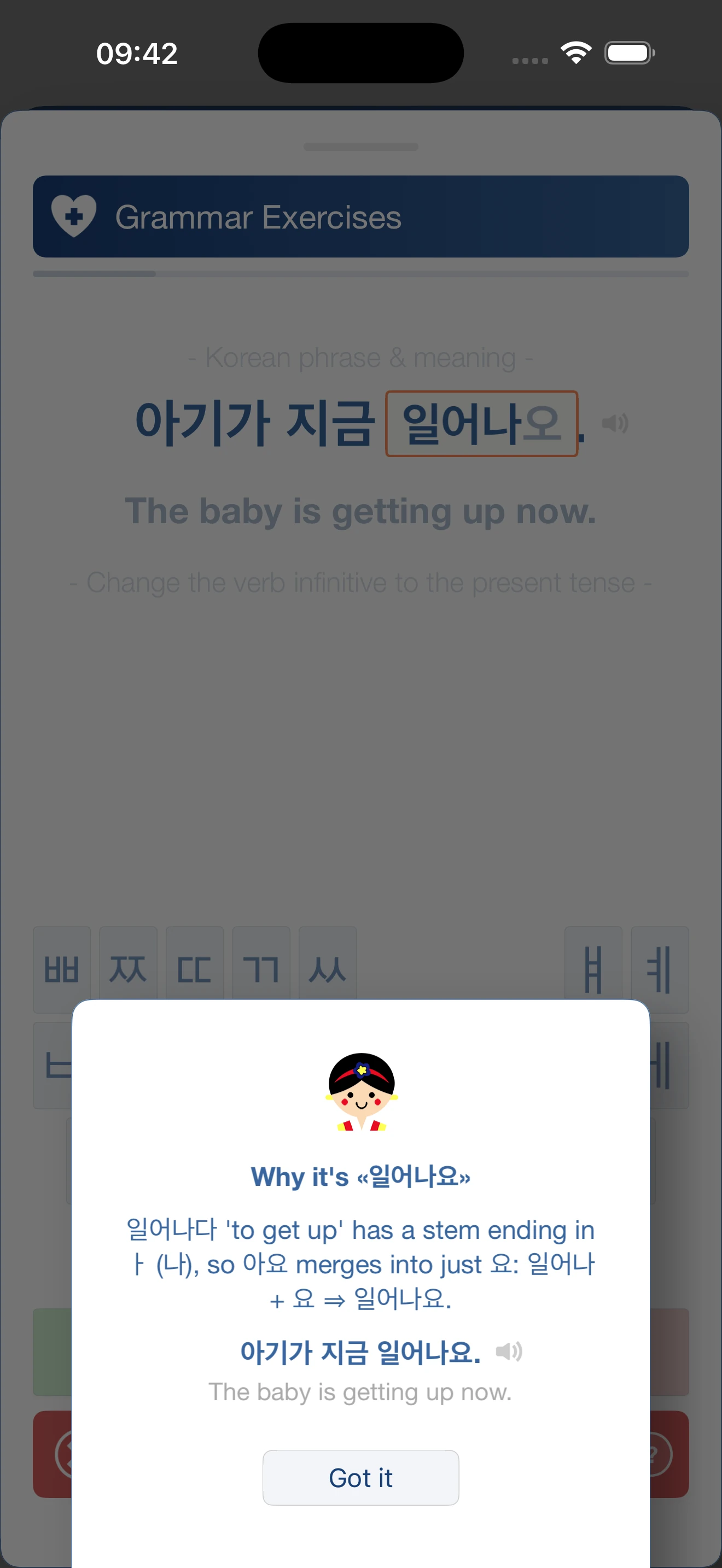
  • Why feedback explains the present-tense form 일어나요 and shows the corrected Korean sentence
    04

    Understand why

    The “Why?” explanation shows how 일어나다 becomes 일어나요, then puts the correct form back into the full sentence.
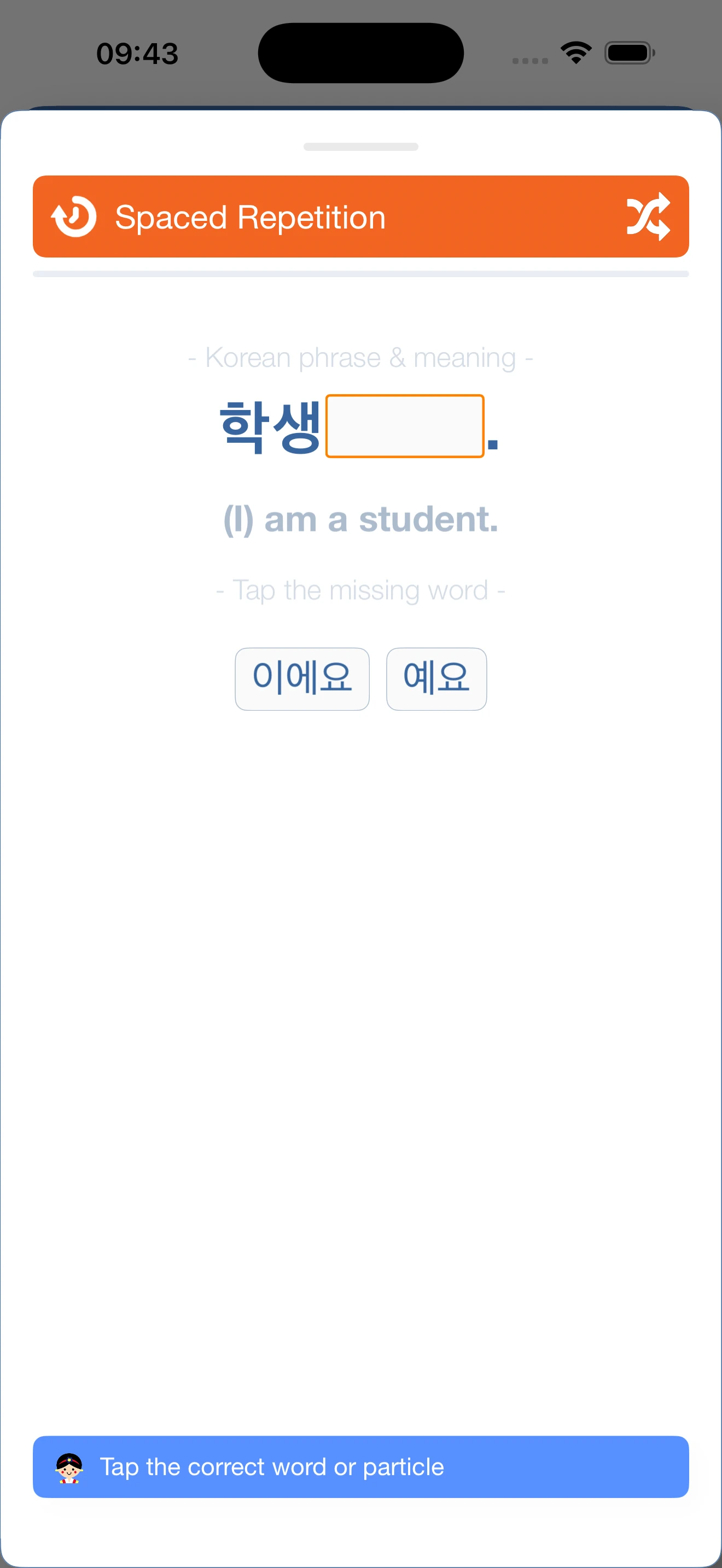
  • Korean spaced repetition exercise asking the learner to choose 이에요 or 예요 after 학생
    05

    Remember with review

    Revisit earlier phrases with spaced repetition. Here, choose between 이에요 and 예요 to complete I am a student.
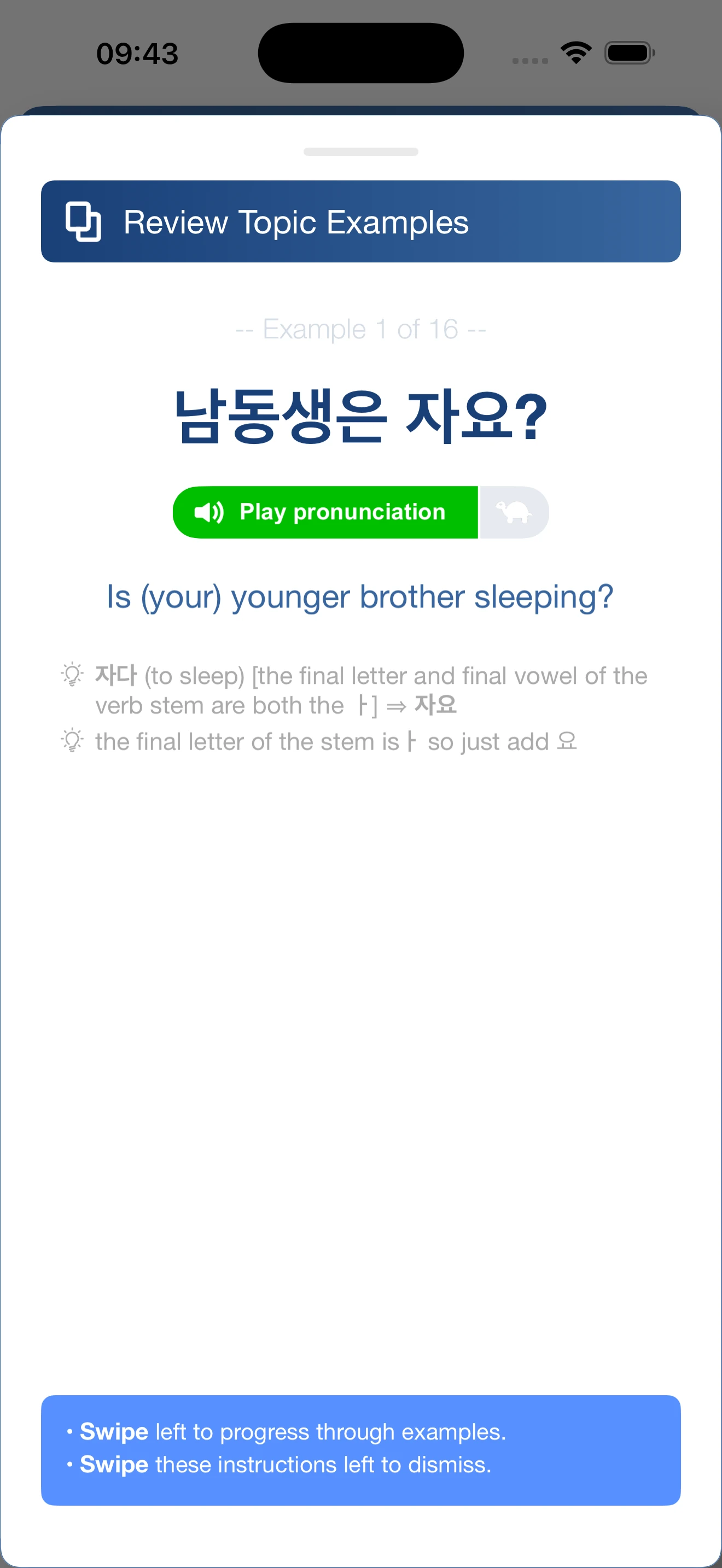
  • Korean topic review for 남동생은 자요? with pronunciation playback, English translation and grammar notes
    06

    Revisit each example

    Hear the pronunciation, check the translation and review the notes, one example at a time.
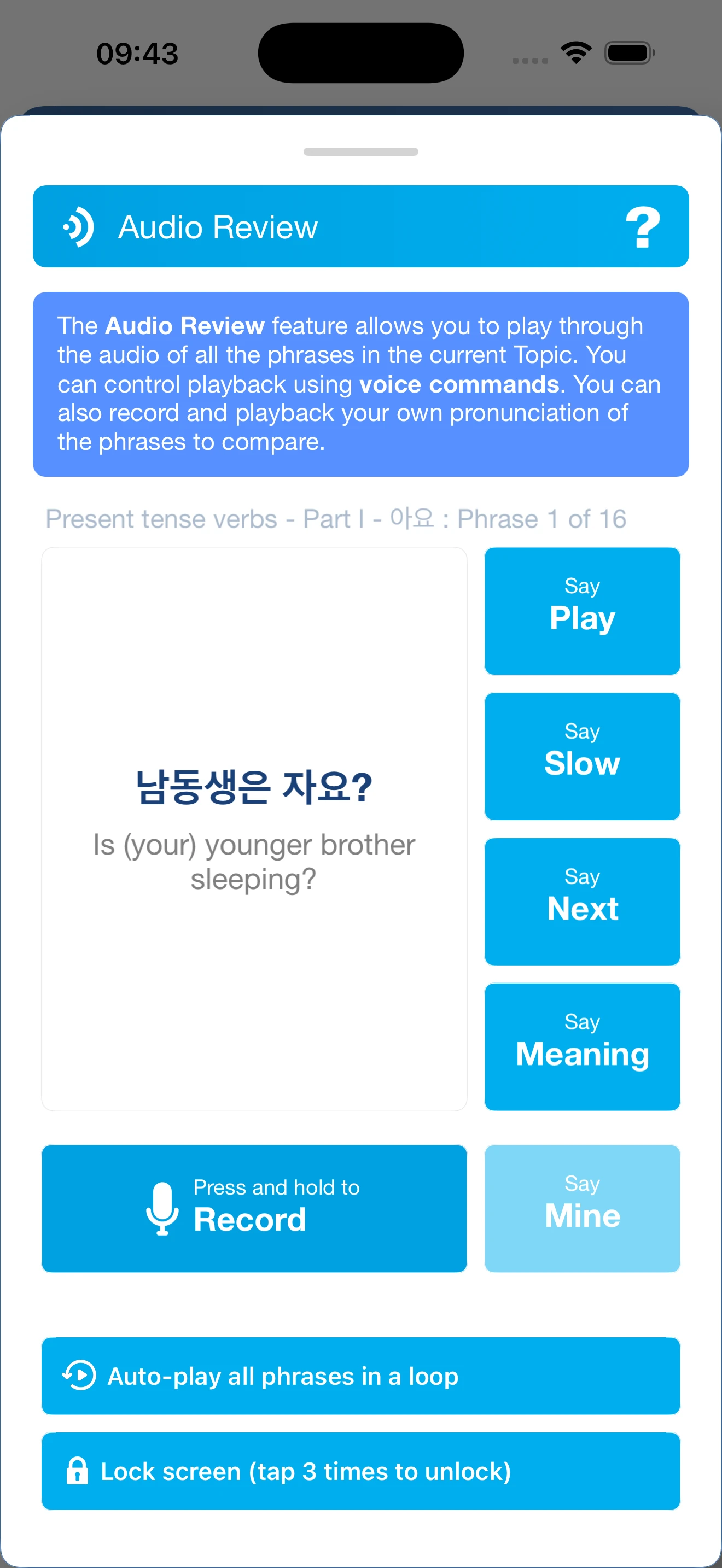
  • Korean Audio Review screen with Play, Slow, Next, Meaning, Record and automatic playback controls
    07

    Hear it Say it

    Play a phrase, slow it down or record your pronunciation to compare. Use voice commands to control the audio review.
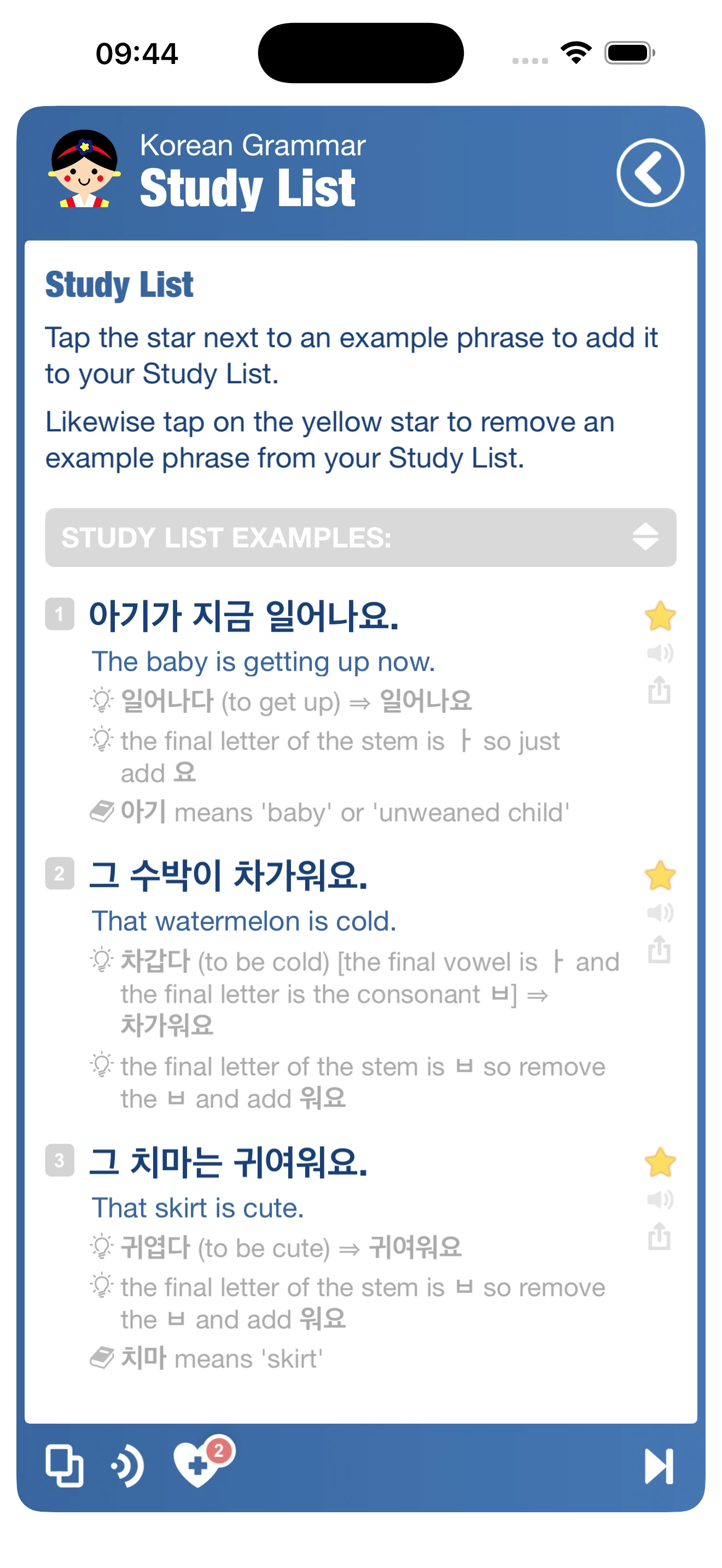
  • Korean Study List showing starred phrases with translations and grammar notes
    08

    Save useful phrases

    Star the examples you want to revisit and keep them together in your personal Study List.

Understand your mistakes

Make a mistake with the topic’s grammar? A short “Why?” explanation shows the correct answer and the rule behind it, so you know what to change next time.

Keep earlier grammar fresh

Use spaced repetition to revisit phrases at increasing intervals. Keep practising earlier patterns as you work through new topics.

Your own Study List

Star examples you want to keep and gather them in your personal Study List. Focus your review on useful phrases and the grammar you want to practise again.

From Korean learners

Grammar that earns its place

4.3 / 5Learner rating ↗

A godsend to any Korean language learner

“I'm so pleased to have found this app. It makes complex Korean grammar simple to understand. It's now my go-to grammar resource.”

Elise3004

Great app

“I find it structured and very handy. I believe this will be useful in my Korean studies.”

Excerpt · The full review also shares feedback on exercise controls and instructions.

Read the full review

I find it structured and very handy. I believe this will be useful in my Korean studies. I am right handed. I find it very cumbersome to do some of the exercises since some of them demanding me to alter hand and press enter with my left hand. I would suggest you swipe for enter and/ or make the position of the button possible to move depending on if you’re right or left handed or you get that option when you start the app for the first time. I managed to swipe away the instructions when I opened without reading them and couldn’t find them afterwards. I almost didn’t figure out how to do the exercises and nearly uninstalled the app. I suggest you have the possibility to review the instructions somewhere in the menus in the app too. Or use another symbol that indicates exercises better.

Oahppi · Norway

Free vs Full

Start free Keep going when you’re ready

Try the first 10 topics, then unlock the complete Korean grammar course in the same app.

No subscription
Compare the free Korean grammar lessons with the full course.
What’s includedFreeGet startedFull courseLifetime access
Grammar topicsFirst 10 topicsFirst sentences, particles, pronouns & verb basics.All 185 topicsParticles, verb endings, honorifics & more, including the first 10 topics.
Examples & audioExamples and audio for the first 10 topics.3,200+ examplesWith native-speaker audio throughout the course.
ExercisesPractise the first 10 topics.Practise every topic in the course.
PaymentFree to downloadThe first 10 topics are free.One-time purchaseUnlock the full course in the app. No recurring payments.

Your path through Korean grammar

Korean particles, verb endings and more

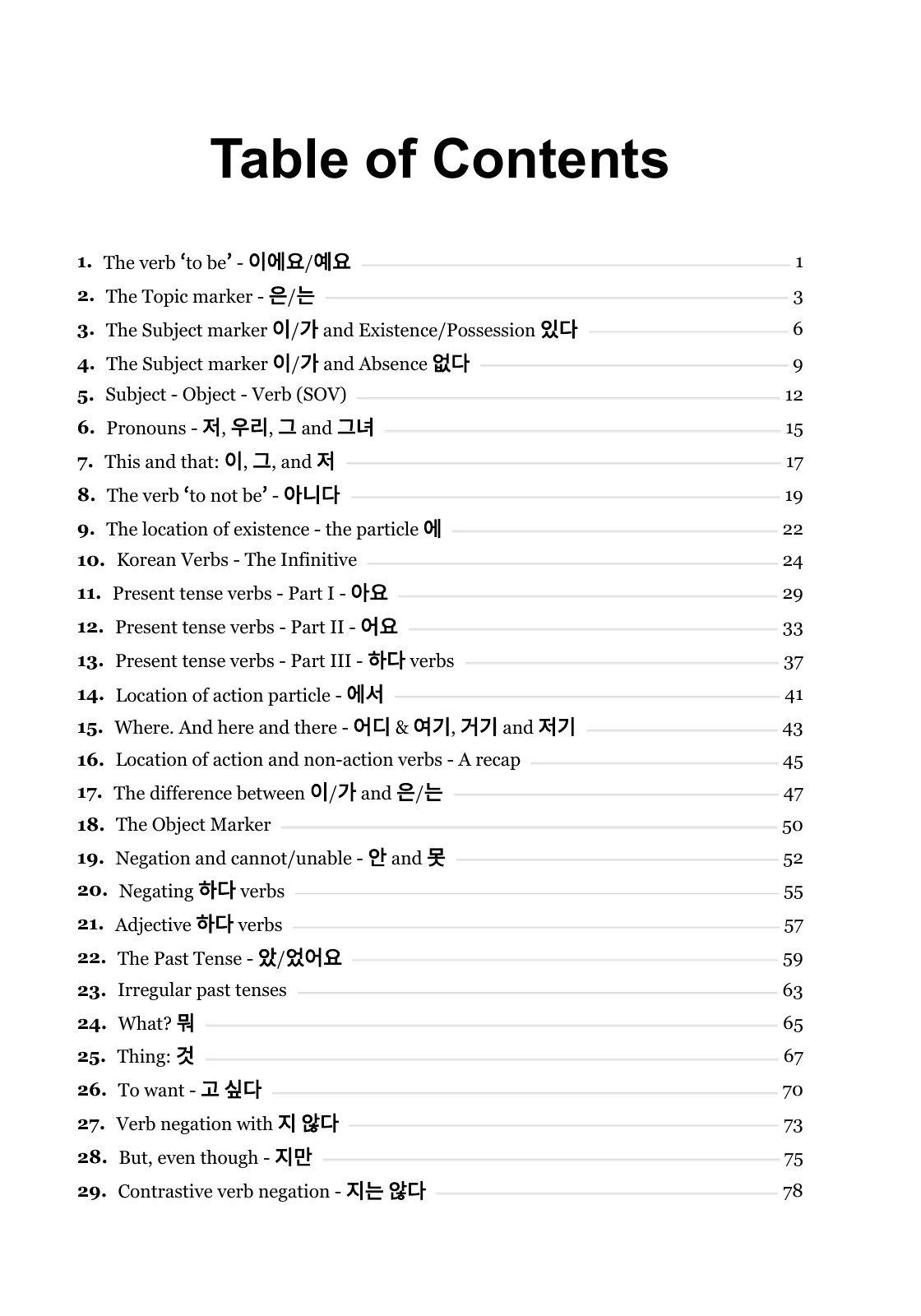
Start with 10 free topics, explore key patterns or search the full 185-topic course. The book and app follow the same sequence.

185 topics to explore

Topics 1–10First 10 topics Free“To be”, particles, word order, pronouns and verb basics
  1. The verb ‘to be’ - 이에요/예요
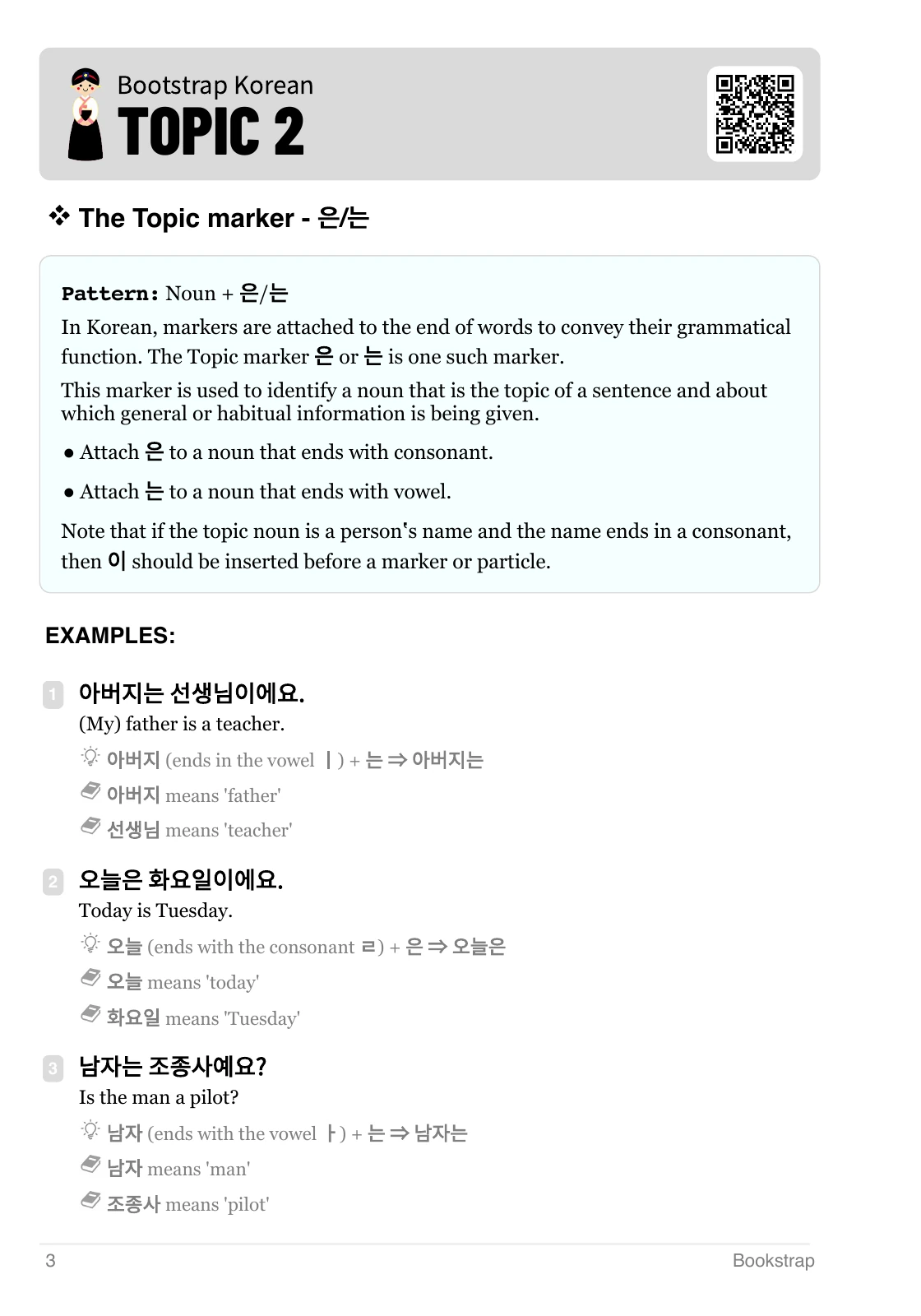
  2. The Topic marker - 은/는
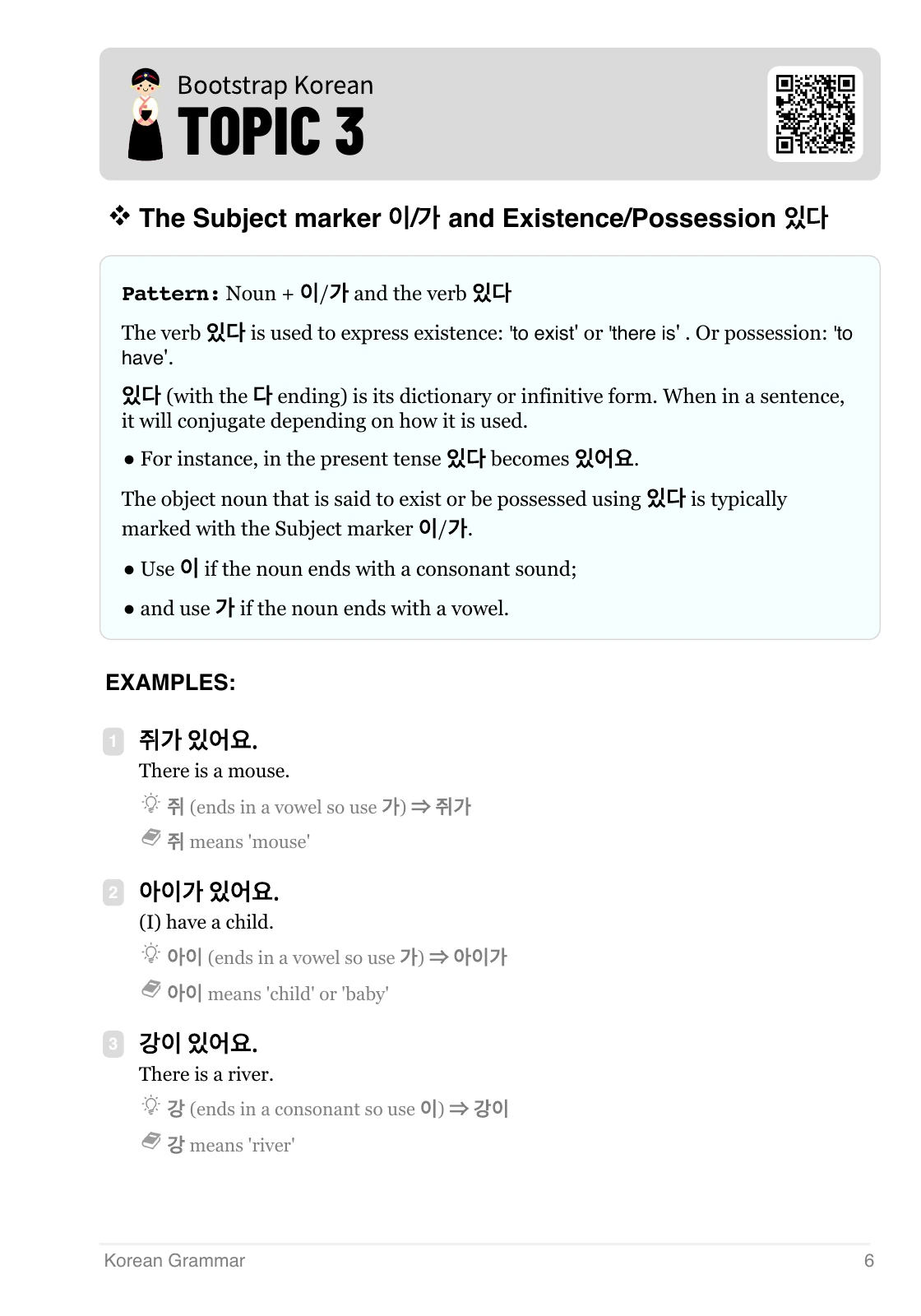
  3. The Subject marker 이/가 and Existence/Possession 있다
  4. The Subject marker 이/가 and Absence 없다
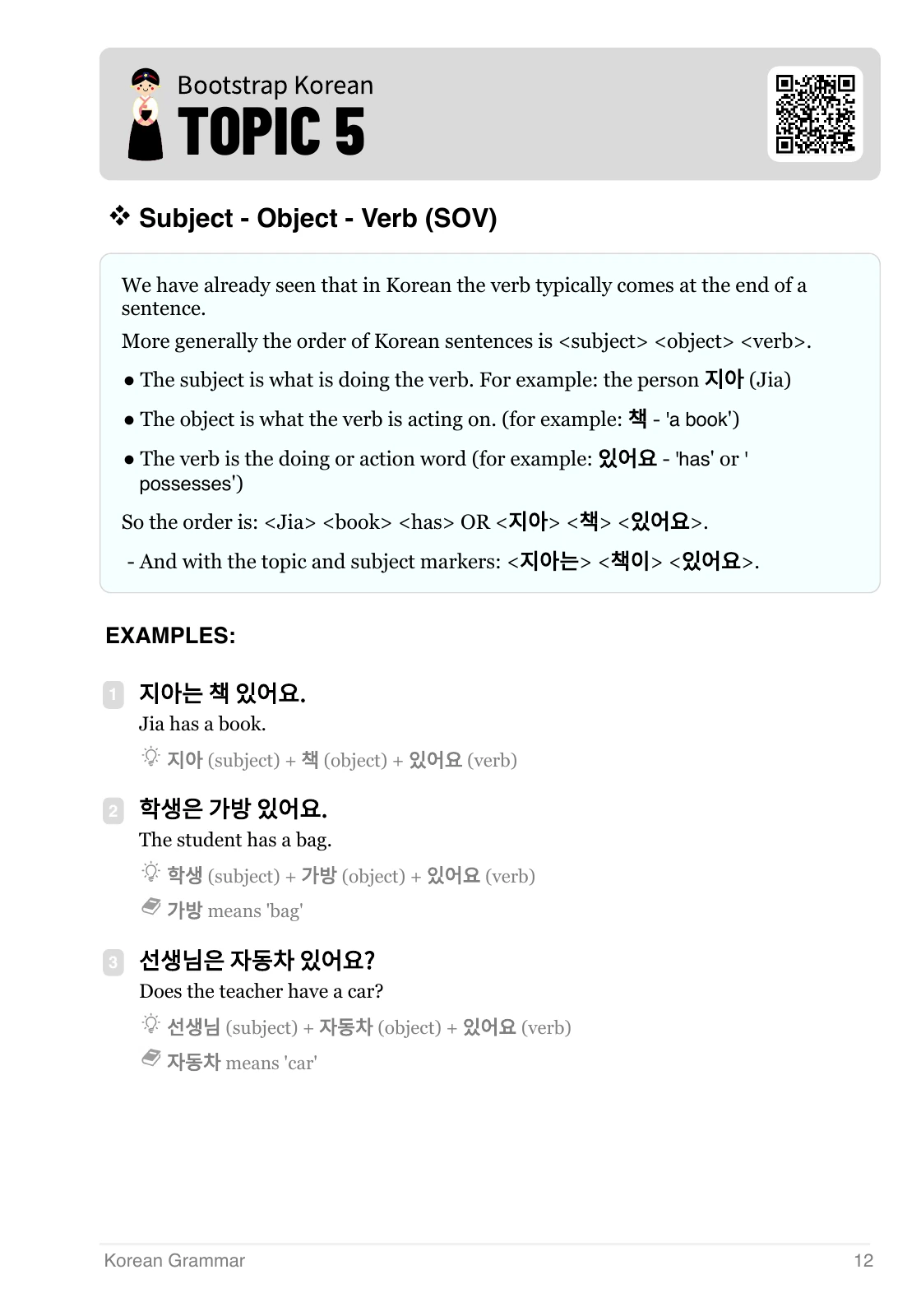
  5. Subject - Object - Verb (SOV)
  6. Pronouns - 저, 우리, 그 and 그녀
  7. This and that: 이, 그, and 저
  8. The verb ‘to not be’ - 아니다
  9. The location of existence - the particle 에
  10. Korean Verbs - The Infinitive

Key topics

Select a pattern to find it in the course
Show all 185 topicsHide the full topic list
Topics 11–30Verbs and everyday sentencesPresent and past tense, negation, questions and expressing wants
  1. Present tense verbs - Part I - 아요
  2. Present tense verbs - Part II - 어요
  3. Present tense verbs - Part III - 하다 verbs
  4. Location of action particle - 에서
  5. Where. And here and there - 어디 & 여기, 거기 and 저기
  6. Location of action and non-action verbs - A recap
  7. The difference between 이/가 and 은/는
  8. The Object Marker
  9. Negation and cannot/unable - 안 and 못
  10. Negating 하다 verbs
  11. Adjective 하다 verbs
  12. The Past Tense - 았/었어요
  13. Irregular past tenses
  14. What? 뭐
  15. Thing: 것
  16. To want - 고 싶다
  17. Verb negation with 지 않다
  18. But, even though - 지만
  19. Contrastive verb negation - 지는 않다
  20. Verb past bases
Topics 31–47Making everyday meaningComparisons, requests, the future tense, direction and ability
  1. The contrastive function of the Topic marker
  2. How is and how about - 어때요?
  3. During, while, for: 동안
  4. During or while doing something - 동안(에)
  5. More and much more - 더 and 훨씬
  6. Comparisons - 보다
  7. Good and to like - 좋다 and 좋아하다
  8. The Imperative - (으)세요
  9. Please do something / give something - 주세요
  10. What kind and which? - 무슨, 어떤 and 어느
  11. The Future Tense - (으)ㄹ 거예요
  12. To try, to give something a go - 보다
  13. The plural marker - 들
  14. To and from - 에 and 에서
  15. In the direction of - 으로/로
  16. To be able/unable - (으)ㄹ 수 있다 / 없다
  17. With, and - 와/과, 하고, (이)랑
Topics 48–63Describing and connectingAdjectives, possessives, verb nouns, reasons and linking ideas
  1. Gerunds: turning verbs into nouns
  2. And - 고
  3. Adjectives from descriptive verbs - 은/ㄴ
  4. Degrees of adjectives - 너무, 매우 and 아주
  5. The Narrative/Exclamation form - 다 ending
  6. Superlatives - 가장 and 제일
  7. Verb nominalisation - Verb stem + 기
  8. Expressing reason - 때문에
  9. Verb nominalization: past tense
  10. The Possessive Marker - 의
  11. Possessive pronouns
  12. Unable, cannot - 지 못 하다
  13. Adjectives from action verbs
  14. The thing being done - 는 것이에요
  15. Isn’t it? - 지요?
  16. From and to a location - 부터 and 까지
Topics 64–85Time, actions and possibilitiesTimes and dates, conditionals, ongoing actions, guesses and wishes
  1. Telling the time in Korean
  2. Dates - day, month and year
  3. From/since, and to/until - 부터 and 까지
  4. Before doing and after doing - 전에 and 후에
  5. So, therefore. And then - 아서/어서
  6. If, when, whenever - (으)면
  7. To and from a person - 에게/한테 and 에게서/한테서
  8. To do something for someone - 아/어 주다
  9. Or and Either - (이)나
  10. Instrumental marker - (으)로
  11. Also, too, in addition - 도
  12. Adverbs
  13. Adverbs from descriptive verbs - 게, 히 & 이
  14. As you know - 잖아요
  15. The Progressive Tense - 고 있다
  16. At the time of, when, during - (으)ㄹ 때
  17. Do not - 지 마세요
  18. Simultaneous actions - 면서
  19. It seems like, looks like - 것 같아요
  20. Guesses and intentions - 겠
  21. The future base with 겠
  22. To wish or hope - 면 좋겠다
Topics 86–111Intentions, causes and permissionsPolite requests, suggestions, causative verbs and expressing purpose
  1. Even more polite imperative - 십시오
  2. To become, to get, to turn into - 아/어지다
  3. To need and to not need - 필요 있/없다 & 필요하다
  4. Indefinite Nouns - 누군가, 어딘가, 뭔가 & 언젠가
  5. Not sure who/what/where - ㄴ/은지
  6. Listing possible actions - 든지
  7. Whenever, whatever etc. - words that use 든지
  8. Let’s… - (으)ㅂ시다
  9. Shall we…? - (으)ㄹ까요?
  10. Because, so - when expressing commands - (으)니까
  11. So that, in order to, to allow - 게
  12. To look like or to show - 보이다
  13. Introducing Causative Verbs - 사동사
  14. More Causative Verbs
  15. To end up, turned out to be - 게 됐어요
  16. In order to do; for the purpose of - (으)려고
  17. Intend to - (으)려고 하다
  18. To go/come with the intention of - (으)러
  19. To have to be/do, must, to need to - 아/어야 해요
  20. May, to be allowed to, ok to - 아/어도 되다
  21. Any, anything, anyone - 아무
  22. Background information - (으)ㄴ/는데
  23. About, concerning - 대해/대한
  24. And, so, that's why, therefore, in that case - 그리고, 그래서 etc.
  25. Just have to, it is enough to - (으)면 되다
  26. If (you) want to - 려면
Topics 112–137Reported speech and honorificsQuoting others, respectful language, counters and recalling experience
  1. Reported or Indirect speech - action verbs - ㄴ/는다고
  2. Reported or Indirect speech - descriptive verbs - 다고
  3. Reported or Indirect speech (Part III)
  4. In order to do, for the sake of - 위해(서)
  5. To take (time), how long? - 걸리다
  6. The honorific verb particle - (으)시
  7. Honorific markers, particles and verbs - 께서 & 께
  8. Expressing surprise - 군요
  9. Expressing impression, thought or surprise - 네요
  10. Compared to - 에 비해(서)
  11. Only, just - 만
  12. Counters - 개, 명, 마리 etc.
  13. Nothing but, nothing else - 밖에
  14. Recalling past actions - 던
  15. Have done, have tried - (본) 적이 있다
  16. In a similar way, as if - 듯(이)
  17. Looks like, appears to be - 듯하다
  18. To know/don't know how to - (으)ㄹ 줄 알았다/몰랐다
  19. Know/think that - 줄 알다/모르다
  20. May or might - (으)ㄹ지도 모르다
  21. I heard…. Is it true? - (으)ㄴ/는다면서요?
  22. To think of doing - (으)ㄹ까 하다
  23. To make, or to let something happen - 게 하다
  24. To make, or to cause something to happen - 시키다
  25. Make sure - 도록 하다
  26. Ended up doing or becoming - 게 되다
Topics 138–164More precise meaningsHypotheticals, comparisons, completed actions and degrees of possibility
  1. Do something in reaction: 기에 and 길래
  2. Hypothetical if - 다면/라면
  3. Past hypotheticals - 았/었다면
  4. Would have - ㄹ/을 텐데
  5. What if? - 어떡하죠?
  6. While in action, during - 는 중이다 & 중에
  7. Among - 중에(서)
  8. As soon as - 자마자
  9. Every, every time - 마다 & ㄹ/을 때마다
  10. Instead of, rather than - 말고
  11. Except, without - 빼(놓)고
  12. I think that - 것 같다
  13. Well, if not even better than - 못지않게
  14. Not as good as, less than - 만 못하다
  15. Because, and so - 아/어서 & 아/어 가지고
  16. As much as, as well as - 만큼
  17. To act like - 답다
  18. To leave or to keep - 두다 & 놓다
  19. Feelings due to an action being complete - 버리다
  20. To look like - 보이다
  21. Even if, regardless - 아/어/여도
  22. No less than, as many as - (이)나
  23. Something else might happen - (으)ㄹ 수도 있다
  24. Almost happened - (으)ㄹ 뻔했다
  25. No choice but to - (으)ㄹ 수밖에 없다
  26. Even to the extent that - (으)ㄹ 정도로
  27. Perhaps because - 아/어/여서 그런지
Topics 165–185Formal endings and finer detailsFormal statements and questions, intentions, contrasts and common idioms
  1. Polite ending - 습니다 / ㅂ니다
  2. Polite questions - 습니까? / ㅂ니까?
  3. According to - 에 따라(서)
  4. The same as, just like - 마찬가지(로)
  5. Different from, unlike - 다르게 & 달리
  6. Why don’t you…? - 지 그래요?
  7. As soon as, right after - ㄴ/는 대로
  8. And so, as a consequence - 았/었더니
  9. As, based on, in the manner of - 대로
  10. Turning Verbs into Nouns using ㅁ/음
  11. No different from - (이)나 다름없다
  12. Warning of a negative outcome - 다가는
  13. Intend to, had been intending to - (으)려고 하다
  14. Interrupted action - (으)려던 참이다
  15. Although, despite that - ㄴ/는데도
  16. To pretend to, to act like - ㄴ/은/는 척하다
  17. Each, once every - 씩
  18. As you know… - 다시피
  19. Until something happens - ㄹ/을 때까지
  20. Instead - 대신
  21. Common Korean idioms
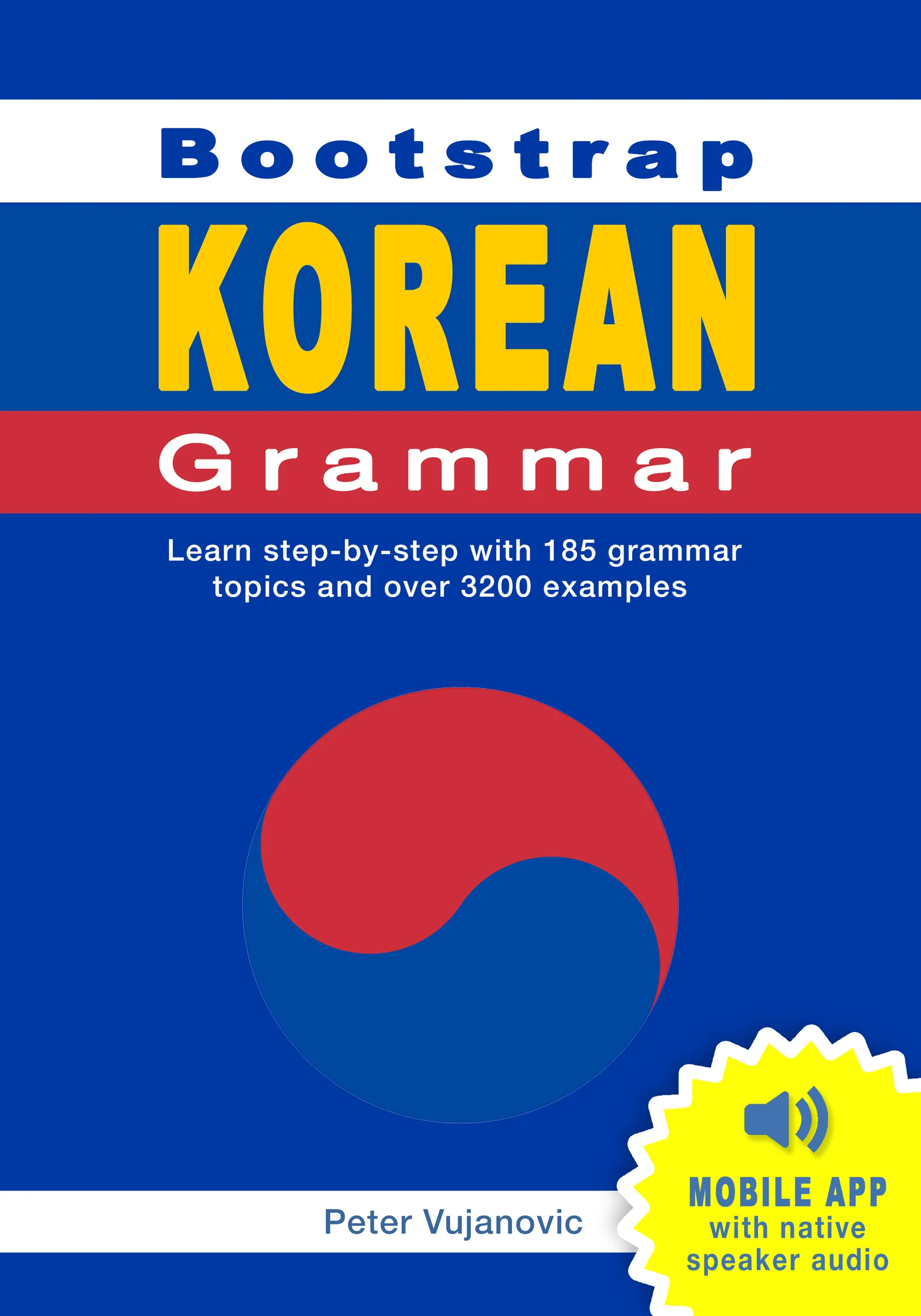
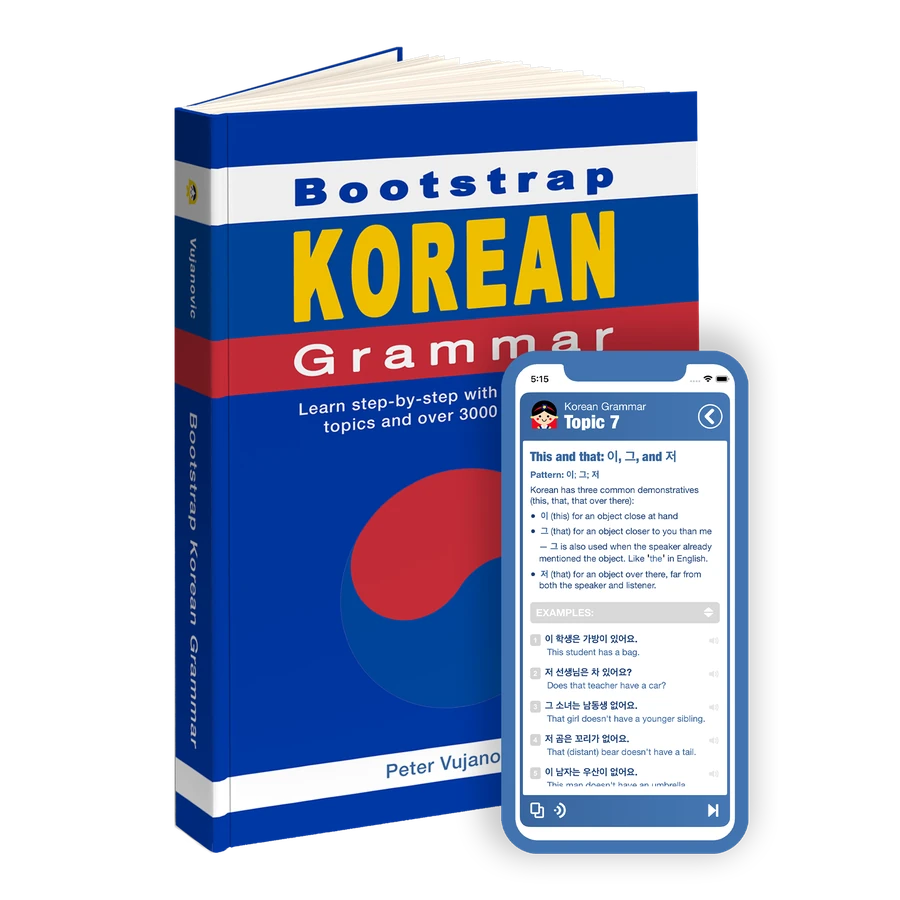
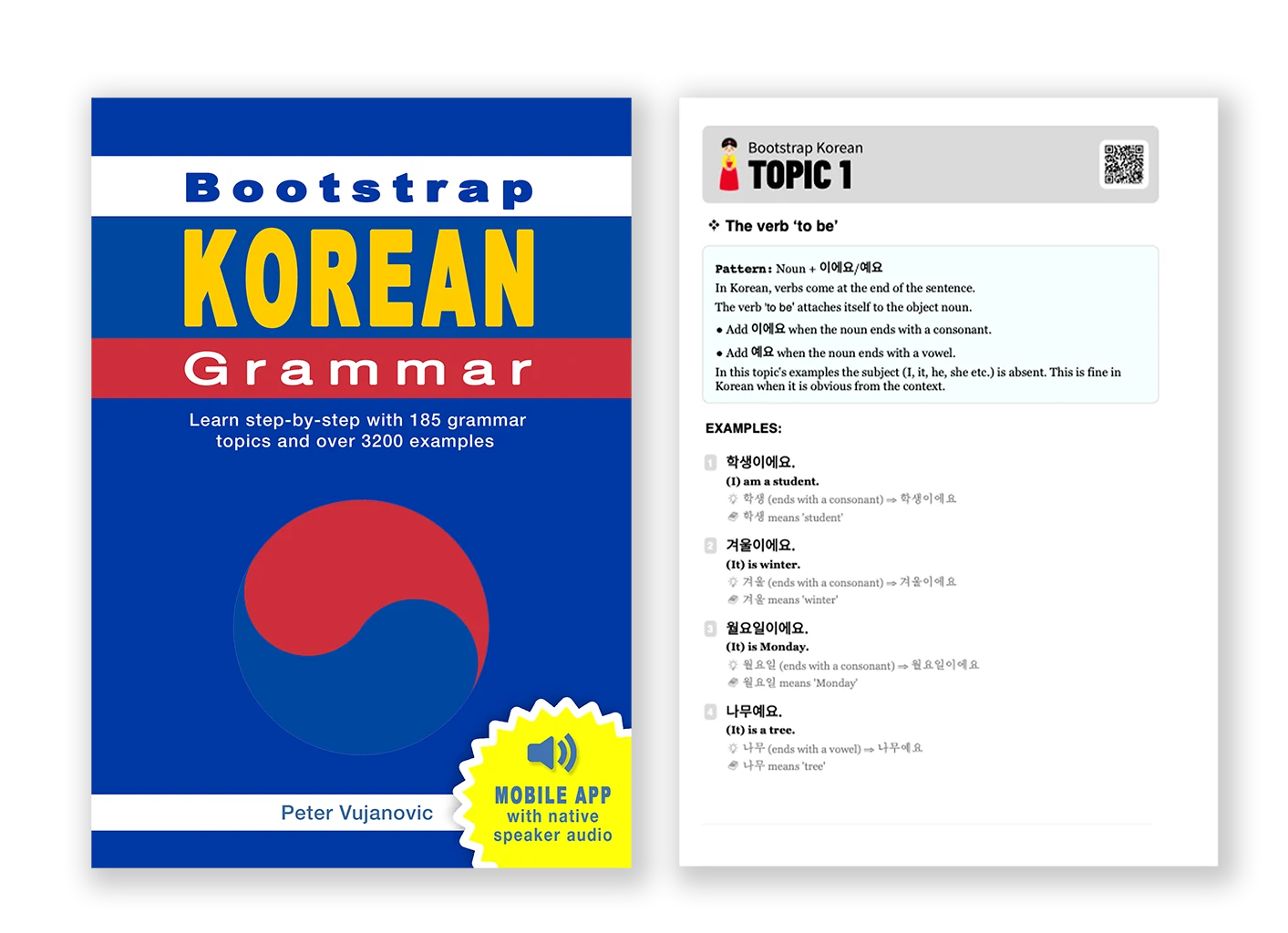
Bootstrap Korean Grammar paperback with the companion app showing a Korean lesson

The Bootstrap Korean Grammar book

Korean grammar
In your hands

Prefer to study on paper? The companion book brings together all 185 topics and 3,200+ annotated examples. Read the explanation in the book, then use the app to hear the matching phrases and practise the grammar.

525
pages
185
grammar topics
3,200+
annotated examples
Special introductory offer
Paperback + companion app

Buy the book Get the app free

Already have a copy?

Email us for the offer details

More than a list of rules

Your book, with matching audio

  1. Follow the same clear path

    The book and app follow the same 185-topic sequence. Work from the beginning or turn straight to the grammar point you need.

  2. Understand every example

    Korean phrases come with English translations and notes on the grammar and new vocabulary. See how each pattern works in context.

  3. Go straight to the audio

    Scan the QR code at the start of a book topic with the companion app. It opens the matching topic, with native-speaker audio for the examples on the page.

Take a look inside

Tap a page to open the preview. Close it to return here.
Peter Vujanovic

The people behind the course

Made for people who want to understand

I’m Peter Vujanovic, CEO and Chief Editor at Declan Software. I brought together Korean language experts to create the explanations, examples and audio in Bootstrap Korean Grammar.

Our aim is to make each pattern clear enough to understand, then give you plenty of examples to practise.

Meet the Korean language contributors
  • Julia Park, Kim Sinae and Lee Youngjoo — Korean and English proofreading and advice on the grammar.
  • Dada Kang — recordings of the Korean example phrases.

Get in touch with Peter and the team →

Before you begin

About the app
and the course

What can I try for free?

The first 10 topics are completely free and include full explanations, native-speaker audio and exercises. You can use them without creating an account in the app. A one-time in-app purchase unlocks the full 185-topic course with lifetime access — no subscription.

Is there a subscription?

No. You unlock the full Korean course with one lifetime purchase, with no monthly fees. Your app store shows the exact price in your local currency before you buy.

How is this different from free apps or websites?

Bootstrap Korean Grammar gives you a structured path through 185 self-contained topics. Each one combines a plain-English explanation, annotated examples, native-speaker audio and exercises. New vocabulary appears in context, and “Why?” feedback helps you understand a mistake instead of guessing the answer again.

Do I need to buy the book?

No. The app is a complete course on its own. Choose the companion paperback if you prefer to study explanations and examples on paper. The book follows the same topic sequence, and its QR codes open the matching topics in the app so you can listen as you read.

Can I start as a beginner?

Yes. The course starts with the verb “to be”, particles, word order and pronouns, then builds step by step. Hangul is used throughout, with English translations and audio. Knowing the Korean alphabet will help you move faster.

Which Korean grammar topics does the app cover?

The course covers topic and subject markers 은/는 and 이/가, object and location particles, verb conjugation, tense, negation, honorifics, reported speech and more. Browse the 185-topic syllabus above to see the full sequence.

Can I use it with a class or another app?

Yes. Follow the course in order or revisit a grammar point from your class or another app. Save useful examples in your Study List and use the exercises and audio for focused practice between lessons.

How does spaced repetition work?

Phrases you practise return for review at increasing intervals, helping you revisit earlier grammar as you learn new patterns. Use the review feature for ongoing practice. Spaced repetition and “Why?” explanations are available on both iOS and Android.

Is the Korean grammar app available on iPhone and Android?

The app is available for iPhone and iPad on the App Store, and Android on Google Play. Check the relevant listing for the current device requirements.

Start with one small step

Make your next Korean sentence make sense

Try the first 10 topics free. Unlock the full course with one lifetime purchase when you’re ready.

4.3 / 5Learner rating

Keep a little Korean in your inbox

Occasional language-learning tips and resources from Declan Software, including Korean study material.

Book preview

Take a look inside

Inside the iPhone app

Open full-size image ↗
Interactive lesson

Explore three Korean examples. Learn the pattern, listen to the audio, and practise choosing the correct word.

Bootstrap Korean Grammar

Free to download

Your first 10 lessons are free.

Which device do you use?

Scan with your phone’s camera, or use a download button.

4.3 / 5Learner rating

One lifetime purchase unlocks all 185 topics.
No subscription.

First 10 topics freeNo subscription.

Try the app ↗