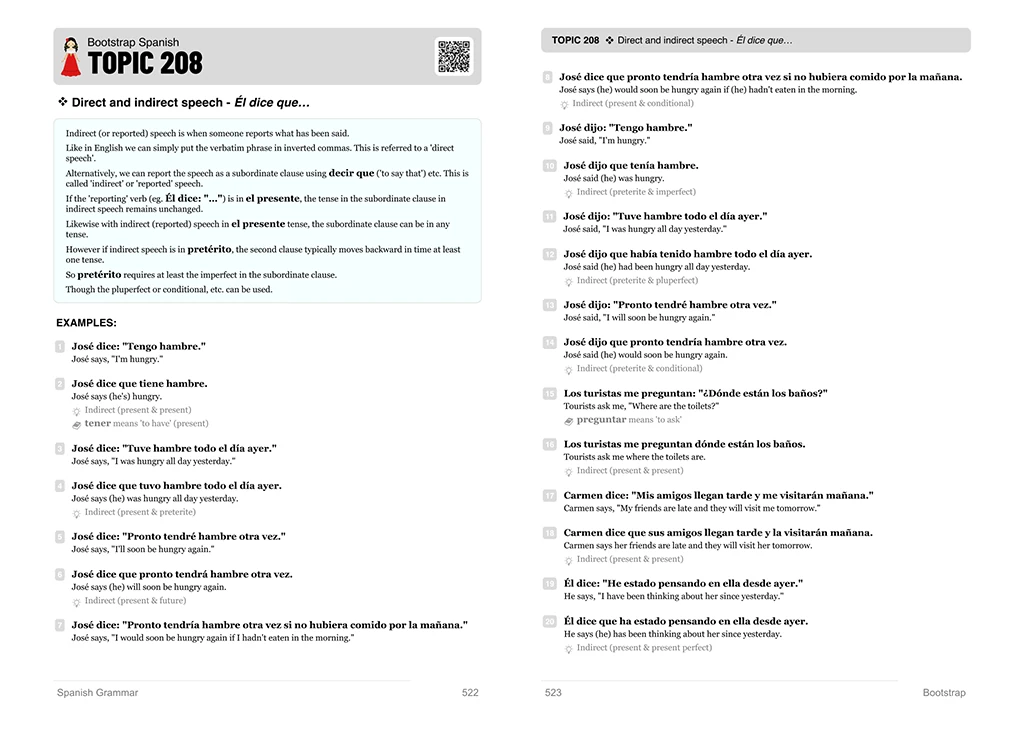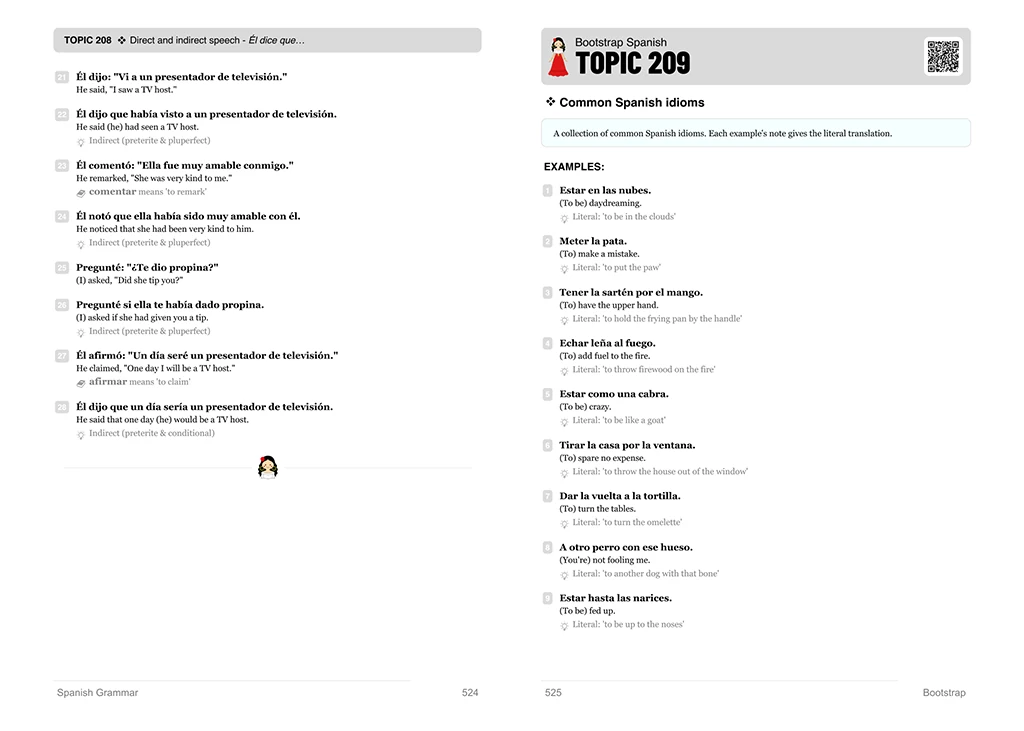


Spanish grammar app

Spanish grammar
Now it clicks

Finally understand Spanish grammar—one small step at a time. Learn ser and estar, verb conjugation and sentence patterns with clear explanations, native-speaker audio and practice. For iPhone, iPad and Android.

Download free — try the first 10 topics with full audio & exercises

No account required · Unlock the rest anytime with a one-time purchase

Inside the appSee the rule · Use the rule
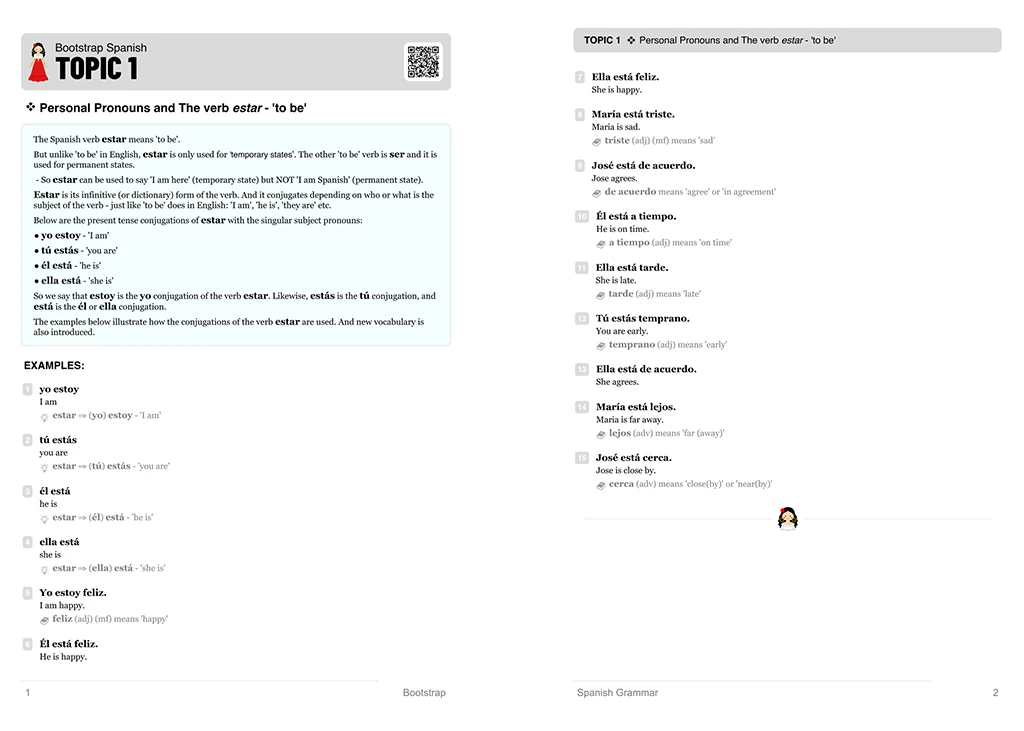
Spanish Topic 1 explaining estar with yo estoy, tú estás, él está and ella está
Spanish exercise asking for the correct form of estar in tú estás, with estoy, estás and está as choices Explore the exercises

Real iPhone screenshots. Tap either preview to enlarge.

209step-by-step grammar topics
3,700+examples with audio
Verbs & genderexplained in context
One purchaselifetime course access
Try it hereExample 1 / 3

Estoy, estás or está? Try it yourself

Topic 1 · The verb estar: “to be”

Yo estoy feliz.

I am happy.

yo + estar → yo estoy

With yo (I), estar becomes estoy. Feliz means “happy”: Yo estoy feliz describes how I feel.

Understand the pattern

A website lesson using real course examples. See the app ↗

Make the connection

Spanish grammar
one small step at a time

209 self-contained topics give you a clear path through the grammar. Start with ser, estar and your first Spanish sentences, then build through pronouns and verb patterns to the preterite, imperfect, conditional and subjunctive.

01 / UNDERSTAND

Build on what you know

Each topic explains one grammar point in plain English, then builds on what came before. Add new patterns in small, manageable steps and learn at your own pace.

02 / HEAR

Learn vocabulary in context

Explore 3,700+ annotated examples, each with native-speaker audio and an English translation. Notes explain how the grammar works and what new words mean, so your vocabulary grows alongside it.

03 / PRACTISE

Put each pattern into practice

Use interactive exercises to practise the Spanish grammar you have just learned. Choose the right form, build sentences and connect the explanation to an answer you can produce yourself.

Inside Bootstrap Spanish Grammar

See how the learning happens

Spanish app previews. Select a screen to take a closer look.
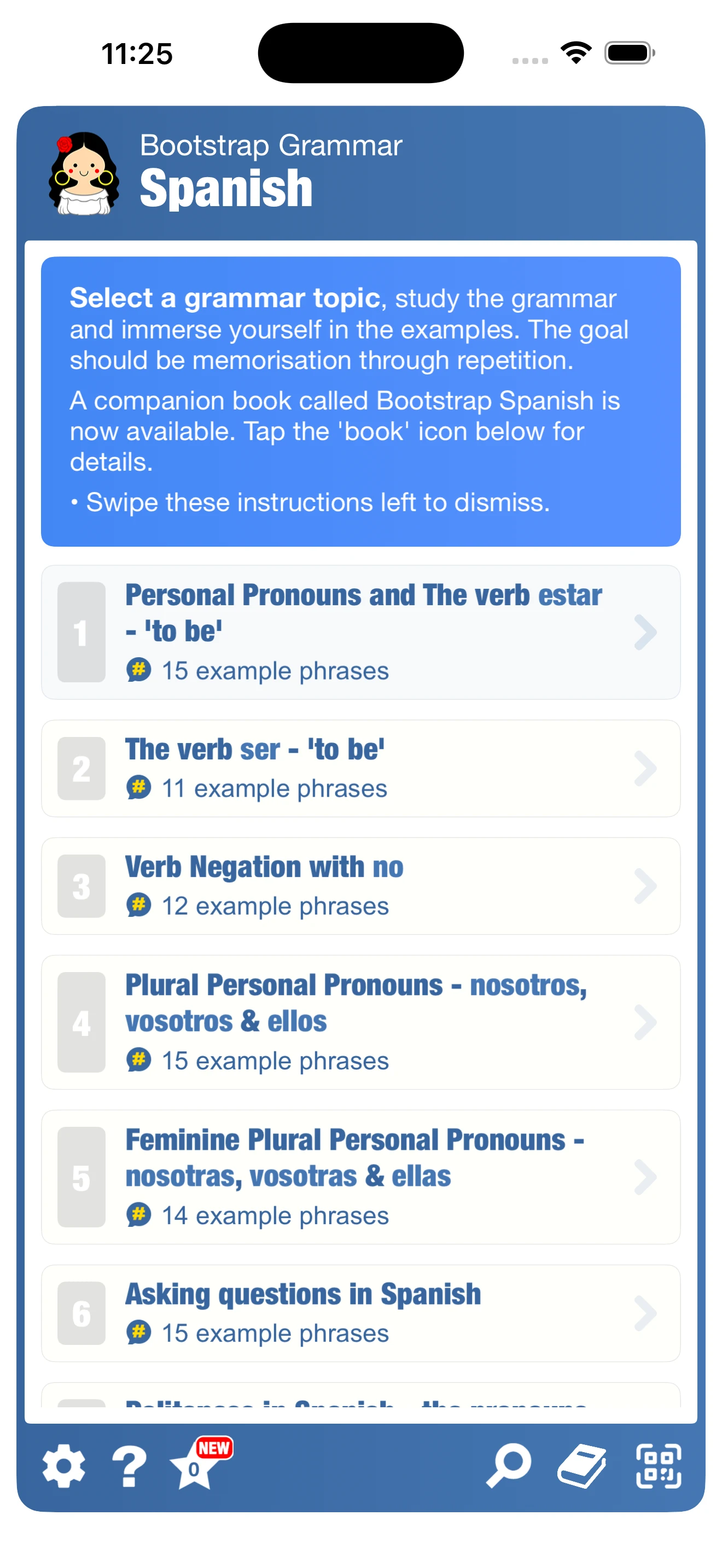
  • Spanish course topic list showing estar, ser, negation, personal pronouns and questions
    01

    Find your starting point

    Follow the course step by step, from ser and estar to more advanced Spanish patterns.
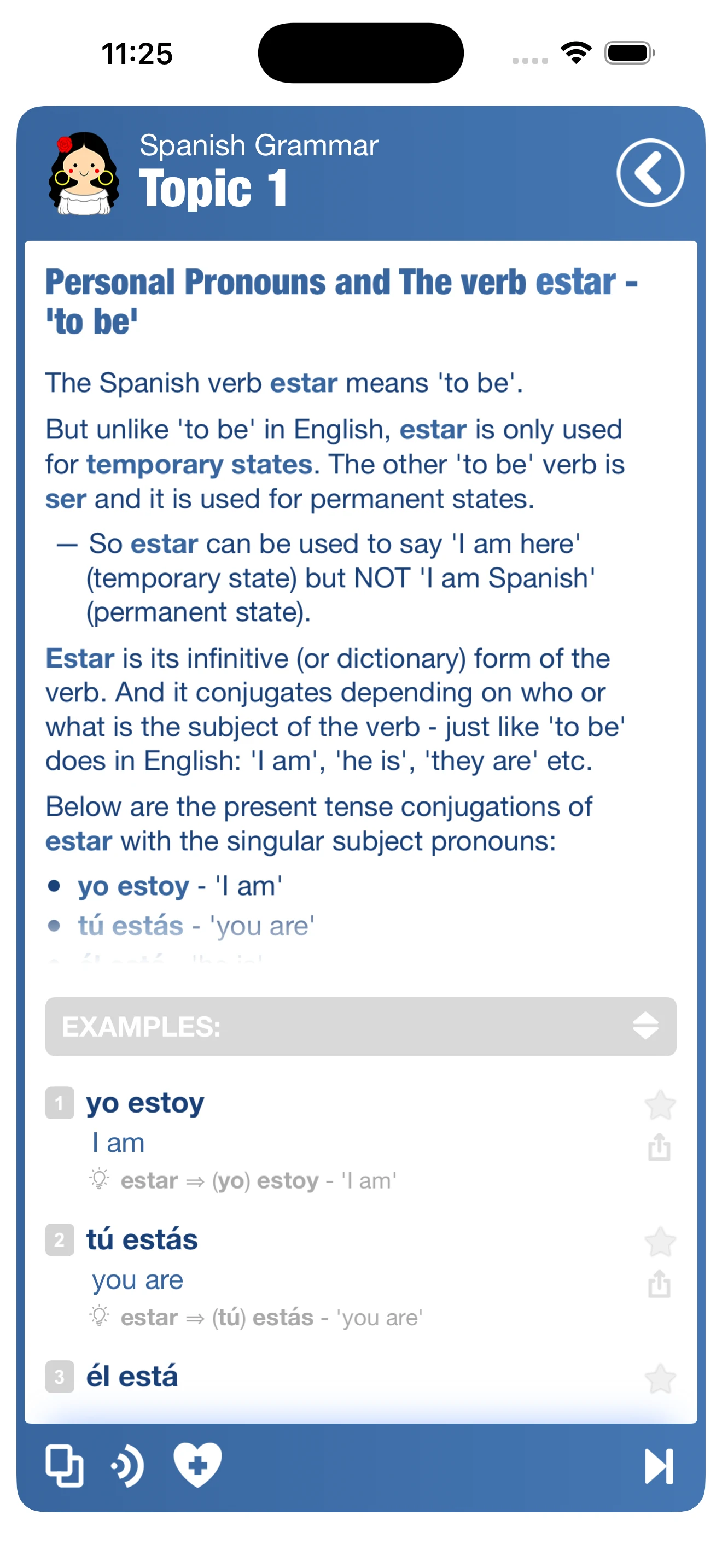
  • Spanish Topic 1 explaining estar with yo estoy, tú estás, él está and ella está
    02

    Understand the rule

    Start with the verb estar. Read a clear explanation, then see its present-tense forms in Spanish examples.
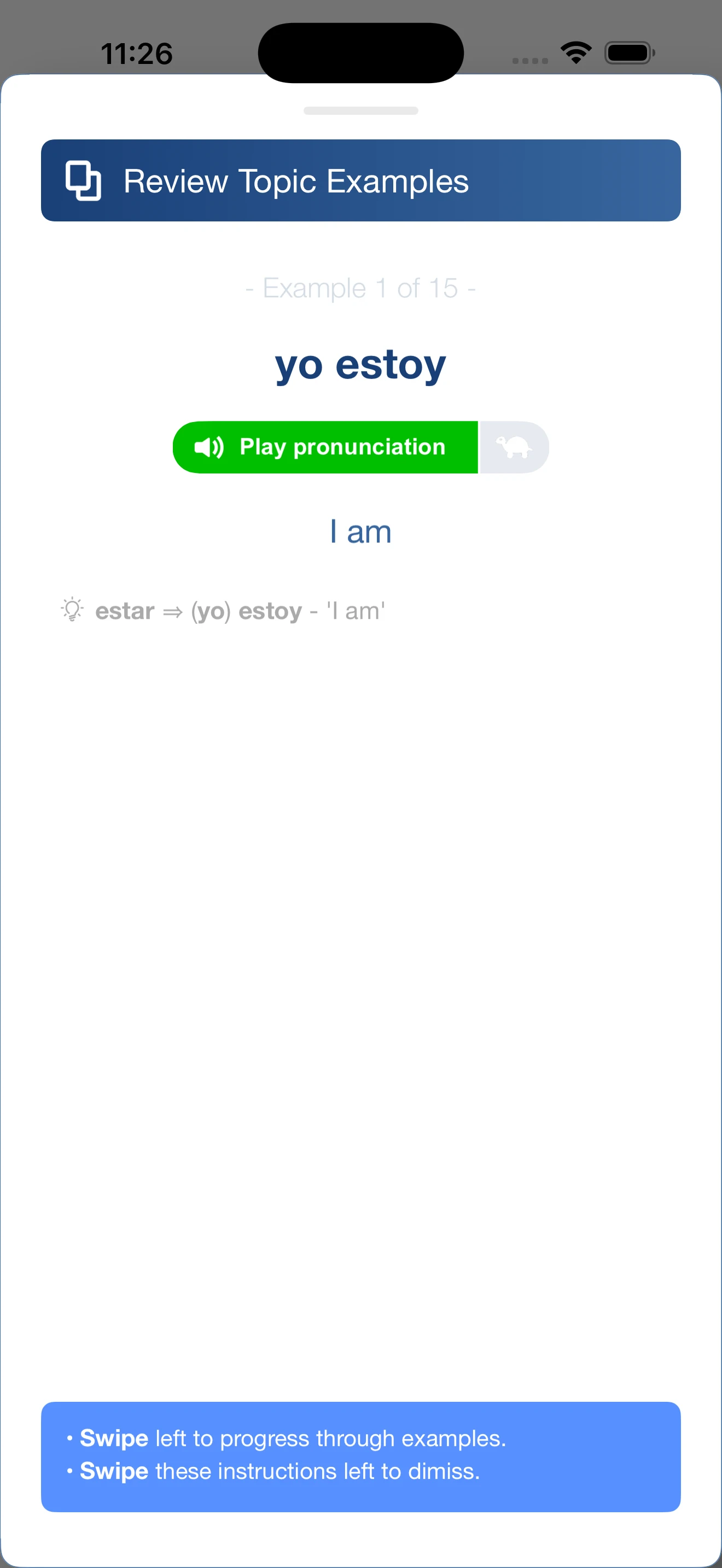
  • Spanish example review showing yo estoy, I am, with pronunciation and a conjugation note
    03

    Review each example

    Listen to the pronunciation, read the English meaning and check the notes, one phrase at a time.
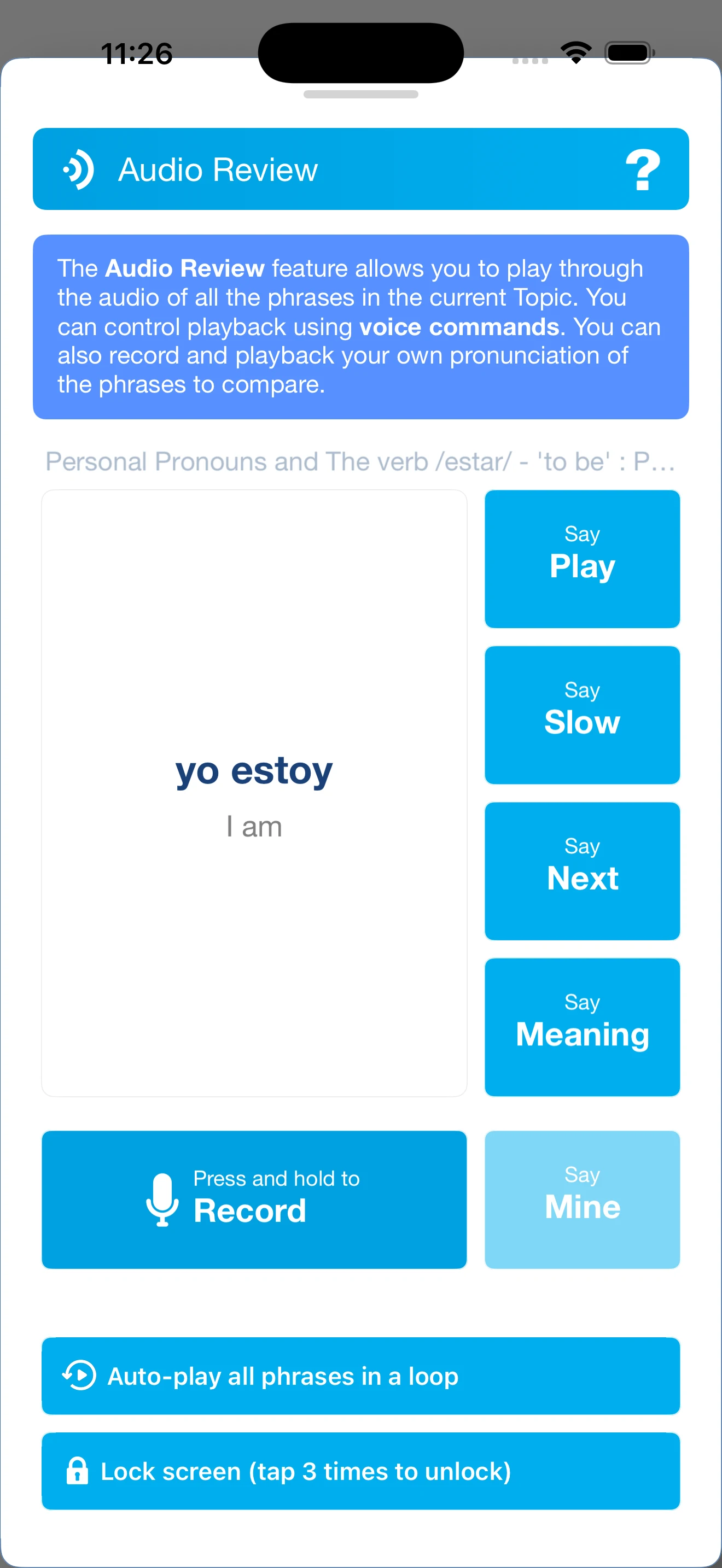
  • Spanish Audio Review showing yo estoy with Play, Slow, Next, Meaning and Record controls
    04

    Listen and say it

    Play a phrase, slow it down or record your pronunciation to compare. Voice commands help you control the audio review.
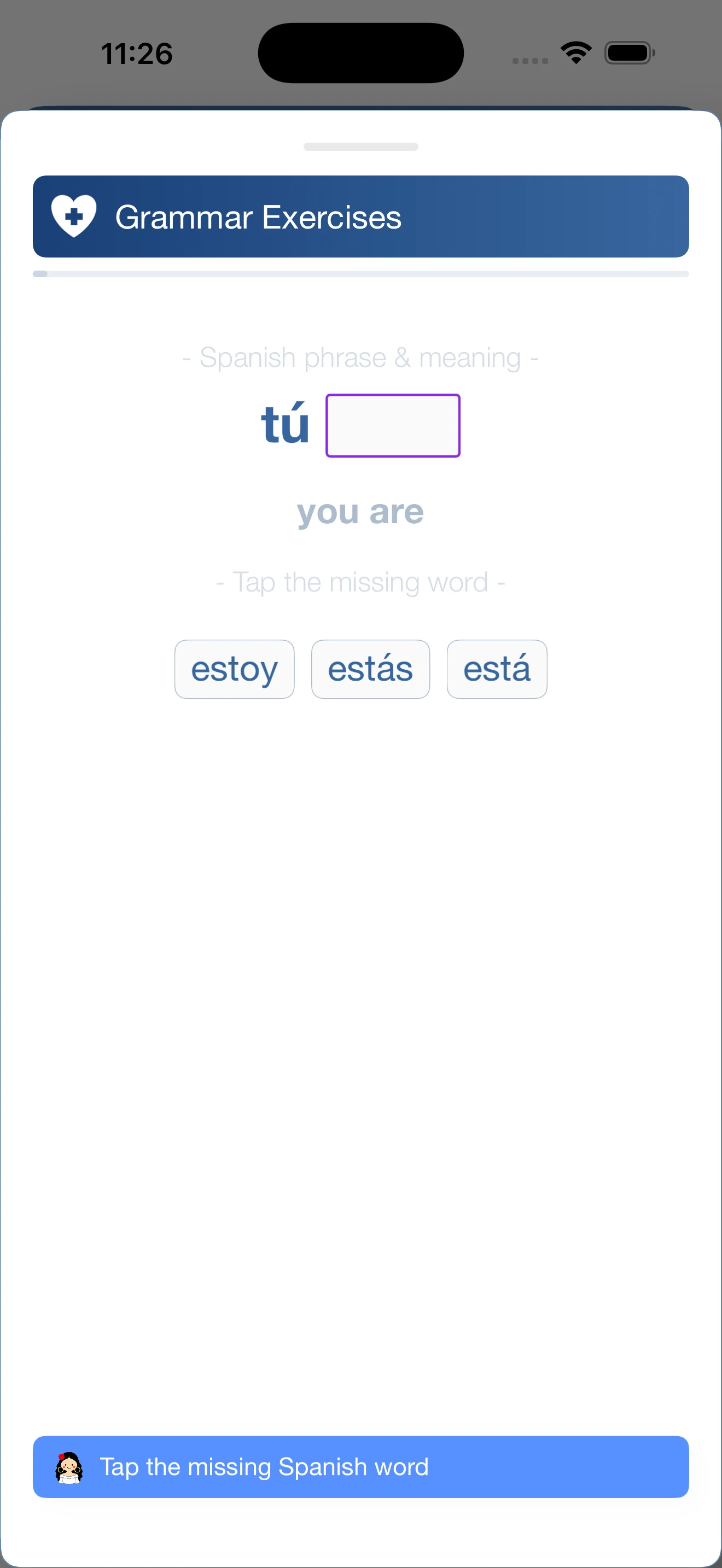
  • Spanish exercise asking for the correct form of estar in tú estás, with estoy, estás and está as choices
    05

    Choose the missing word

    Use the meaning to choose the correct verb form and complete the Spanish phrase.
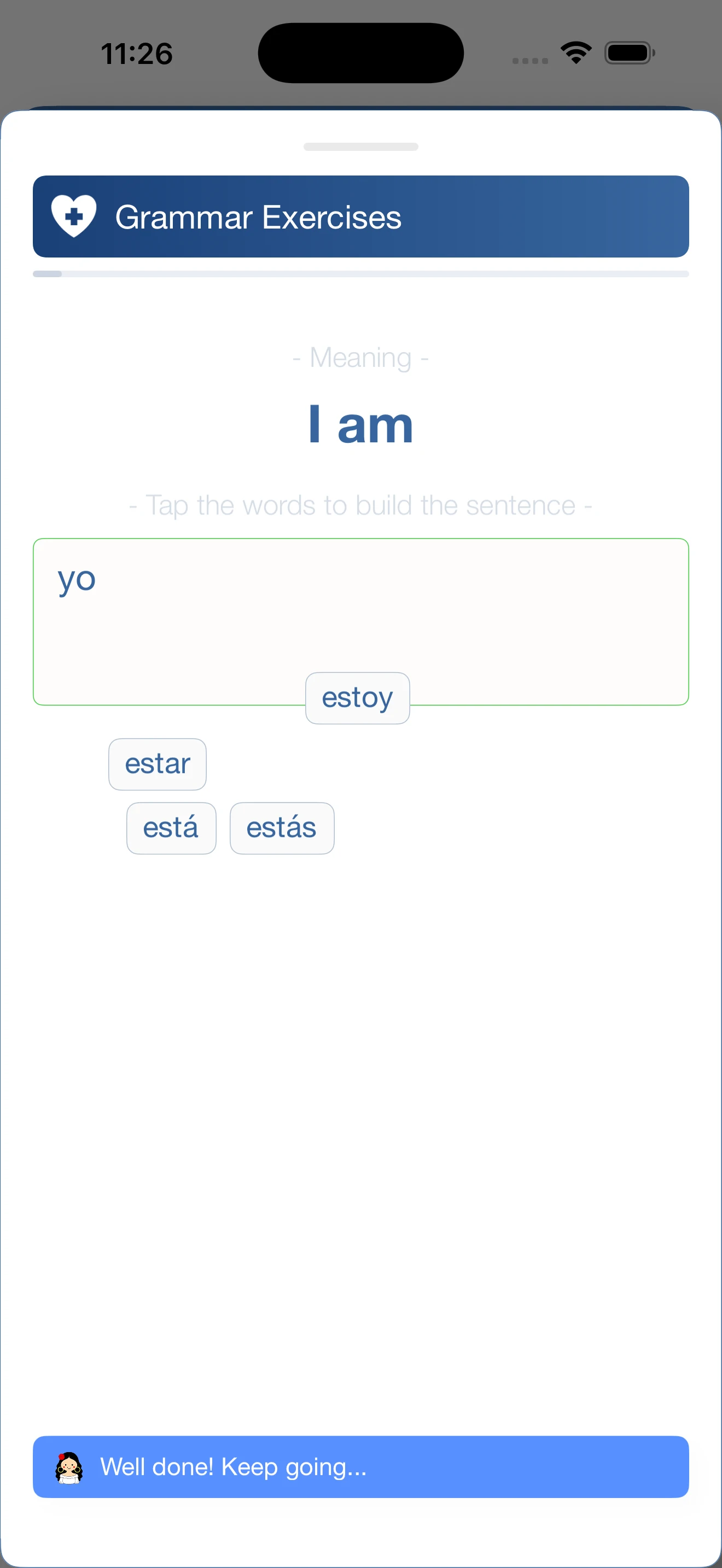
  • Spanish phrase-building exercise for I am, with yo and forms of estar
    06

    Build a Spanish sentence

    Tap the words in order, using the English meaning as your guide.
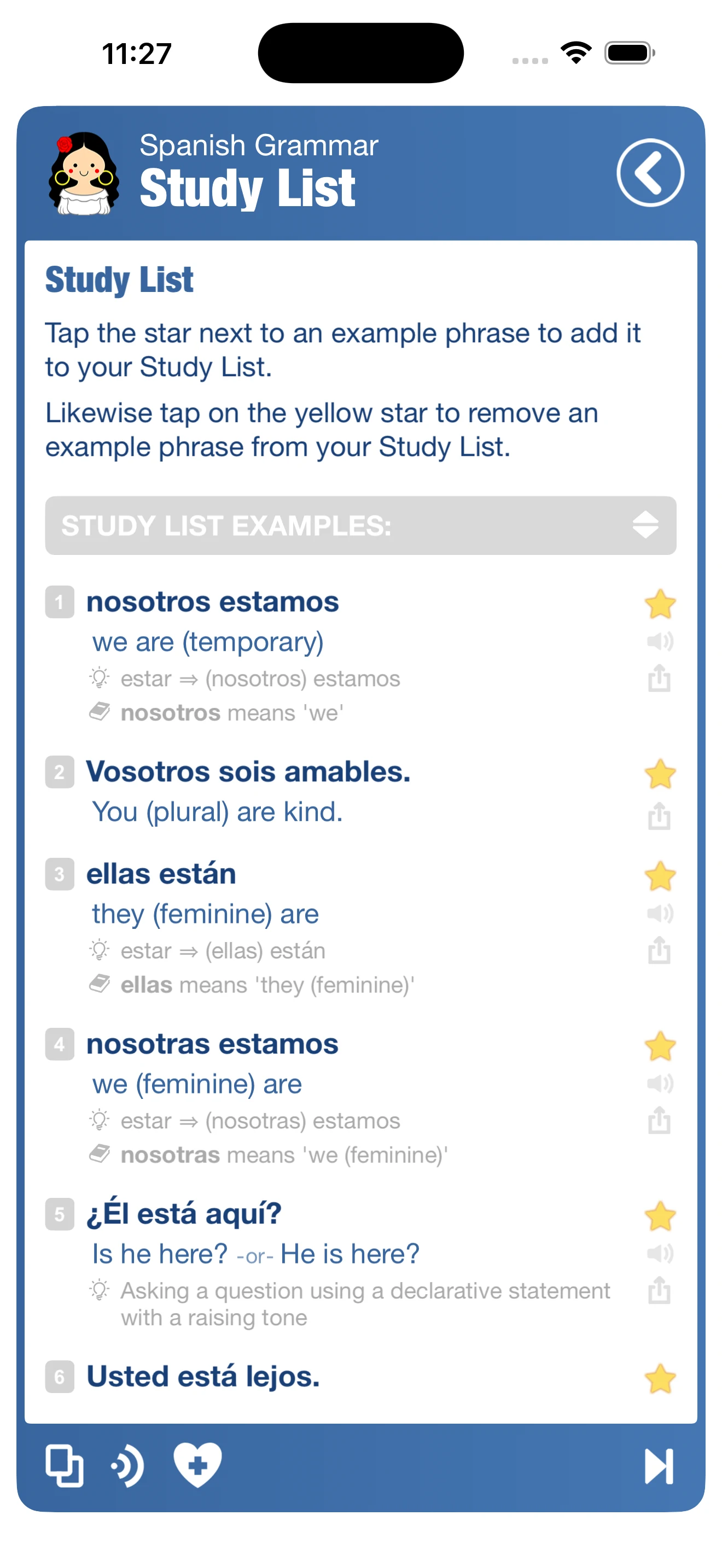
  • Spanish Study List showing starred example phrases, English translations and audio buttons
    07

    Keep useful phrases close

    Star the examples you want to revisit and collect them in your personal Study List.
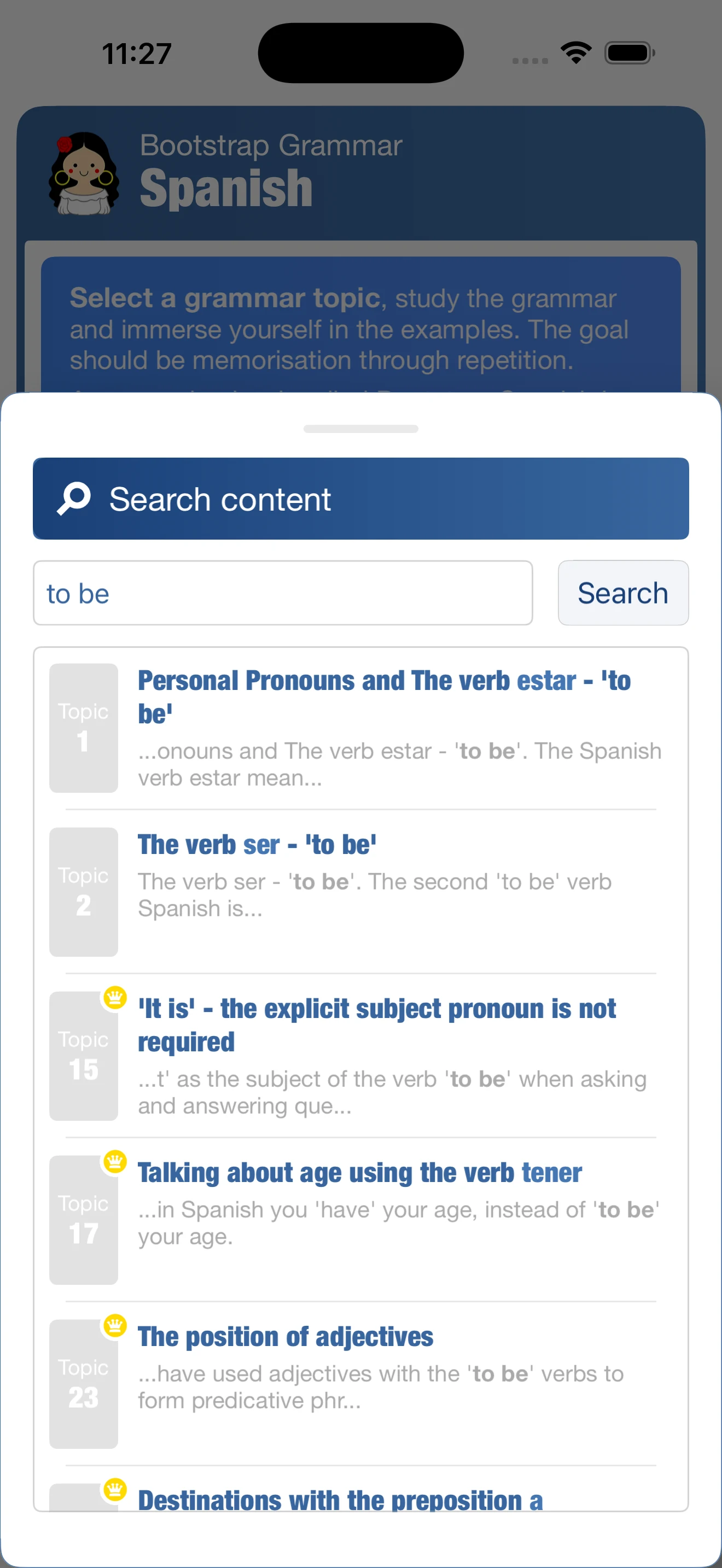
  • Spanish content search for to be, showing related topics including estar and ser
    08

    Find the grammar you need

    Search in English or Spanish and jump to the topics that explain the pattern you need.

Understand your mistakes

Make a mistake with the topic’s grammar? A short “Why?” explanation shows the correct answer and the rule behind it, so you know what to change next time.

Keep earlier grammar fresh

Use spaced repetition to revisit phrases at increasing intervals. Keep practising earlier patterns as you work through new topics.

Your own Study List

Star examples you want to keep and gather them in your personal Study List. Focus your review on useful phrases and the grammar you want to practise again.

Free vs Full

Start free Keep going when you’re ready

Try the first 10 topics, then unlock the complete Spanish grammar course in the same app.

No subscription
Compare the free Spanish grammar lessons with the full course.
What’s includedFreeGet startedFull courseLifetime access
Grammar topicsFirst 10 topicsSer and estar, pronouns, questions, articles, gender & plurals.All 209 topicsVerb conjugation, tenses, pronouns, the subjunctive & more, including the first 10 topics.
Examples & audioExamples and audio for the first 10 topics.3,700+ examplesWith native-speaker audio throughout the course.
ExercisesPractise the first 10 topics.Practise every topic in the course.
PaymentFree to downloadThe first 10 topics are free.One-time purchaseUnlock the full course in the app. No recurring payments.

Your path through Spanish grammar

Spanish verb conjugation, tenses and more

Start with 10 free topics, explore key patterns or search the full 209-topic course. The book and app follow the same sequence.

209 topics to explore

Topics 1–10First 10 topics FreeSer and estar, pronouns, questions, gender and plurals
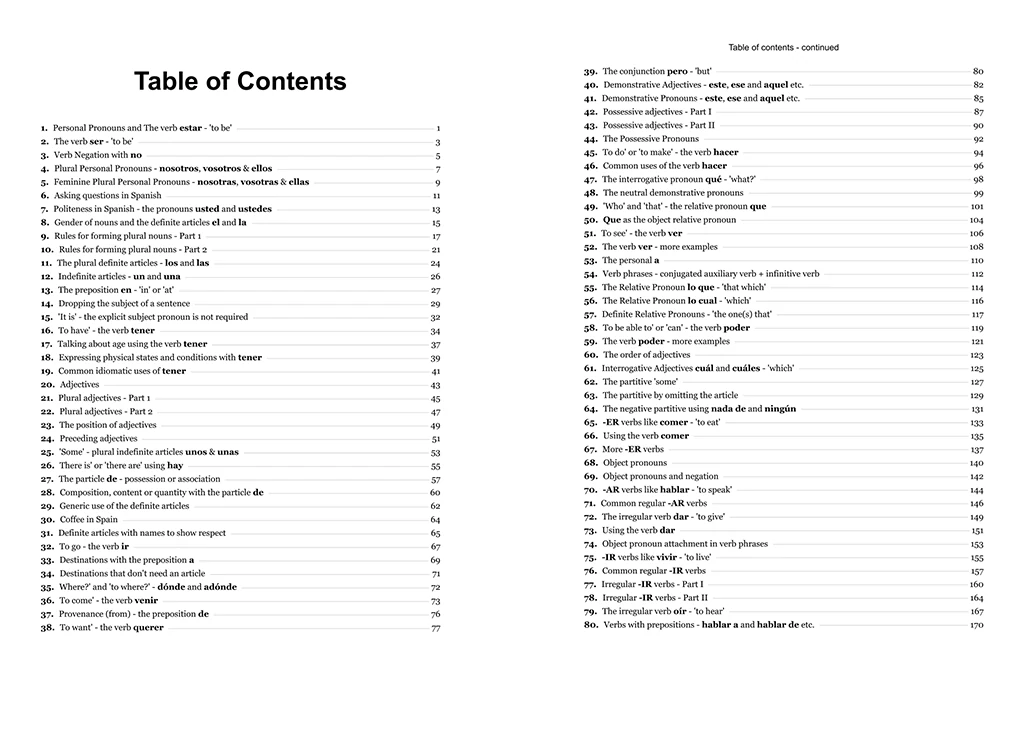
  1. Personal Pronouns and The verb estar - 'to be'
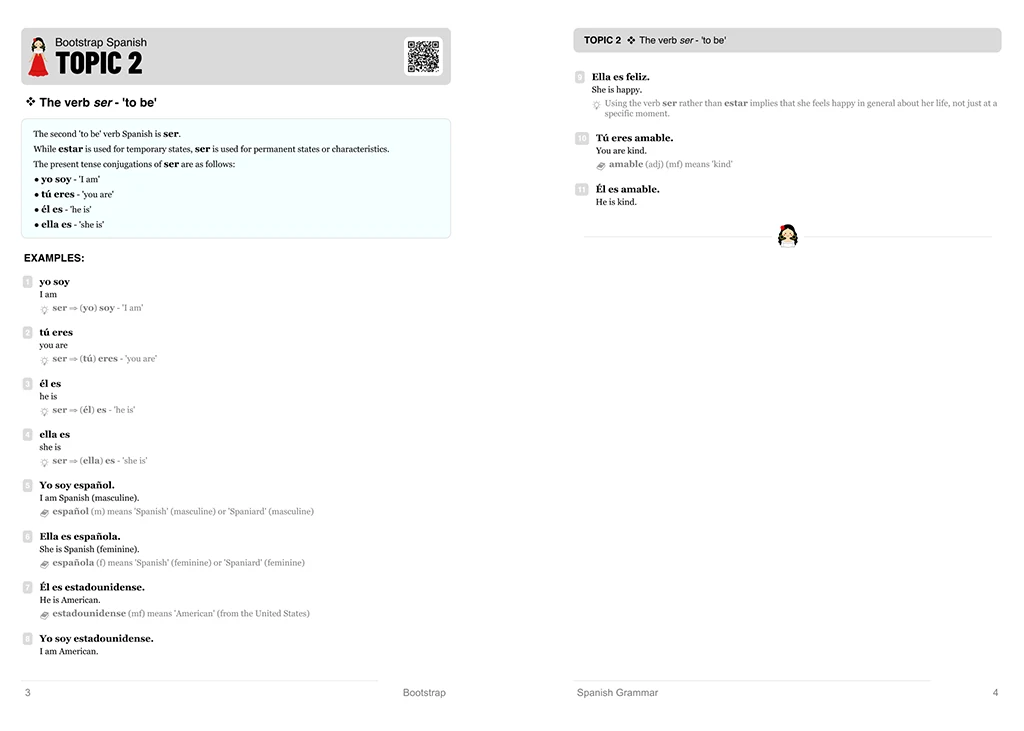
  2. The verb ser - 'to be'
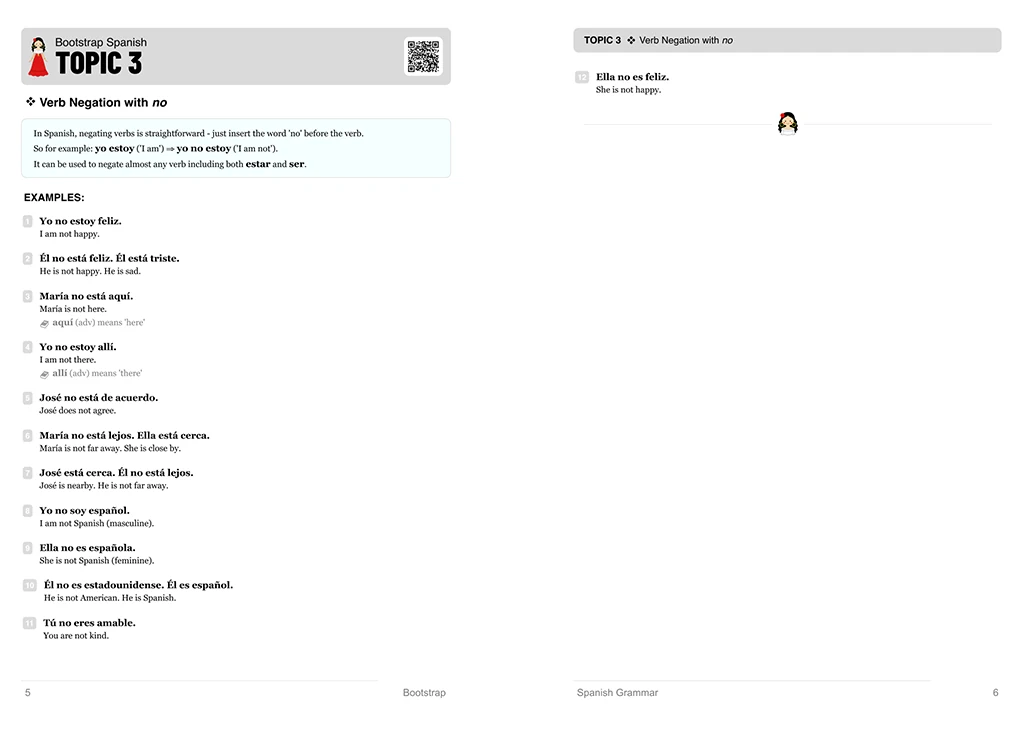
  3. Verb Negation with no
  4. Plural Personal Pronouns - nosotros, vosotros & ellos
  5. Feminine Plural Personal Pronouns - nosotras, vosotras & ellas
  6. Asking questions in Spanish
  7. Politeness in Spanish - the pronouns usted and ustedes
  8. Gender of nouns and the definite articles el and la
  9. Rules for forming plural nouns - Part 1
  10. Rules for forming plural nouns - Part 2

Key topics

Select a pattern to find it in the course
Show all 209 topicsHide the full topic list
Topics 11–31Nouns, adjectives and everyday SpanishArticles, tener, possession, agreement and useful expressions
  1. The plural definite articles - los and las
  2. Indefinite articles - un and una
  3. The preposition en - 'in' or 'at'
  4. Dropping the subject of a sentence
  5. 'It is' - the explicit subject pronoun is not required
  6. To have' - the verb tener
  7. Talking about age using the verb tener
  8. Expressing physical states and conditions with tener
  9. Common idiomatic uses of tener
  10. Adjectives
  11. Plural adjectives - Part 1
  12. Plural adjectives - Part 2
  13. The position of adjectives
  14. Preceding adjectives
  15. 'Some' - plural indefinite articles unos & unas
  16. There is' or 'there are' using hay
  17. The particle de - possession or association
  18. Composition, content or quantity with the particle de
  19. Generic use of the definite articles
  20. Coffee in Spain
  21. Definite articles with names to show respect
Topics 32–64Verbs and making connectionsIr, venir, questions, demonstratives, relative pronouns and quantities
  1. To go - the verb ir
  2. Destinations with the preposition a
  3. Destinations that don't need an article
  4. Where?' and 'to where?' - dónde and adónde
  5. To come' - the verb venir
  6. Provenance (from) - the preposition de
  7. To want' - the verb querer
  8. The conjunction pero - 'but'
  9. Demonstrative Adjectives - este, ese and aquel etc.
  10. Demonstrative Pronouns - este, ese and aquel etc.
  11. Possessive adjectives - Part I
  12. Possessive adjectives - Part II
  13. The Possessive Pronouns
  14. To do' or 'to make' - the verb hacer
  15. Common uses of the verb hacer
  16. The interrogative pronoun qué - 'what?'
  17. The neutral demonstrative pronouns
  18. 'Who' and 'that' - the relative pronoun que
  19. Que as the object relative pronoun
  20. To see' - the verb ver
  21. The verb ver - more examples
  22. The personal a
  23. Verb phrases - conjugated auxiliary verb + infinitive verb
  24. The Relative Pronoun lo que - 'that which'
  25. The Relative Pronoun lo cual - 'which'
  26. Definite Relative Pronouns - 'the one(s) that'
  27. To be able to' or 'can' - the verb poder
  28. The verb poder - more examples
  29. The order of adjectives
  30. Interrogative Adjectives cuál and cuáles - 'which'
  31. The partitive 'some'
  32. The partitive by omitting the article
  33. The negative partitive using nada de and ningún
Topics 65–93Verb patterns and pronounsRegular verbs, direct objects, reflexives and indirect objects
  1. -ER verbs like comer - 'to eat'
  2. Using the verb comer
  3. More -ER verbs
  4. Object pronouns
  5. Object pronouns and negation
  6. -AR verbs like hablar - 'to speak'
  7. Common regular -AR verbs
  8. The irregular verb dar - 'to give'
  9. Using the verb dar
  10. Object pronoun attachment in verb phrases
  11. -IR verbs like vivir - 'to live'
  12. Common regular -IR verbs
  13. Irregular -IR verbs - Part I
  14. Irregular -IR verbs - Part II
  15. The irregular verb oír - 'to hear'
  16. Verbs with prepositions - hablar a and hablar de etc.
  17. Obligation or necessity using tener que - 'to have to'
  18. Reciprocal references - 'each other'
  19. Reflexive personal pronouns
  20. Reflexive verbs
  21. Reflexive verbs and negation.
  22. To find and to be located - the verbs encontrar & encontrarse
  23. Parts of the body and reflexive verbs
  24. Verb phrase sentences with reflexive verbs
  25. Indirect object pronouns - 'to' or 'for' someone
  26. Redundant or reiterative indirect object pronouns
  27. Indirect object pronouns with verb phrases
  28. Order of pronouns
  29. Order of pronouns - pronoun substitution
Topics 94–129Negation, the past and ongoing actionsObligation, adverbs, gustar, preterite, perfect and continuous tenses
  1. To have to' or 'must' - the auxiliary verb deber
  2. 'To owe' - the verb deber
  3. Using para to express intention
  4. Haber que - 'it is necessary'
  5. More impersonal verbs - quedar & faltar
  6. Because' - porque, ya que, puesto que & como
  7. 'It turns out that' with a verb resultar
  8. The placement of adverbs
  9. Forming adverbs with -mente
  10. 'Neither nor' - ni..ni..
  11. Double negatives in Spanish
  12. Nada que - 'nothing to do something'
  13. Using solo - 'only'
  14. Using gustar - 'to like' and encantar - 'to love'
  15. Stressed pronouns - with prepositions and conjunctions
  16. Stressed pronouns with con - conmigo, contigo and consigo
  17. The simple past (preterite) tense with -AR verbs
  18. The simple past tense with -ER verbs
  19. The simple past tense with -IR verbs
  20. Simple past tense for ser and ir
  21. More irregular simple past tense verbs
  22. More impersonal verbs: suceder and ocurrir
  23. Expressing 'to miss' using extrañar and echar de menos
  24. Using hacer falta - 'to need' or 'to lack'
  25. Using casi - 'almost'
  26. The present perfect tense and past participles
  27. Common Verbs with irregular past participles
  28. The passive voice in the preterite tense
  29. Past participles as adjectives
  30. The present continuous
  31. Verbs with irregular present participles
  32. Using ser in the present continuous
  33. The two ways to know - saber and conocer
  34. The various uses of the verb llegar - 'to arrive'
  35. The verb pasar - 'something happening'
  36. To take place - tener lugar
Topics 130–151More expressive sentencesInfinitives, comparisons, superlatives and the near future
  1. Verb phrases that require a before the infinitive
  2. The verb infinitive as a noun
  3. Infinitives after certain prepositions
  4. 'Have just' and 'about to' with acabar de and estar a punto de
  5. Verb phrases with de before the infinitive
  6. 'Oneself' with mismo
  7. Using mismo to emphasize reflexive actions
  8. Comparison of quantities of nouns - más, menos and tanto
  9. Comparison of adjectives and adverbs - más, menos & tan
  10. Comparisons of 'good' - mejor & peor
  11. Comparisons of 'well' – mejor & peor as adverbs
  12. Superlatives
  13. The infinitive following adjectives or nouns – requiring de, a and other prepositions
  14. The infinitive following adjectives or nouns - no preposition required
  15. The future tense - el futuro próximo
  16. 'With me' - conmigo, contigo and consigo
  17. Indefinite pronouns for people
  18. Indefinite pronouns with an adjective
  19. Any or unspecified - cualquier
  20. 'All of' or 'every' - todo as an adjective
  21. 'Everything' and 'everyone' - todo as a noun or pronoun
  22. Possession or ownership with propia - 'own'
Topics 152–181Time, dates and the futureImperfect, past perfect, weather, durations and the future tense
  1. The imperfect past tense - El imperfecto
  2. El imperfecto for -AR verbs
  3. El imperfecto for -ER and -IR verbs
  4. El imperfecto for ser and estar
  5. 'Was going to' - interrupted or uncompleted intention
  6. Talking about the weather - el tiempo
  7. The past perfect tense - El pluscuamperfecto
  8. Expressing manner with el gerundio - 'while' or 'by'
  9. The Days of the Week - ¿Qué día es hoy?
  10. Telling the time - ¿Qué hora es?
  11. For how long? - durations with durante & por
  12. Using llevar with durations of time
  13. How long does it take?
  14. 'Until' and duration with en
  15. 'Time ago' using hacer
  16. 'For how long?' & 'How long since?' - ¿Cuánto tiempo hace que...?
  17. Talking about dates
  18. Intervals of time - de..a, del..al & entre..y
  19. 'How old are you?' - talking about age
  20. The simple future tense - El futuro simple
  21. El futuro simple - Irregular conjugations
  22. Si ('if') with el futuro simple
  23. More time-related prepositions
  24. 'As soon as' and 'since' - tan pronto como, en cuanto and desde que
  25. The relative pronouns el cual etc.
  26. The relative pronouns with a
  27. In what way? - de qué manera?, forma? or modo?
  28. 'In the style of' or 'in the manner of'
  29. 'Because of' - gracias a & a causa de
  30. 'To be about' - tratar de
Topics 182–192Commands and possibilitiesImperatives, future perfect and conditional forms
  1. The imperative - el imperativo - PART I
  2. The imperative - el imperativo - PART II
  3. The Imperative - el imperativo - PART III
  4. Attaching object pronouns to imperatives
  5. Reflexive imperatives
  6. The negative imperative
  7. The negative imperative - irregular verbs
  8. The future perfect - el futuro perfecto
  9. The conditional 'would' - el condicional
  10. Polite requests and wishes using el condicional
  11. Could' - the conditional of poder
Topics 193–209The subjunctive and beyondSubjunctive patterns, conditional perfect, reported speech and idioms
  1. The subjunctive mood - el subjuntivo - PART I
  2. The subjunctive mood - el subjuntivo - PART II
  3. The subjunctive mood - el subjuntivo - PART III
  4. Irregular subjunctives - PART I
  5. Irregular subjunctives - PART II
  6. Causative construction with hacer
  7. The Present Perfect Subjunctive - el pretérito perfecto compuesto de subjuntivo
  8. The imperfect subjunctive - el pretérito imperfecto de subjuntivo
  9. Subjunctive with negative pronouns and indefinite pronouns
  10. The subjunctive mood and antes de que - 'before'
  11. 'To see to it that' - the subjunctive with hacer que & asegurarse de que
  12. Inverted sentences with subjunctive clauses
  13. The subjunctive mood with 'whatever', 'whichever', 'whenever', and 'whoever'
  14. Would have' - El condicional perfecto
  15. Should', 'should have' - El condicional of deber
  16. Direct and indirect speech - Él dice que…
  17. Common Spanish idioms
Bootstrap Spanish Grammar paperback cover

The Bootstrap Spanish Grammar book

Spanish grammar
In your hands

Prefer to study on paper? The companion book brings together all 209 topics and 3,700+ annotated examples. Read the explanation in the book, then use the app to hear the matching phrases and practise the grammar.

Step by step
clear explanations
209
grammar topics
3,700+
annotated examples
Special introductory offer
Paperback + companion app

Buy the book Get the app free

Already have a copy?

Email us for the offer details

More than a list of rules

Your book, with matching audio

  1. Follow the same clear path

    The book and app follow the same 209-topic sequence. Work from the beginning or turn straight to the grammar point you need.

  2. Understand every example

    Spanish phrases come with English translations and notes on the grammar and new vocabulary. See how each pattern works in context.

  3. Go straight to the audio

    Scan the QR code at the start of a book topic with the companion app. It opens the matching topic, with native-speaker audio for the examples on the page.

Take a look inside

Tap a page to open the preview. Close it to return here.
Peter Vujanovic

The people behind the course

Made for people who want to understand

I’m Peter Vujanovic, CEO and Chief Editor at Declan Software. I brought together Spanish language experts to create the explanations, examples and audio in Bootstrap Spanish Grammar.

Our aim is to make each pattern clear enough to understand, then give you plenty of examples to practise.

Meet the Spanish language contributors
  • Iris Salanova, Bruno Rodriguez and María José Fernández Pintelos — Spanish and English proofreading and advice on the grammar.
  • Lucia Sanchez — recordings of the Spanish example phrases.

Get in touch with Peter and the team →

Before you begin

About the app
and the course

What can I try for free?

The first 10 topics are completely free and include explanations, native-speaker audio and exercises. You can use them without creating an account in the app. A one-time purchase unlocks all 209 topics with lifetime access — no subscription.

Is there a subscription?

No. You unlock the full Spanish course with one lifetime purchase, with no monthly fees. Your app store shows the exact price in your currency before you buy.

How is this different from free apps or websites?

Bootstrap Spanish Grammar gives you a structured path through 209 self-contained topics. Each one combines a plain-English explanation, annotated examples, native-speaker audio and exercises. New vocabulary appears in context, and “Why?” feedback helps you understand a mistake instead of guessing the answer again.

Do I need to buy the book?

No. The app is a complete course on its own. Choose the companion paperback if you prefer to study explanations and examples on paper. The book follows the same topic sequence, and its QR codes open the matching topics in the app so you can listen as you read.

Can I start as a beginner?

Yes. The course starts with estar and ser (to be), personal pronouns and simple sentences. It then introduces negation, questions, articles, gender and plurals before moving on to more complex patterns. English explanations, translations and native-speaker audio support you throughout.

Which Spanish grammar topics does the app cover?

The course covers ser and estar, articles and gender, adjective agreement, verb conjugation, object and reflexive pronouns, negation, preterite and imperfect tenses, perfect and future tenses, conditionals, the subjunctive, reported speech and idioms. Browse the 209-topic syllabus above for the complete sequence.

Can I use it with a class or another app?

Yes. Follow the course in order or revisit a grammar point from your class or another app. Save useful examples in your Study List and use the exercises and audio for focused practice between lessons.

How does spaced repetition work?

Phrases you practise return for review at increasing intervals, helping you revisit earlier grammar as you learn new patterns. Use the review feature for ongoing practice. Spaced repetition and “Why?” explanations are available on both iOS and Android.

Is the Spanish grammar app available on iPhone and Android?

Yes. Bootstrap Spanish Grammar is available for iPhone and iPad on the App Store, and Android on Google Play. Check the relevant listing for current device requirements.

Start with one small step

Make your next Spanish sentence make sense

Try the first 10 topics free. Unlock the full course with one lifetime purchase when you’re ready.

Keep a little Spanish in your inbox

Occasional language-learning tips and resources from Declan Software, including Spanish study material.

Book preview

Take a look inside

Inside the iPhone app

Open full-size image ↗
Interactive lesson

Explore three Spanish examples. Learn the pattern, listen to the audio, and practise choosing the correct word.

Bootstrap Spanish Grammar

Free to download

Your first 10 lessons are free.

Which device do you use?

Scan with your phone’s camera, or use a download button.

One lifetime purchase unlocks all 209 topics.
No subscription.

First 10 topics freeNo subscription.

Try the app ↗