

French grammar app

French grammar
Now it clicks

Finally understand French grammar—one small step at a time. Learn verb conjugation, gender and sentence patterns with clear explanations, native-speaker audio and practice. For iPhone, iPad and Android.

Download free — try the first 10 topics with full audio & exercises

No account required · Unlock the rest anytime with a one-time purchase

Inside the appSee the rule · Use the rule
French Topic 14 explaining avoir, the verb to have, with its present-tense conjugations
French exercise with J’ai une nouvelle voiture and six forms of avoir to choose from Explore the exercises

Real iPhone screenshots. Tap either preview to enlarge.

224step-by-step grammar topics
4,000+examples with audio
Verbs & genderexplained in context
One purchaselifetime course access
Try it hereExample 1 / 3

Suis, es or est? Try it yourself

Topic 1 · The verb être: “to be”

Je suis ici.

I am here.

je + être → je suis

Être means “to be”. With je (I), it becomes suis: Je suis ici means “I am here”. Ici means “here”.

Understand the pattern

A website lesson using real course examples. See the app ↗

Make the connection

French grammar
one small step at a time

224 self-contained topics give you a clear path through the grammar. Start with être, avoir and your first French sentences, then build through agreement and pronouns to past tenses, the conditional and the subjunctive.

01 / UNDERSTAND

Build on what you know

Each topic explains one grammar point in plain English, then builds on what came before. Add new patterns in small, manageable steps and learn at your own pace.

02 / HEAR

Learn vocabulary in context

Explore 4,000+ annotated examples, each with native-speaker audio and an English translation. Notes explain how the grammar works and what new words mean, so your vocabulary grows alongside it.

03 / PRACTISE

Put each pattern into practice

Use interactive exercises to practise the French grammar you have just learned. Choose the right form, build sentences and connect the explanation to an answer you can produce yourself.

Inside Bootstrap French Grammar

See how the learning happens

French app previews. Select a screen to take a closer look.
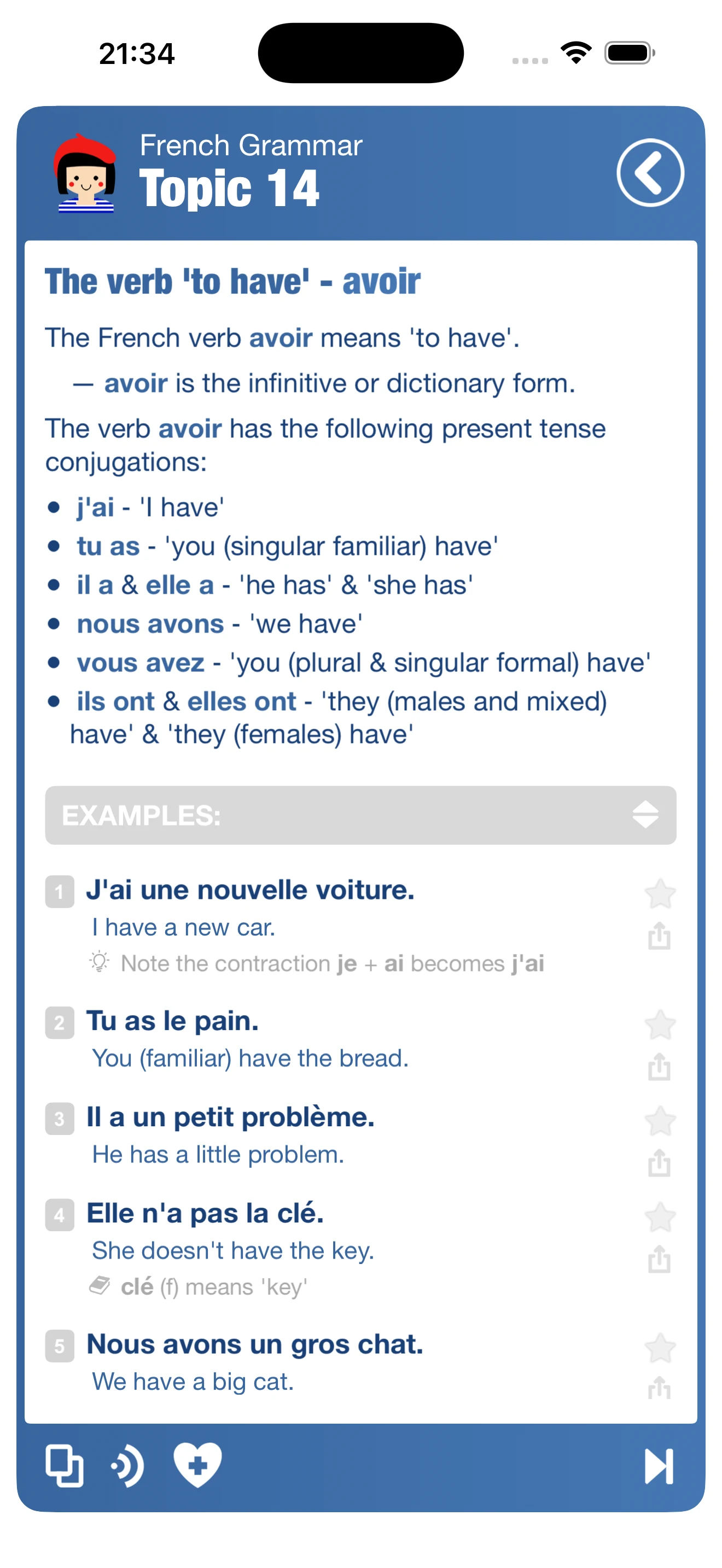
  • French Topic 14 explaining avoir, the verb to have, with its present-tense conjugations
    01

    Understand the rule

    Start with a clear explanation. Topic 14 introduces avoir, with conjugations, translations and examples.
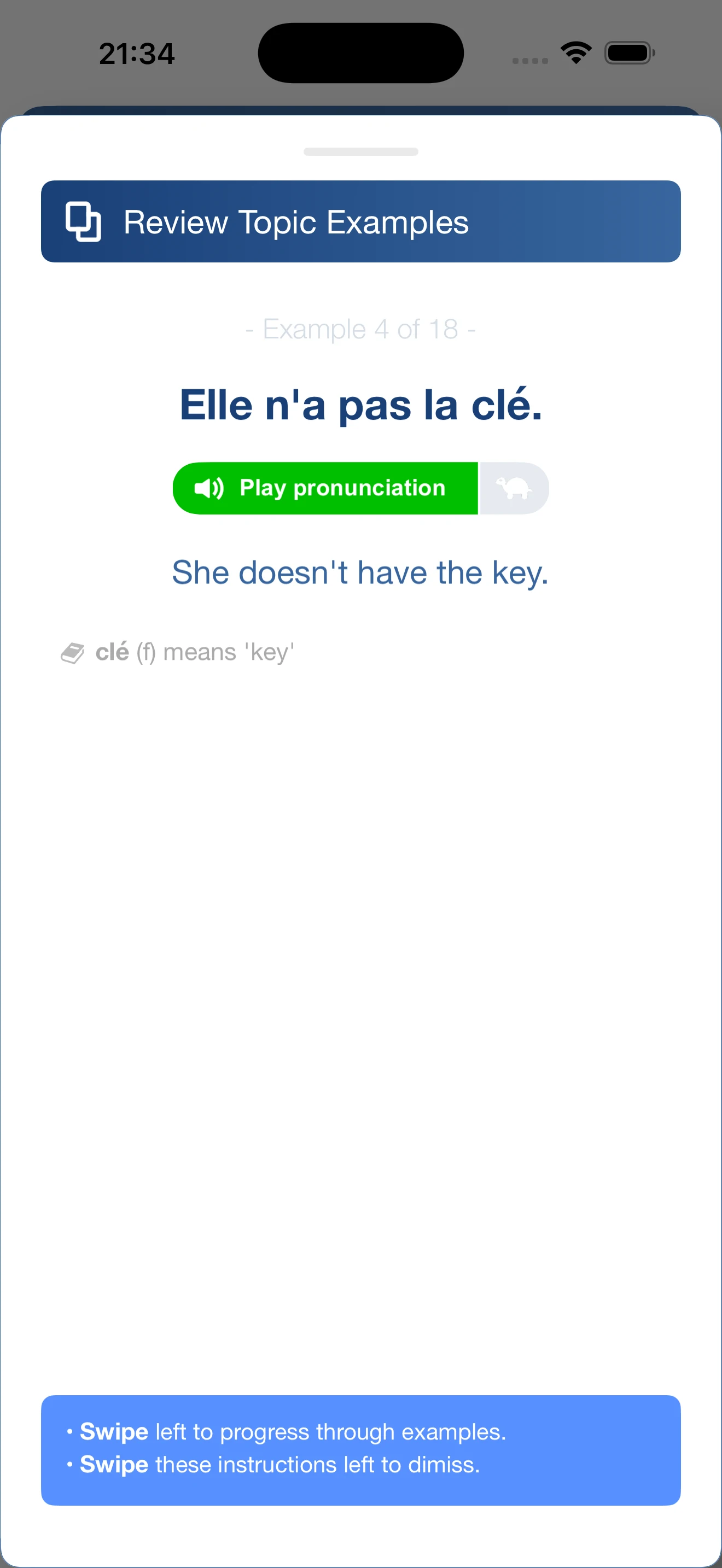
  • French example review: Elle n’a pas la clé, meaning She does not have the key
    02

    Review each example

    Hear the pronunciation, read the translation and check the notes, one phrase at a time.
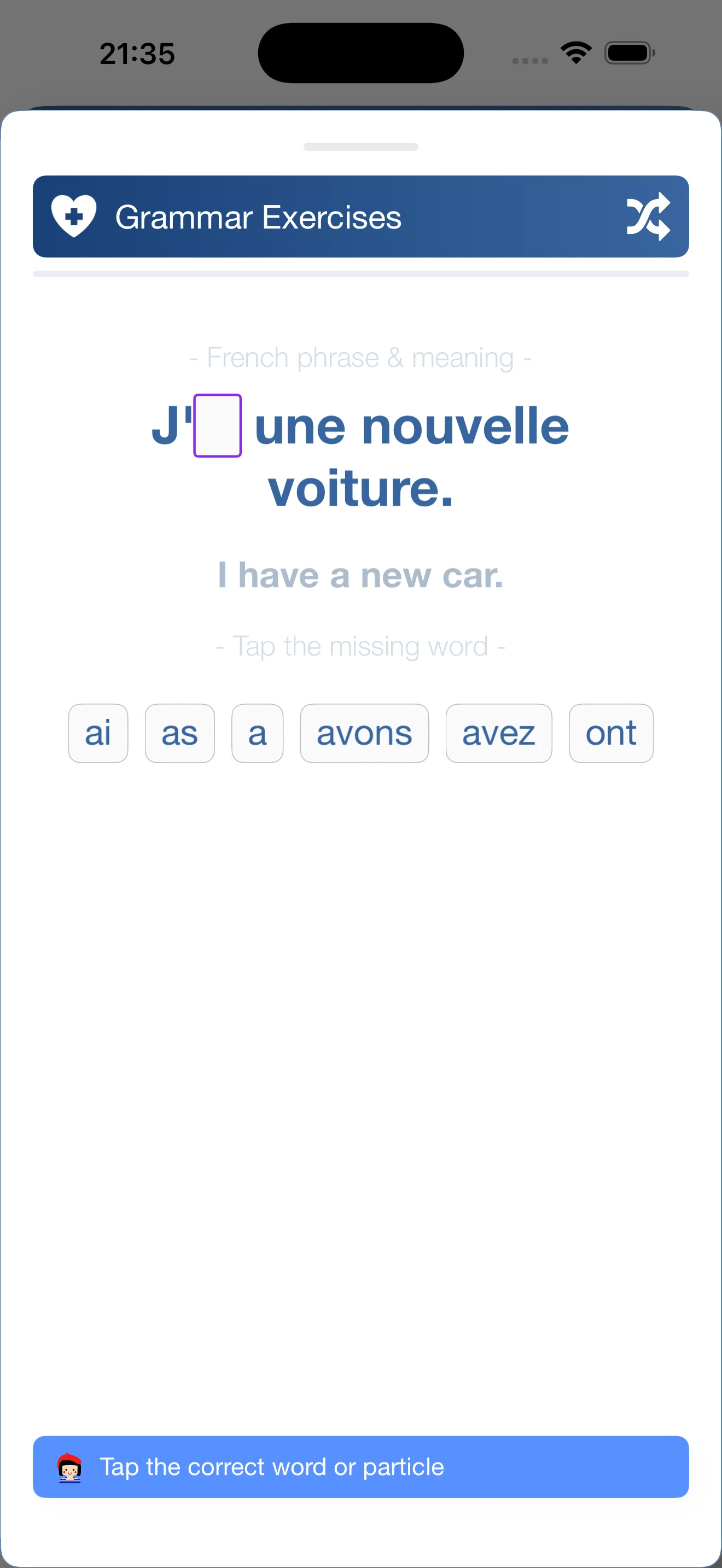
  • French exercise with J’ai une nouvelle voiture and six forms of avoir to choose from
    03

    Choose the missing word

    Use the meaning to choose the right form of the verb and complete the French sentence.
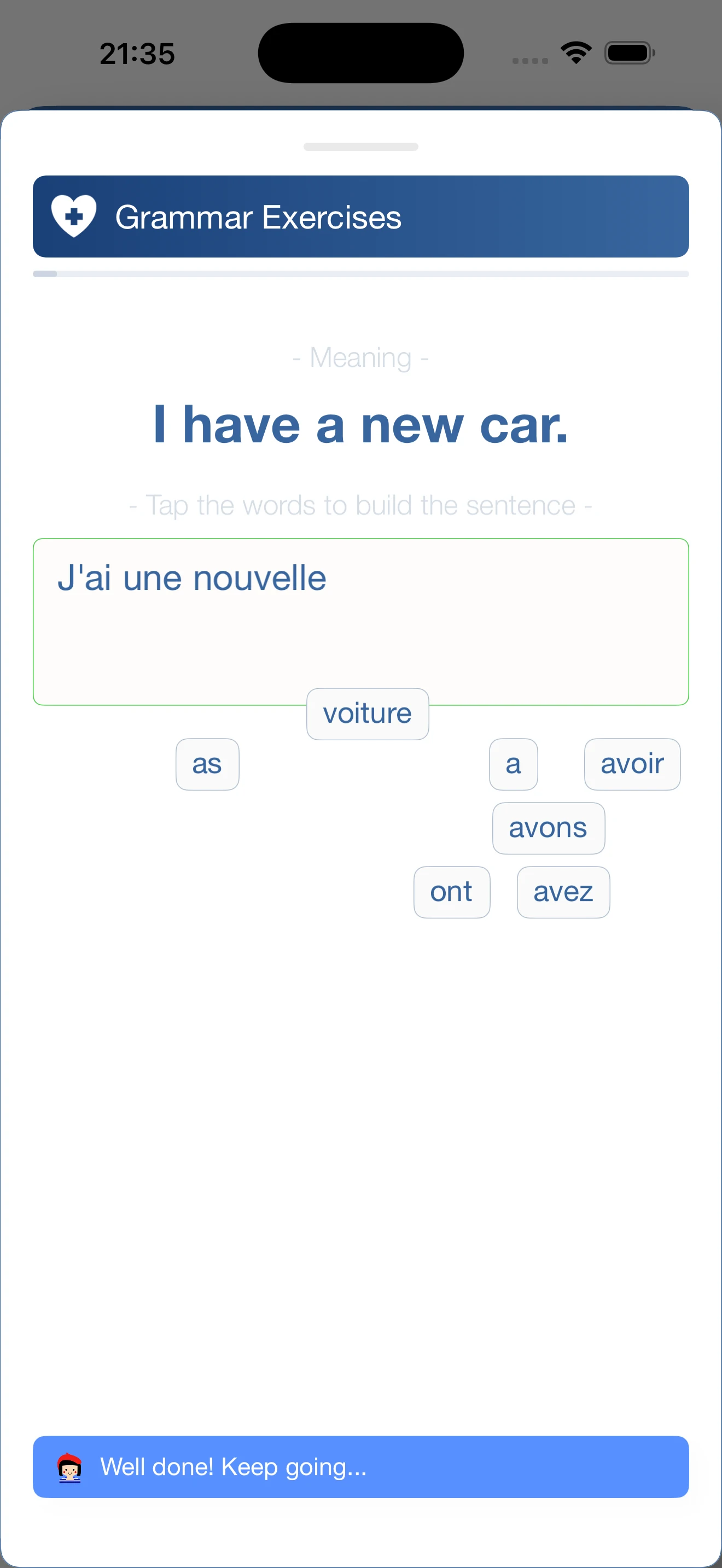
  • French sentence-building exercise for I have a new car
    04

    Build a French sentence

    Tap the words in order, using the English meaning as your guide.
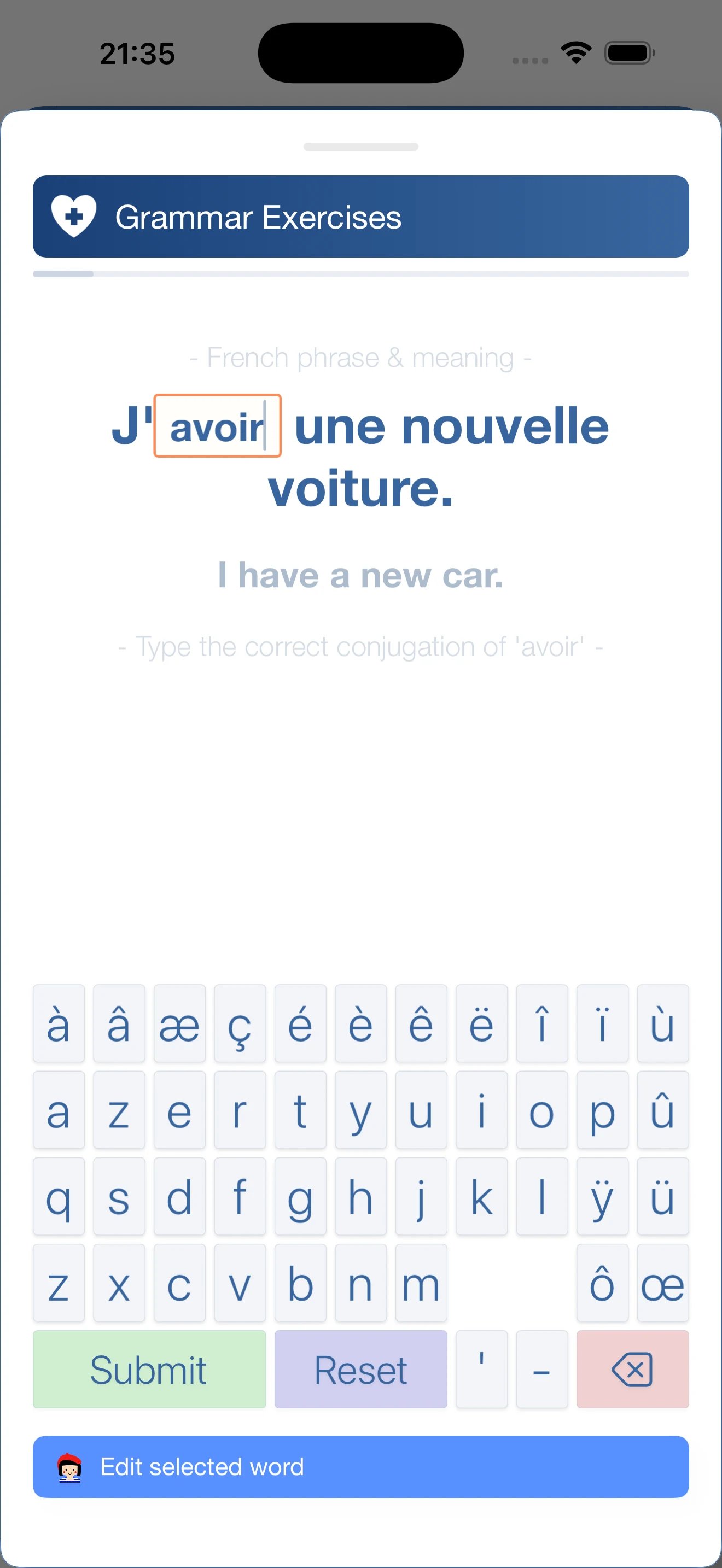
  • French typing exercise asking for the correct conjugation of avoir in J’ai une nouvelle voiture
    05

    Type the correct form

    Practise producing the conjugation yourself, with accented letters ready on the keyboard.
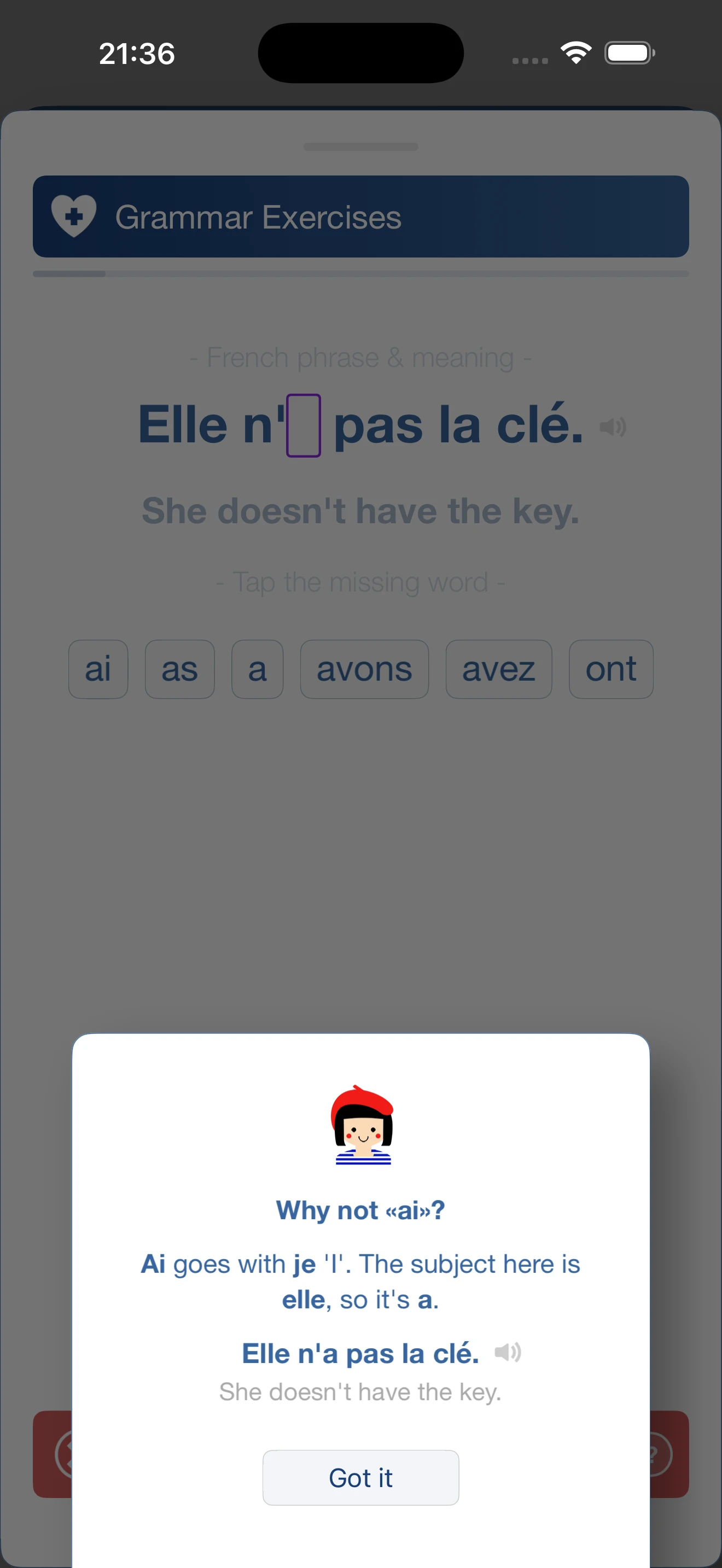
  • Why feedback explains that ai goes with je, while elle takes a
    06

    Understand why

    See why a choice does not fit, learn the rule and put the correct form back into the sentence.
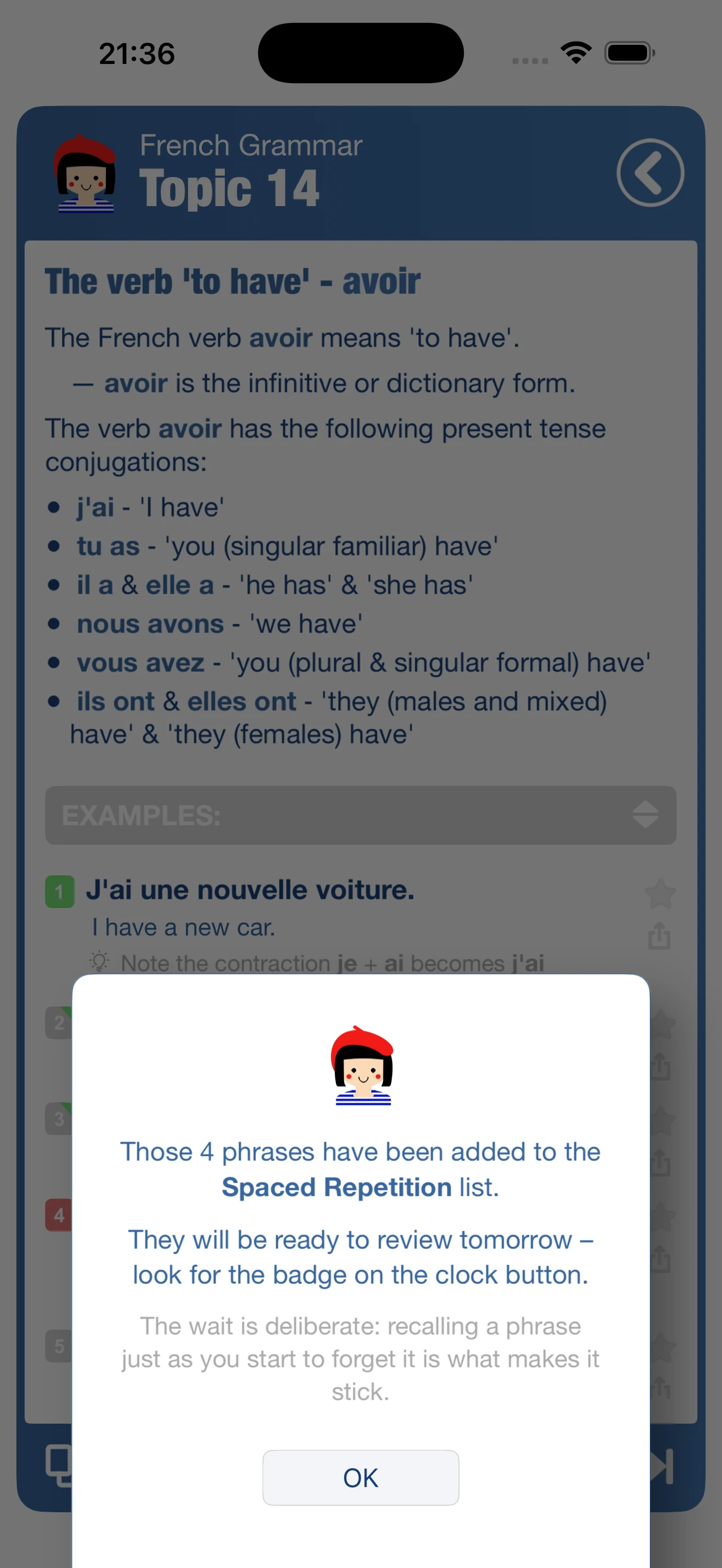
  • French spaced repetition confirmation showing four phrases added for review tomorrow
    07

    Remember with review

    Phrases you practise return for spaced repetition, helping you revisit what you have learned.
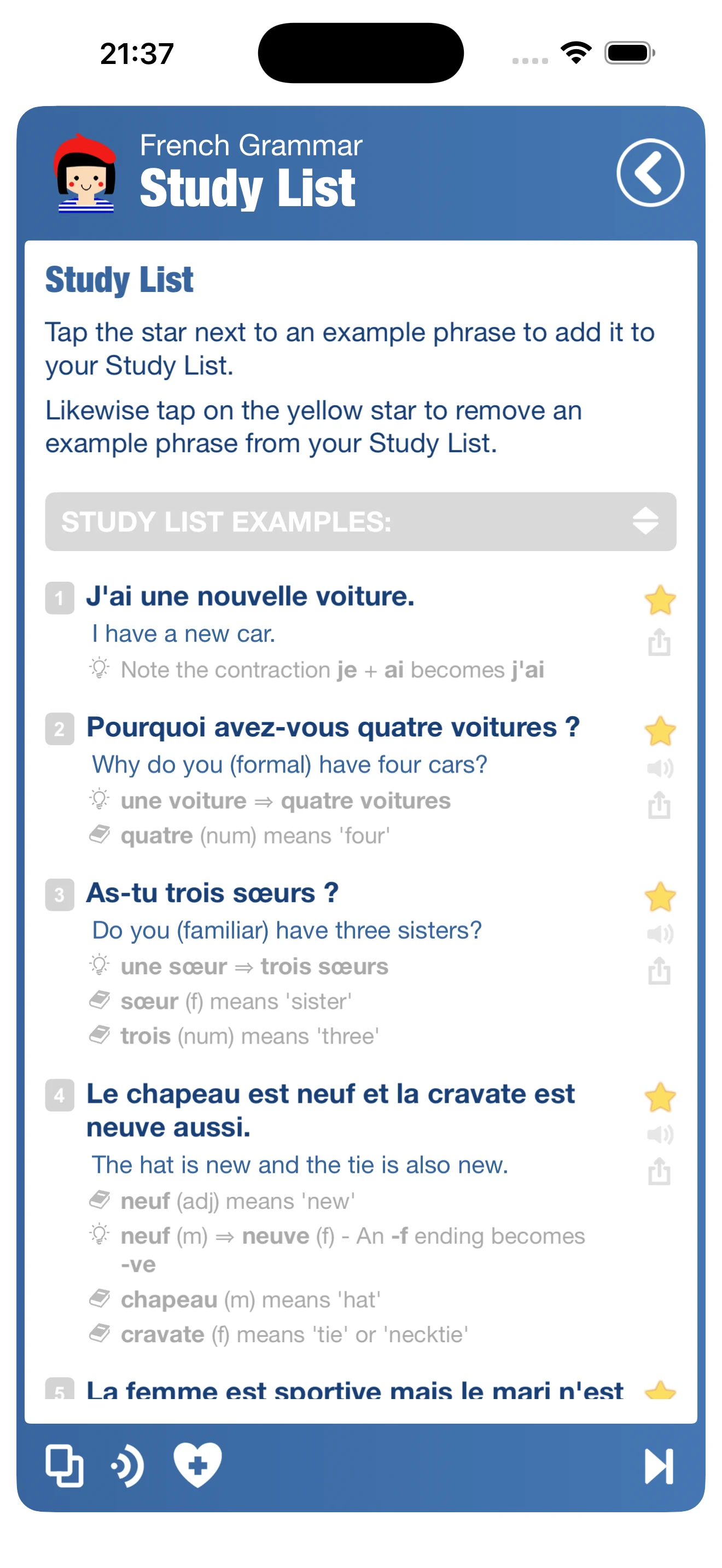
  • French Study List with starred examples ready for review
    08

    Save useful phrases

    Star the examples you want to revisit and keep them together in your personal Study List.
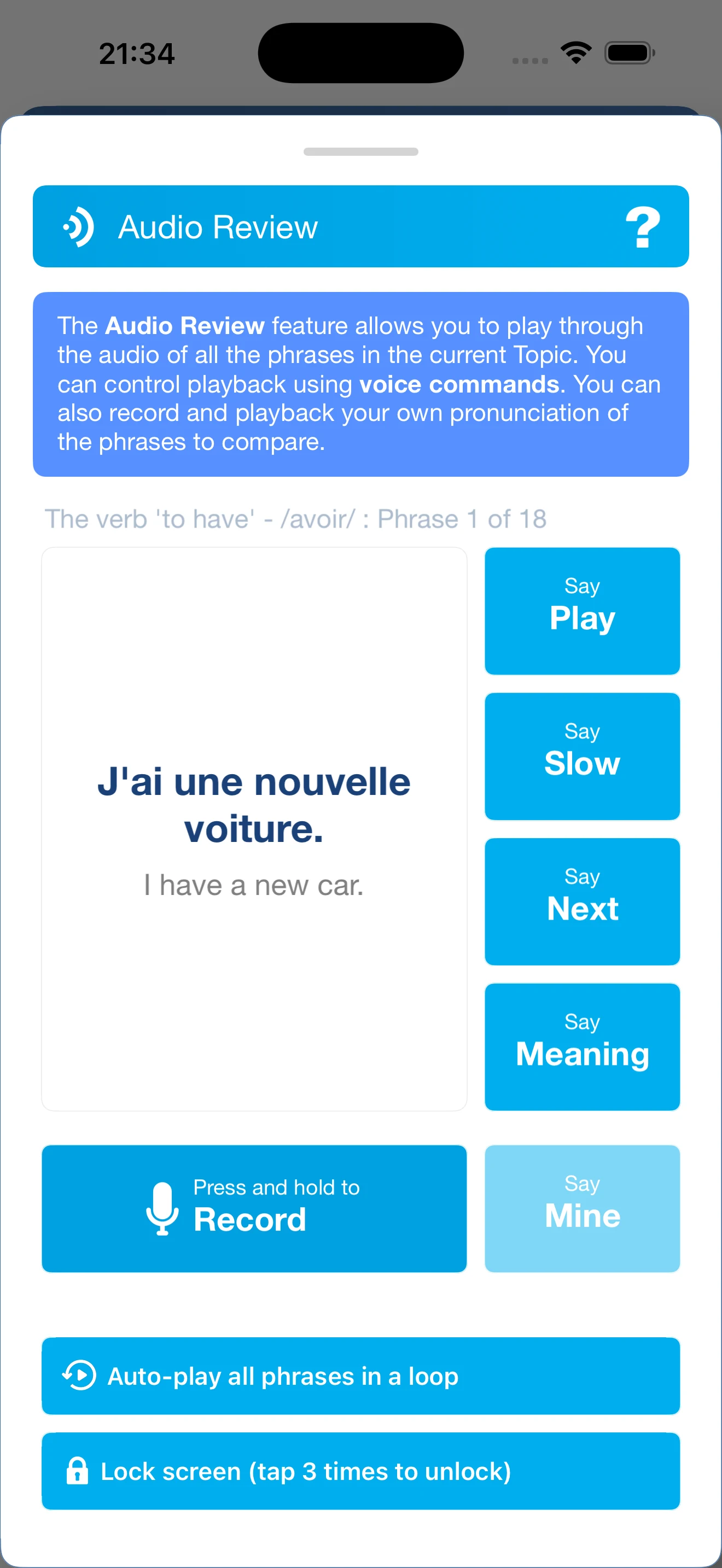
  • French Audio Review with Play, Slow, Next, Meaning and Record controls
    09

    Listen and say it

    Play a phrase, slow it down or record your pronunciation to compare. Use voice commands to control the audio review.
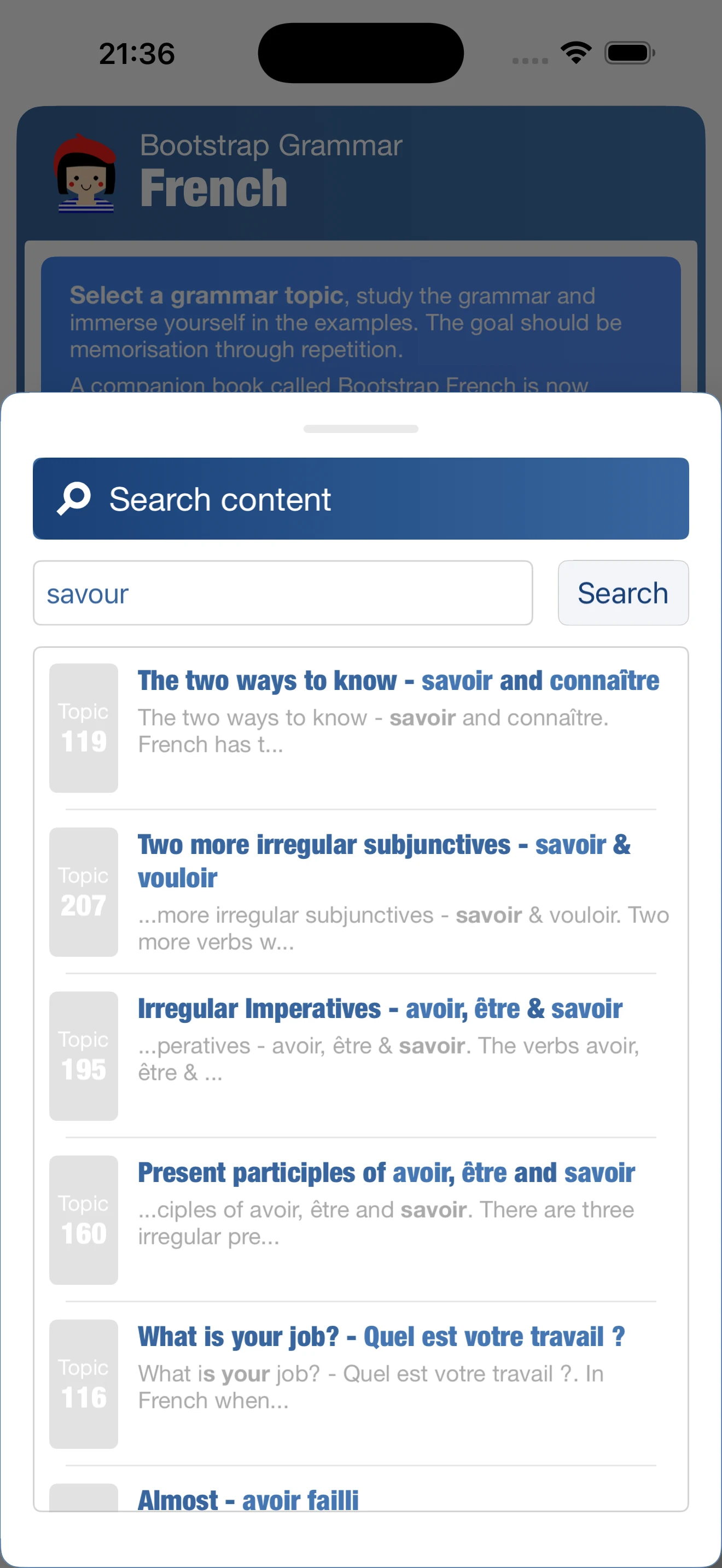
  • French content search for savoir, showing related grammar topics
    10

    Find the grammar you need

    Search for a French word or grammar point and jump to the relevant topics.

Understand your mistakes

Make a mistake with the topic’s grammar? A short “Why?” explanation shows the correct answer and the rule behind it, so you know what to change next time.

Keep earlier grammar fresh

Use spaced repetition to revisit phrases at increasing intervals. Keep practising earlier patterns as you work through new topics.

Your own Study List

Star examples you want to keep and gather them in your personal Study List. Focus your review on useful phrases and the grammar you want to practise again.

Free vs Full

Start free Keep going when you’re ready

Try the first 10 topics, then unlock the complete French grammar course in the same app.

No subscription
Compare the free French grammar lessons with the full course.
What’s includedFreeGet startedFull courseLifetime access
Grammar topicsFirst 10 topicsFirst sentences, pronouns, questions, articles, gender & adjectives.All 224 topicsVerb conjugation, tenses, pronouns, the subjunctive & more, including the first 10 topics.
Examples & audioExamples and audio for the first 10 topics.4,000+ examplesWith native-speaker audio throughout the course.
ExercisesPractise the first 10 topics.Practise every topic in the course.
PaymentFree to downloadThe first 10 topics are free.One-time purchaseUnlock the full course in the app. No recurring payments.

Your path through French grammar

French verb conjugation, tenses and more

Start with 10 free topics, explore key patterns or search the full 224-topic course. The book and app follow the same sequence.

224 topics to explore

Topics 1–10First 10 topics FreeÊtre, pronouns, questions, articles, negation and gender
  1. Subject Pronouns and 'to be' - the verb être
  2. Plural Personal Pronouns - nous, vous, ils & elles
  3. Politeness in French - the pronouns vous and tu
  4. Asking questions using inversion
  5. It is, that is, they are - c'est & ce sont
  6. Genders and the definite articles - le & la
  7. In and on - the prepositions dans & sur
  8. Negation, not - ne pas
  9. Adjectives and gender - masculine and feminine
  10. Feminine adjectives - some rules

Key topics

Select a pattern to find it in the course
Show all 224 topicsHide the full topic list
Topics 11–27Nouns, adjectives and possessionAvoir, plurals, agreement, articles and de
  1. Feminine adjectives - doubling the final consonant
  2. The position of adjectives
  3. Indefinite articles - un & une
  4. The verb 'to have' - avoir
  5. Idiomatic expressions with avoir
  6. Plural nouns
  7. The plural definite article - les
  8. Plural nouns - exceptions
  9. Plural adjectives
  10. Vous and agreement of adjectives
  11. C'est with adjectives
  12. There is & there are - Il y a
  13. The plural indefinite article - des
  14. The plural indefinite article des with adjectives
  15. Using ce as a personal pronoun
  16. Possession - the particle de
  17. Contents - de
Topics 28–56Everyday verbs and useful connectionsAller, venir, questions, relative pronouns and quantities
  1. To go - the verb aller
  2. Location and destination ('in' or 'at' and 'to') - the preposition à
  3. To come - the verb venir
  4. Provenance (from) - the preposition de
  5. Questions with nouns - repeating the subject
  6. Questions with est-ce que
  7. Irregular Adjectives
  8. Special adjectives - vieil, bel, nouvel & fol
  9. To want - the verb vouloir
  10. Demonstrative Adjectives - ce, cet, cette and ces
  11. This one here and those ones there - the particles -ci and -là
  12. Demonstrative Pronouns - this one, that one - celui, celle, ceux & celles
  13. Who and that - the subject relative pronoun qui
  14. Who and that - the object relative pronoun que
  15. Indefinite Relative Pronouns - ce qui & ce que
  16. To do, to make - the verb faire
  17. What? - questions with qu'est-ce que
  18. To see - the verb voir
  19. Dual-verb constructions - conjugated + infinitive
  20. To be able to - the verb pouvoir
  21. Which - quel, quelle, quels & quelles
  22. Which one - lequel, laquelle, lesquels & laquelles
  23. The Possessive Adjectives
  24. The Possessive Pronouns
  25. The partitive articles - du, de la & des
  26. Negative partitive - pas de
  27. Using pas without ne
  28. There is not - il n'y a pas
  29. Lots of, a little of - beaucoup de & un peu de
Topics 57–84Verb patterns and pronounsRegular verbs, object pronouns, reflexives and common irregular verbs
  1. -ER verbs like aimer
  2. -ER verbs exceptions
  3. Verbs with prepositions - parler à & parler de
  4. The Subject Pronoun on
  5. The definite article - concepts, topics and issues
  6. Object pronouns
  7. Negation with object pronouns
  8. Reflexive personal pronouns
  9. Reflexive verbs
  10. Negating reflexive verbs
  11. To find and to be located - the verbs trouver & se trouver
  12. Parts of the body and reflexive verbs
  13. Dual-verb sentences with reflexive verbs
  14. Indirect object pronouns - 'to' or 'for' someone
  15. Another person's body parts
  16. Order of pronouns
  17. This here and that there - cela and ceci
  18. The demonstrative pronoun ça
  19. Subject repetition
  20. -IR Verbs
  21. Irregular -IR verbs - Part I
  22. Irregular -IR verbs - Part II
  23. Irregular -IR verbs - Part III
  24. Irregular -IR verbs - Part IV
  25. The strange case of asseoir & s'asseoir
  26. To have to or must - the verb devoir
  27. It is necessary - the impersonal verb falloir
  28. More impersonal verbs - rester & manquer
Topics 85–118Negation and the past tenseNegative forms, passé composé, participles and the passive
  1. Because - parce que, car, puisque & comme
  2. It turns out - s'avérer
  3. Regular -RE Verbs
  4. The many uses of the verb rendre
  5. The conjunction que
  6. To say - the irregular verb dire
  7. Negative pronouns - rien & personne
  8. Negative adverbs - jamais & plus
  9. Negative adjectives - aucun & nul
  10. Neither nor - ne..ni..ni..
  11. Double negatives
  12. Only - the restrictive ne.. que
  13. Causative construction with faire
  14. Getting someone to do something
  15. Past tense - Le passé composé
  16. Past participles for regular -IR & -RE verbs
  17. Irregular past participles
  18. Must, have to - the verb devoir
  19. Past participles of avoir & être
  20. Past tense and negation - le passé composé with ne..pas
  21. Passé composé - agreement of the past participle
  22. Passé composé, negation and word order
  23. Passé composé with être
  24. Passé composé with être verbs used transitively
  25. Passé composé with reflexive verbs
  26. The Reflexive Causative - se faire
  27. To miss -manquer
  28. Almost - avoir failli
  29. Past participles as adjectives
  30. If, so and yes - si
  31. Passive voice
  32. What is your job? - Quel est votre travail ?
  33. Present participles as adjectives
  34. Immediate past, continuous present and immediate future
Topics 119–151Infinitives, comparisons and detailSavoir, prepositions, stressed pronouns, comparisons and futur proche
  1. The two ways to know - savoir and connaître
  2. The various uses of the verb arriver
  3. The verb se passer
  4. To take place - avoir lieu
  5. Verbs + preposition à + infinitive
  6. Negating the infinitive
  7. The verb infinitive as a noun
  8. Verb infinitives after certain prepositions
  9. Verbs + preposition de + infinitive
  10. Stressed pronouns - with prepositions and conjunctions
  11. Stressed pronouns - for emphasis and abbreviation
  12. Stressed pronouns - with à and même
  13. Stressed pronouns - agreement and disagreement
  14. Using pas without ne
  15. The position of adverbs
  16. Comparison of quantities of nouns - plus, moins & autant
  17. Comparison of adjectives and adverbs - plus, moins & aussi
  18. Comparisons of 'good' - meilleur & pire
  19. Comparisons of 'well' - mieux & mal
  20. Superlatives
  21. The infinitive following adjectives or nouns - using de or à
  22. Idiomatic expressions with avoir..de
  23. The future tense - le futur proche
  24. Verbs of perception and the infinitive
  25. Verbs of perception and agreement
  26. Some, any and a few - quelques
  27. Common uses of quelque
  28. Indefinite pronouns with an adjective require de
  29. Any or unspecified - n'importe
  30. All of or every - tout as an adjective
  31. Everything and all of them - tout as a noun or pronoun
  32. Very or extremely - tout as an adverb
  33. Own and clean - propre
Topics 152–179Time, dates and the futureImparfait, plus-que-parfait, durations and futur simple
  1. The past continuous - L'imparfait
  2. The irregular imparfait of être
  3. A few irregular imparfait conjugations
  4. Was going to - aller from the futur proche in the imparfait
  5. Talking about the weather
  6. The pluperfect - Le plus-que-parfait
  7. Concordance des temps - le passé composé
  8. Present participles as adverbial gerunds
  9. Present participles of avoir, être and savoir
  10. Present participles as adjectives - modifying a noun
  11. The days of the week - Quel jour est-ce ?
  12. Telling the time - Quelle heure est-il ?
  13. For how long? - durations with pendant, depuis & pour
  14. How long does it take?
  15. Time ago - il y a
  16. How long since? - ça fait combien de temps?
  17. Dates
  18. Intervals of time - du..au & de..à
  19. Time with dans and en
  20. Matin & matinée, soir & soirée, jour & journée and an & année
  21. How old are you? - talking about age
  22. Le futur simple
  23. Le futur simple - avoir and être
  24. Le futur simple - other irregulars
  25. Si with le futur simple
  26. When où means 'when'
  27. More time-related prepositions
  28. As soon as and since - dès que and depuis que
Topics 180–202Pronouns, commands and possibilitiesY, en, relative pronouns, imperatives and conditionals
  1. The pronoun y
  2. Expressions using y
  3. The pronoun en
  4. Expressions using en
  5. Of which, about which - the relative pronoun dont
  6. What - quoi
  7. Relative pronouns after prepositions with de - duquel, de laquelle, desquels & desquelles
  8. Relative pronouns after prepositions without de - lequel, laquelle, lesquels & lesquelles
  9. Relative pronouns auquel, auxquels & auxquelles
  10. In what way? - de quelle manière & de quelle façon
  11. In the style of or in the manner of - à la
  12. Because of - grâce à & à cause de
  13. It is about - il s'agit de
  14. The Imperative
  15. The Negative Imperative
  16. Irregular Imperatives - avoir, être & savoir
  17. The future perfect - Le futur antérieur
  18. If… then - Le conditionnel présent
  19. Polite requests and wishes - Le conditionnel présent of vouloir & aimer
  20. Could - the conditional pouvoir
  21. Would have - Le conditionnel passé
  22. Should, should have - the conditional devoir
  23. The verb tenir and its many uses
Topics 203–224The subjunctive and beyondSubjunctive patterns, reported speech and French idioms
  1. The subjunctive mood - Le subjonctif
  2. Irregular subjunctives - être & avoir
  3. The past subjunctive - Le passé du subjonctif
  4. More irregular subjunctives - faire, aller & pouvoir
  5. Two more irregular subjunctives - savoir & vouloir
  6. So that - the subjunctive conjunctions pour que & afin que
  7. Although - the subjunctive conjunction bien que & quoique
  8. Until - the subjunctive conjunction jusqu'à ce que
  9. The subjunctive with negated verbs expressing doubt or uncertainty
  10. Subjunctive with Negative Pronouns and Indefinite Pronouns
  11. To see to it that - the subjunctive with faire en sorte que
  12. Impersonal subjunctives - falloir, pleuvoir & valoir
  13. Whatever, whoever, whenever - the subjunctive with quoi que, qui que & où que
  14. Whichever - the subjunctive and indefinite pronoun quel que
  15. Inverted subjunctive conjunctions
  16. Superlative and the subjunctive
  17. The subjunctive and the ne explétif
  18. Subjunctive conjunctions with and without the ne explétif
  19. Before and after - avant que & après que
  20. To have to - avoir à
  21. Direct and indirect speech - il dit que…
  22. Common French Idioms
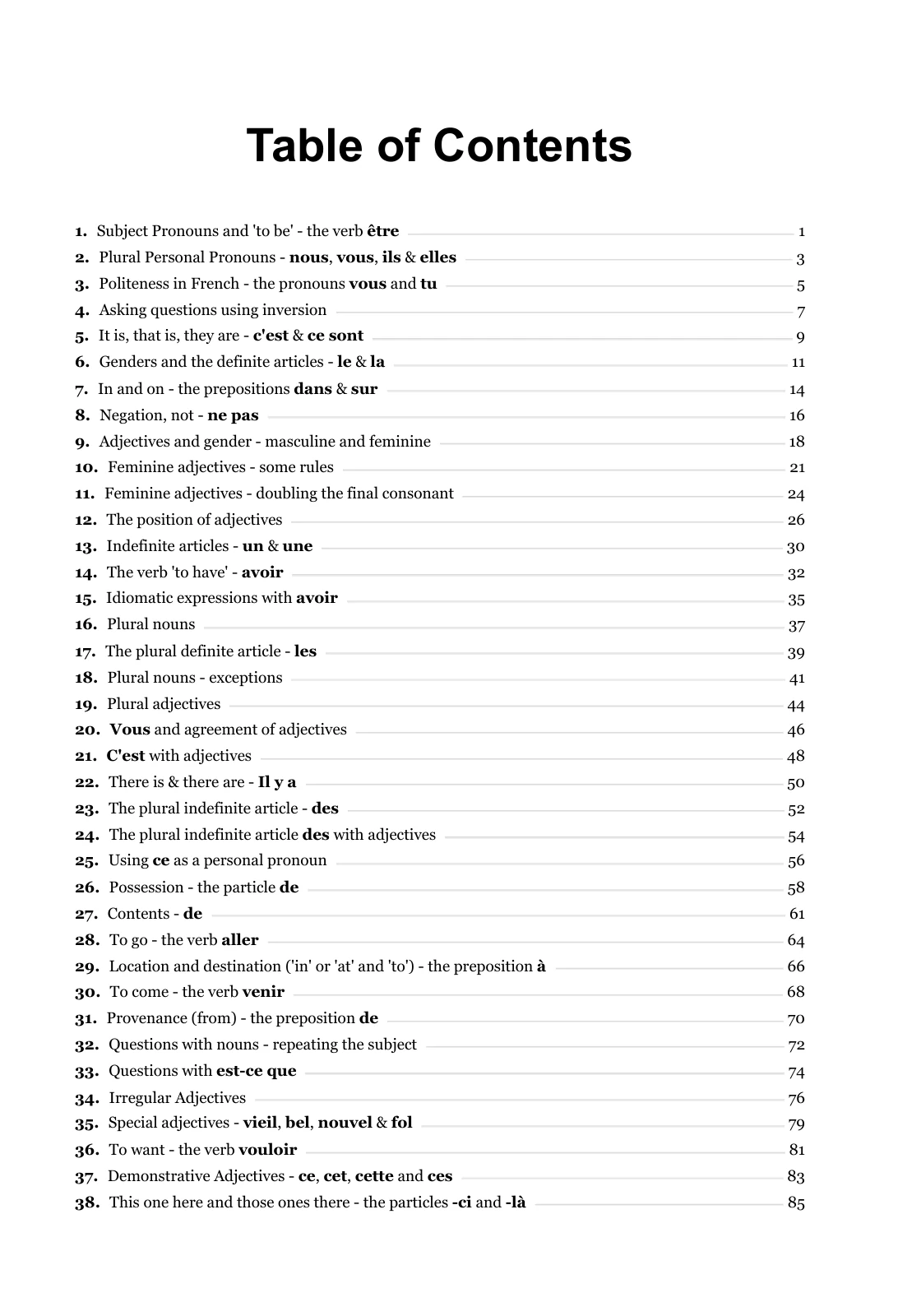
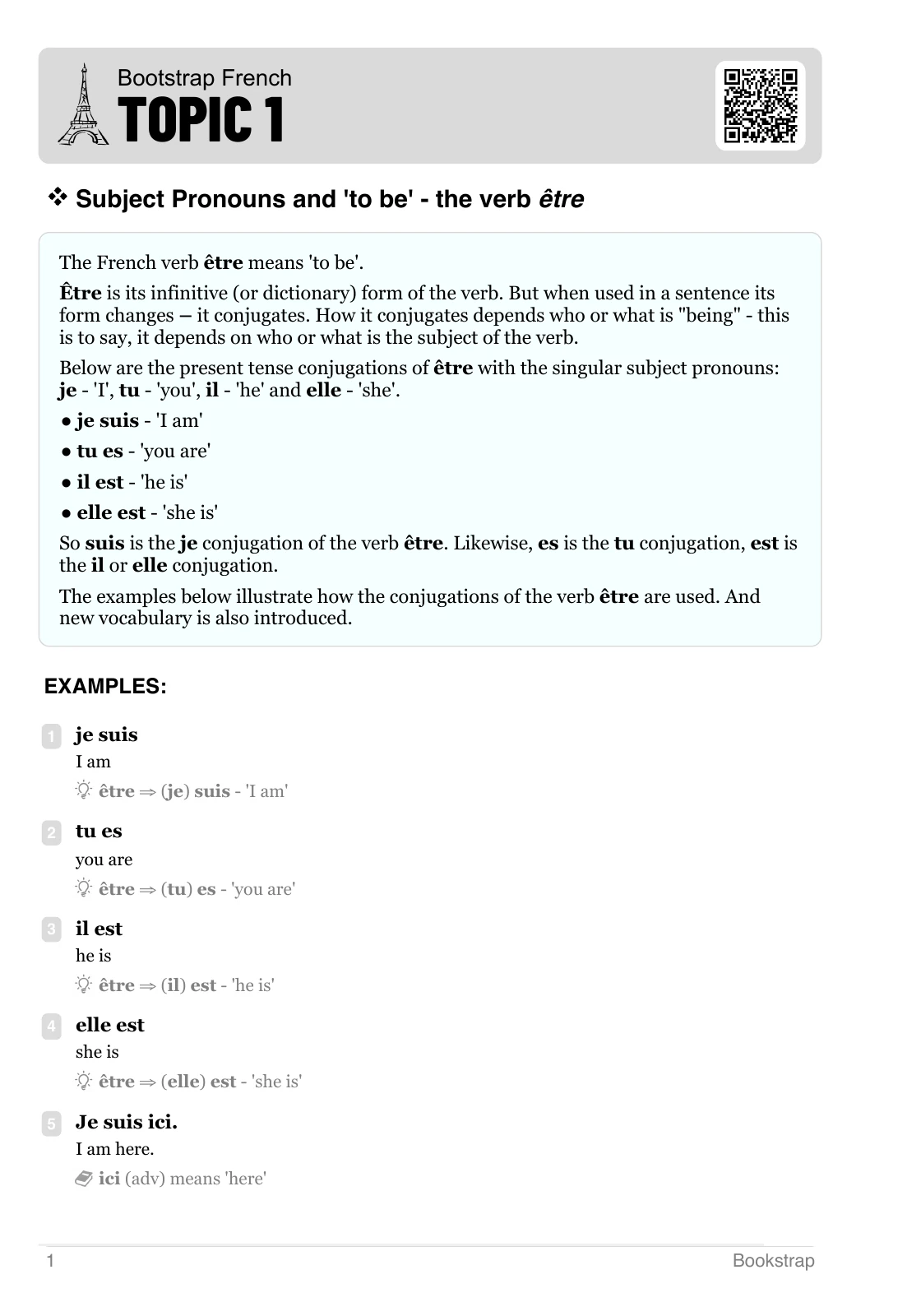
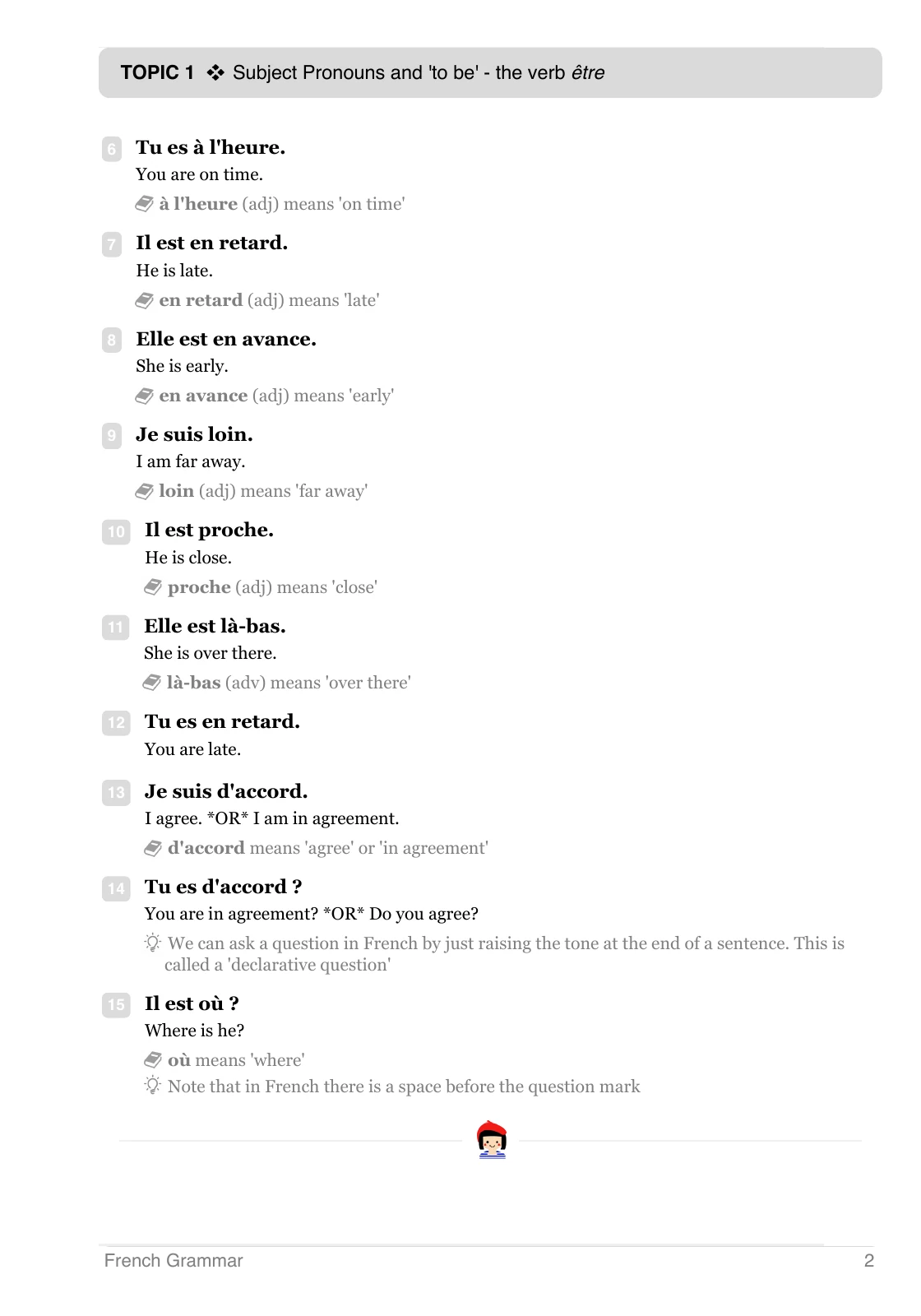
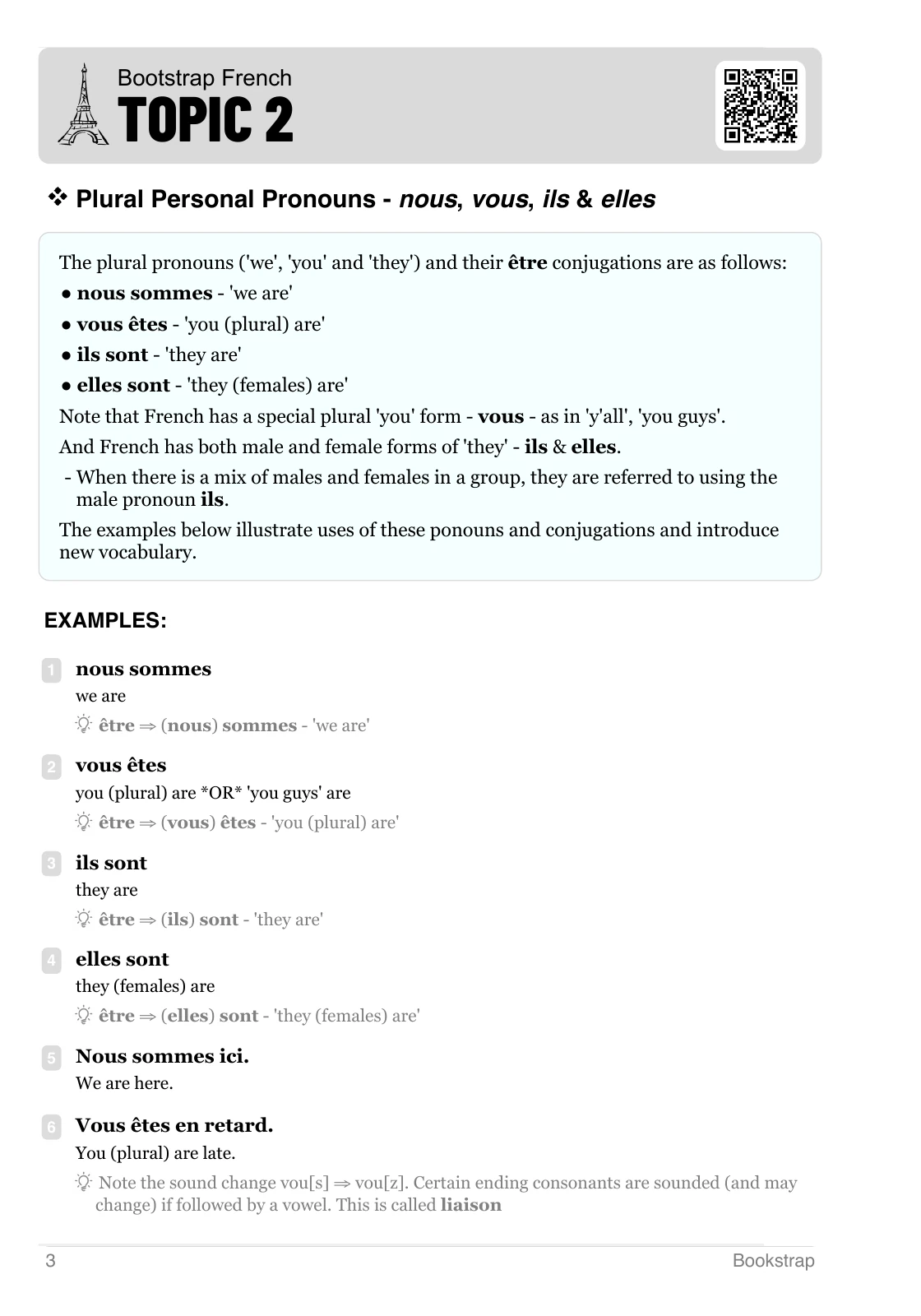
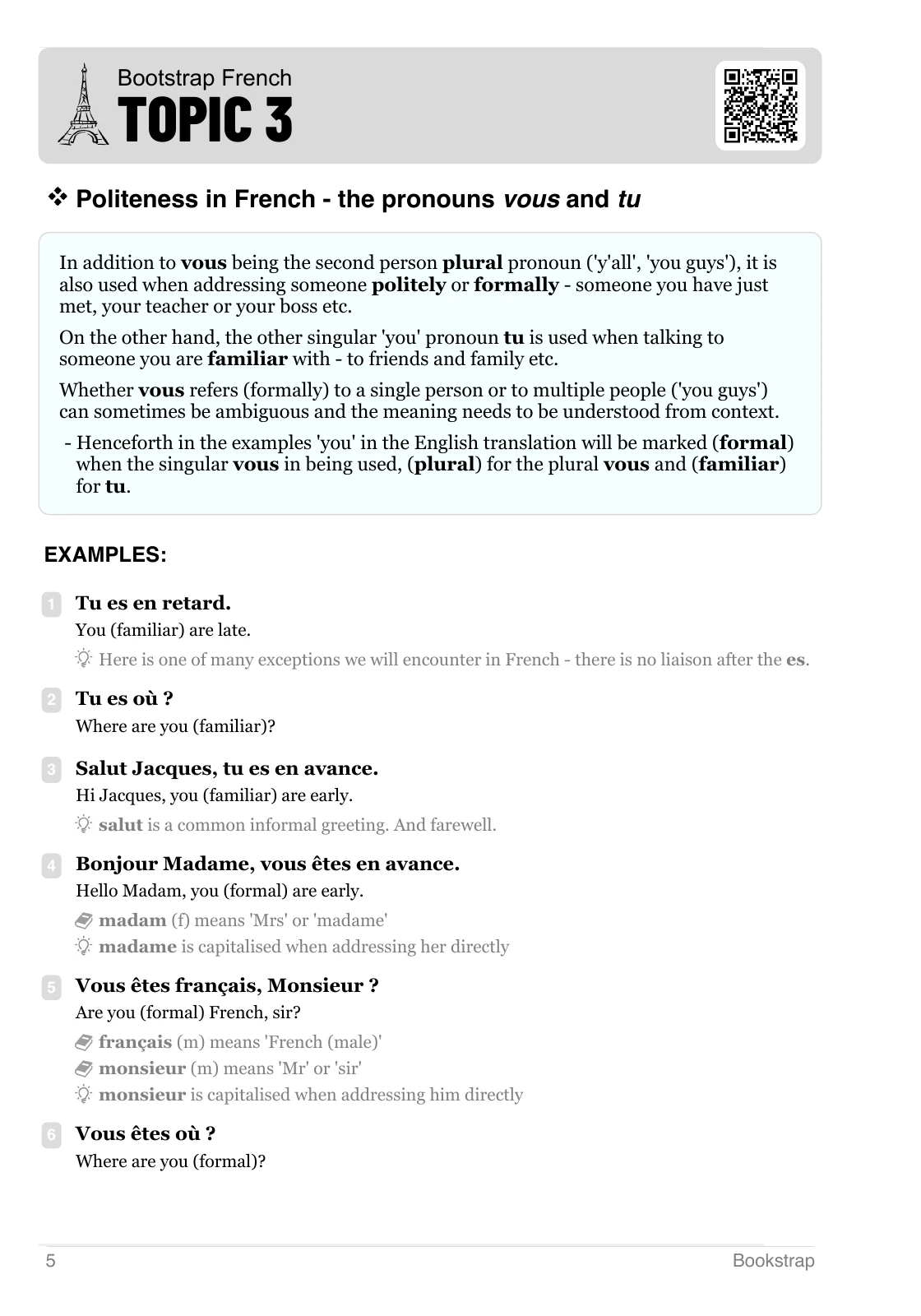
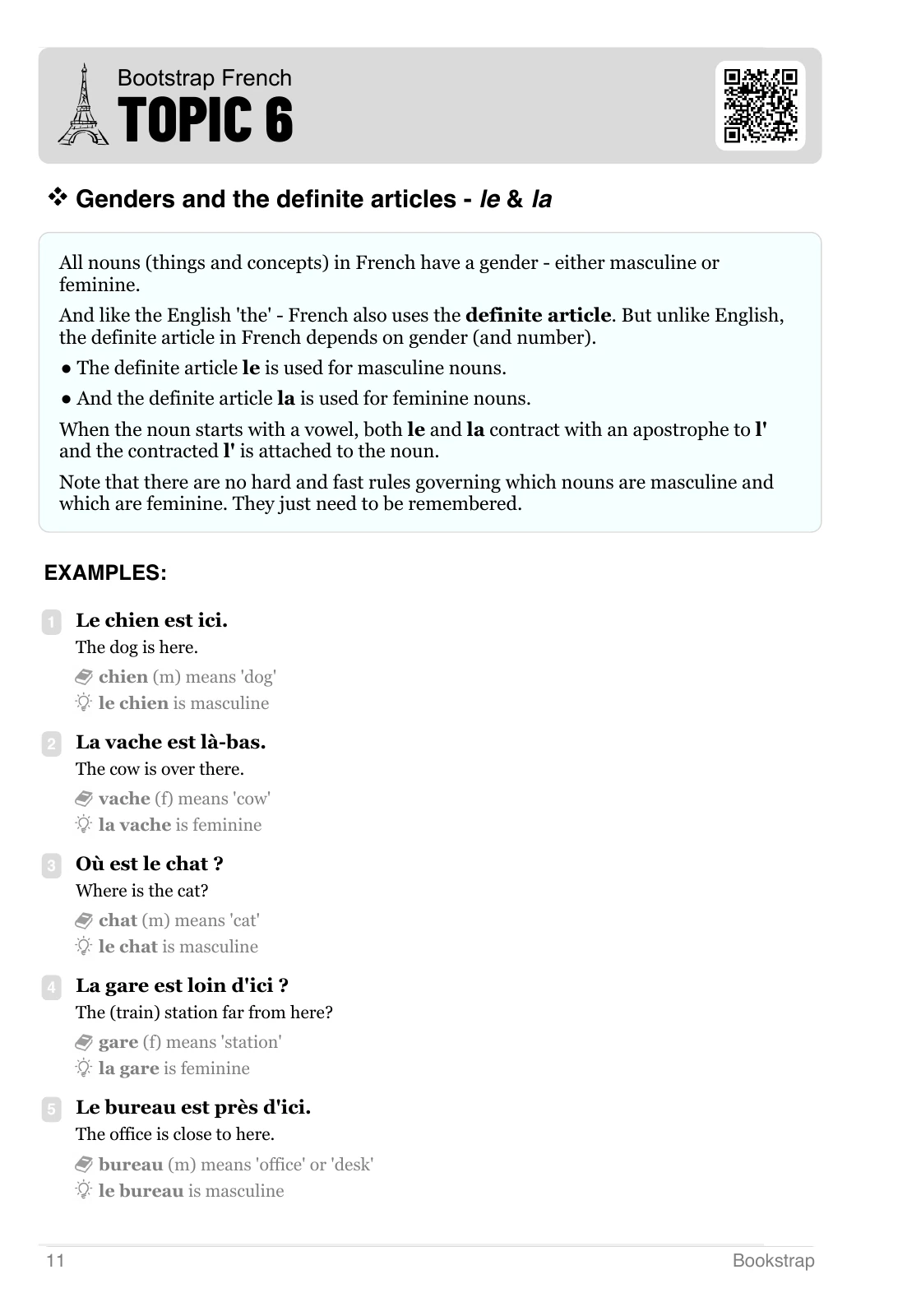
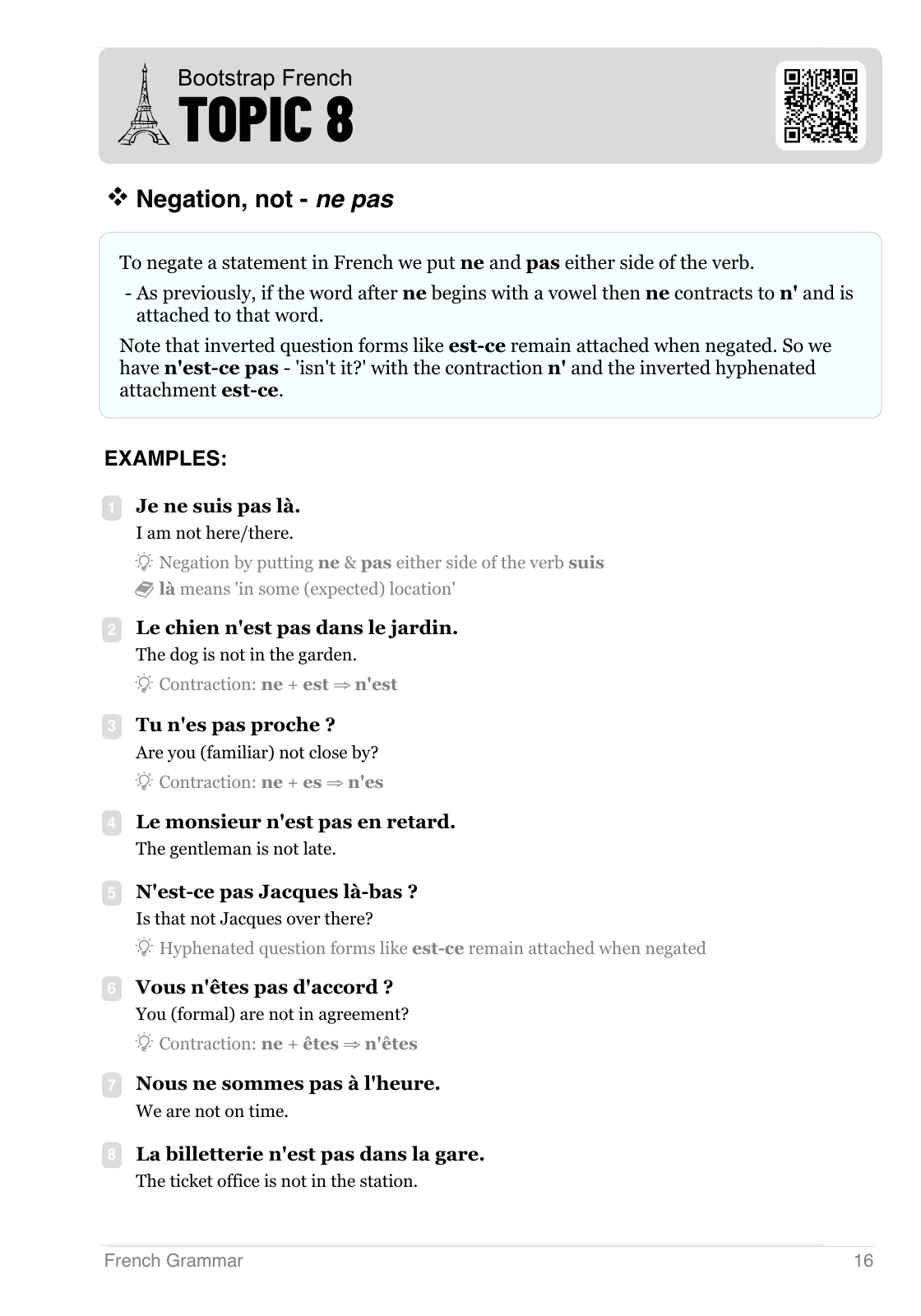
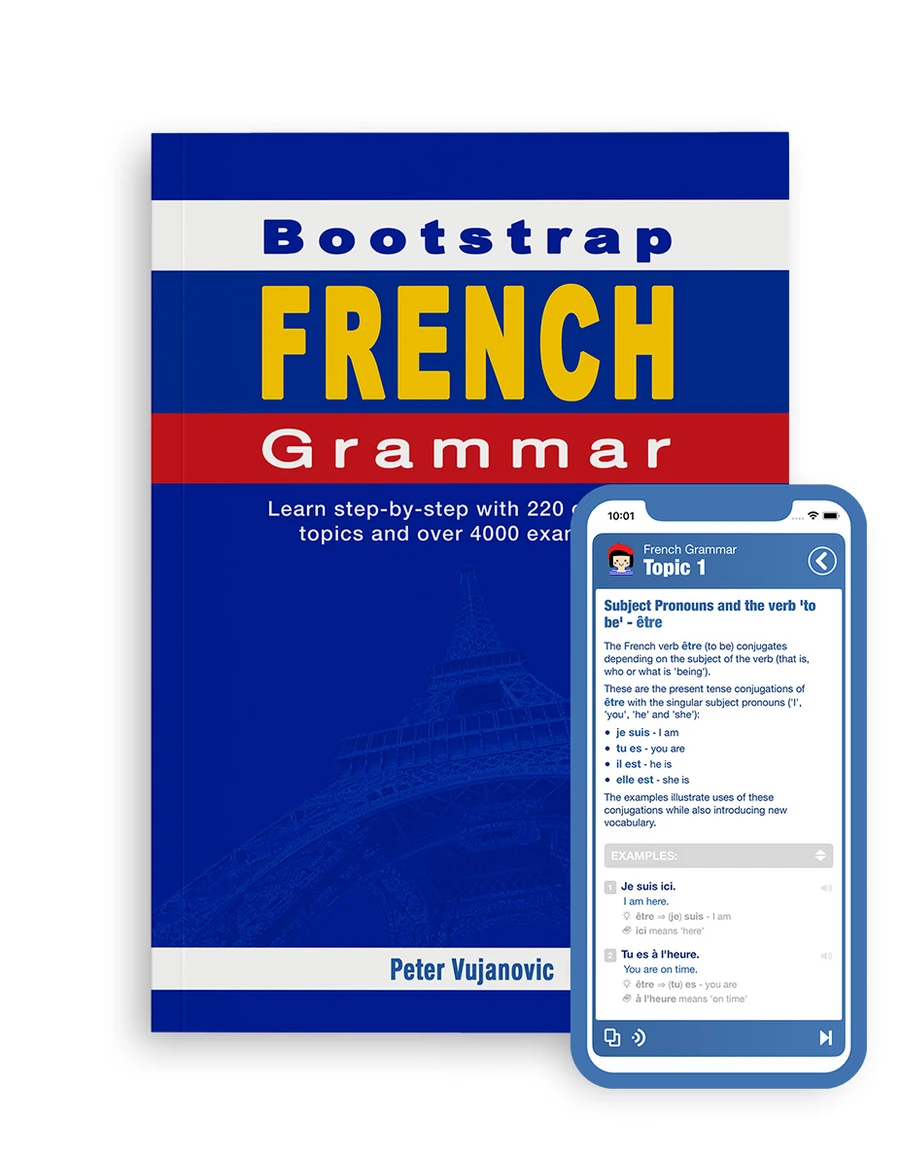
Bootstrap French Grammar paperback with the companion French app

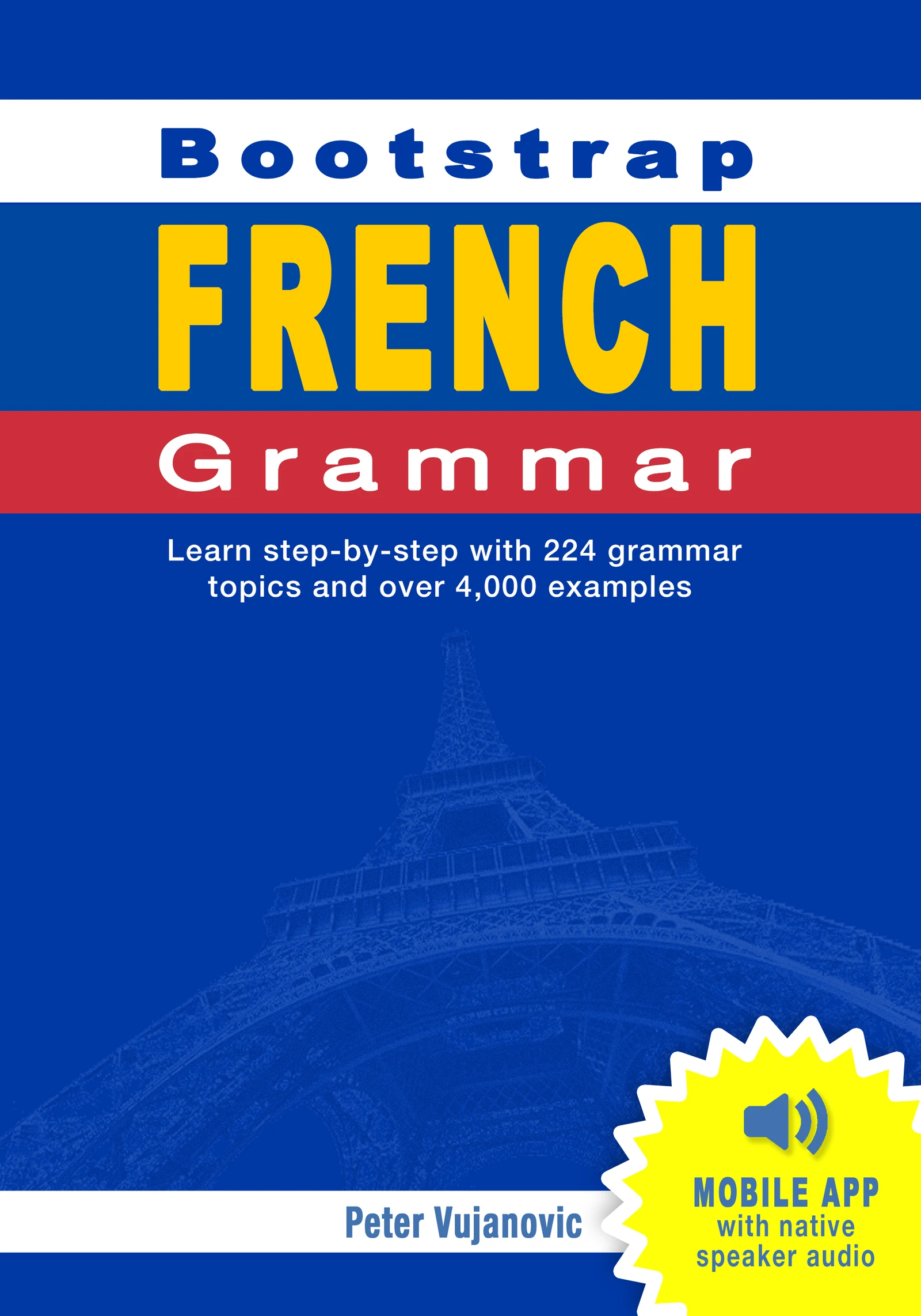
The Bootstrap French Grammar book

French grammar
In your hands

Prefer to study on paper? The companion book brings together all 224 topics and 4,000+ annotated examples. Read the explanation in the book, then use the app to hear the matching phrases and practise the grammar.

550+
pages
224
grammar topics
4,000+
annotated examples
Special introductory offer
Paperback + companion app

Buy the book Get the app free

Already have a copy?

Email us for the offer details

More than a list of rules

Your book, with matching audio

  1. Follow the same clear path

    The book and app follow the same 224-topic sequence. Work from the beginning or turn straight to the grammar point you need.

  2. Understand every example

    French phrases come with English translations and notes on the grammar and new vocabulary. See how each pattern works in context.

  3. Go straight to the audio

    Scan the QR code at the start of a book topic with the companion app. It opens the matching topic, with native-speaker audio for the examples on the page.

Take a look inside

Tap a page to open the preview. Close it to return here.
Peter Vujanovic

The people behind the course

Made for people who want to understand

I’m Peter Vujanovic, CEO and Chief Editor at Declan Software. I brought together French language experts to create the explanations, examples and audio in Bootstrap French Grammar.

Our aim is to make each pattern clear enough to understand, then give you plenty of examples to practise.

Meet the French language contributors
  • Aude Vial, Aurore Baudin and Constance de Crayencour — French and English proofreading and advice on the grammar.
  • Alma Chomel — recordings of the French example phrases.

Get in touch with Peter and the team →

Before you begin

About the app
and the course

What can I try for free?

The first 10 topics are completely free and include explanations, native-speaker audio and exercises. You can use them without creating an account in the app. A one-time purchase unlocks all 224 topics with lifetime access — no subscription.

Is there a subscription?

No. You unlock the full French course with one lifetime purchase, with no monthly fees. Your app store shows the exact price in your currency before you buy.

How is this different from free apps or websites?

Bootstrap French Grammar gives you a structured path through 224 self-contained topics. Each one combines a plain-English explanation, annotated examples, native-speaker audio and exercises. New vocabulary appears in context, and “Why?” feedback helps you understand a mistake instead of guessing the answer again.

Do I need to buy the book?

No. The app is a complete course on its own. Choose the companion paperback if you prefer to study explanations and examples on paper. The book follows the same topic sequence, and its QR codes open the matching topics in the app so you can listen as you read.

Can I start as a beginner?

Yes. The course starts with être (to be), subject pronouns and simple sentences. It then introduces questions, articles, gender and negation before moving on to more complex patterns. English explanations, translations and native-speaker audio support you throughout.

Which French grammar topics does the app cover?

The course covers articles and gender, adjective agreement, verb conjugation, pronouns, negation, passé composé, imparfait, future tenses, conditionals, the subjunctive, reported speech and idioms. Browse the 224-topic syllabus above for the complete sequence.

Can I use it with a class or another app?

Yes. Follow the course in order or revisit a grammar point from your class or another app. Save useful examples in your Study List and use the exercises and audio for focused practice between lessons.

How does spaced repetition work?

Phrases you practise return for review at increasing intervals, helping you revisit earlier grammar as you learn new patterns. Use the review feature for ongoing practice. Spaced repetition and “Why?” explanations are available on both iOS and Android.

Is the French grammar app available on iPhone and Android?

Yes. Bootstrap French Grammar is available for iPhone and iPad on the App Store, and Android on Google Play. Check the relevant listing for current device requirements.

Start with one small step

Make your next French sentence make sense

Try the first 10 topics free. Unlock the full course with one lifetime purchase when you’re ready.

Keep a little French in your inbox

Occasional language-learning tips and resources from Declan Software, including French study material.

Book preview

Take a look inside

Inside the iPhone app

Open full-size image ↗
Interactive lesson

Explore three French examples. Learn the pattern, listen to the audio, and practise choosing the correct word.

Bootstrap French Grammar

Free to download

Your first 10 lessons are free.

Which device do you use?

Scan with your phone’s camera, or use a download button.

One lifetime purchase unlocks all 224 topics.
No subscription.

First 10 topics freeNo subscription.

Try the app ↗