

Japanese grammar app

Japanese grammar
Now it clicks

Finally understand Japanese grammar—one small step at a time. Learn particles, verb forms and sentence patterns with clear explanations, romaji, audio and exercises. For iPhone and iPad.

Download free — try the first 10 topics with full audio & exercises

No account required · Unlock the rest anytime with a one-time purchase

Inside the appSee the rule · Use the rule
Understand the rule in Bootstrap Japanese Grammar
Build a Japanese sentence in Bootstrap Japanese Grammar Explore the exercises

Real iPhone screenshots. Tap either preview to enlarge.

250step-by-step grammar topics
4,094examples with audio
Romajiread with English support
One purchaselifetime course access

Make the connection

Japanese grammar
one small step at a time

250 self-contained topics give you a clear path through Japanese grammar. Start with です (desu), particles and word order, then build through verb forms and tenses to conditionals, passive and causative forms, and respectful and humble language.

01 / UNDERSTAND

Build on what you know

Each topic explains one grammar point in plain English, with examples showing the rule in use. Learn new patterns and useful vocabulary in small, manageable steps.

02 / HEAR

Connect the words and sounds

Explore 4,094 example phrases with pronunciation audio, romaji and English translations. Notes explain the grammar and new vocabulary. Listen again with slower playback when you need it.

03 / PRACTISE

Put each pattern into practice

Arrange word tiles and choose the right words in multiple-choice exercises. Practise Japanese word order and grammatical forms without having to type Japanese characters.

Inside Bootstrap Japanese Grammar

See how the learning happens

Real iPhone screenshots, in learning order. Select a screen to take a closer look.
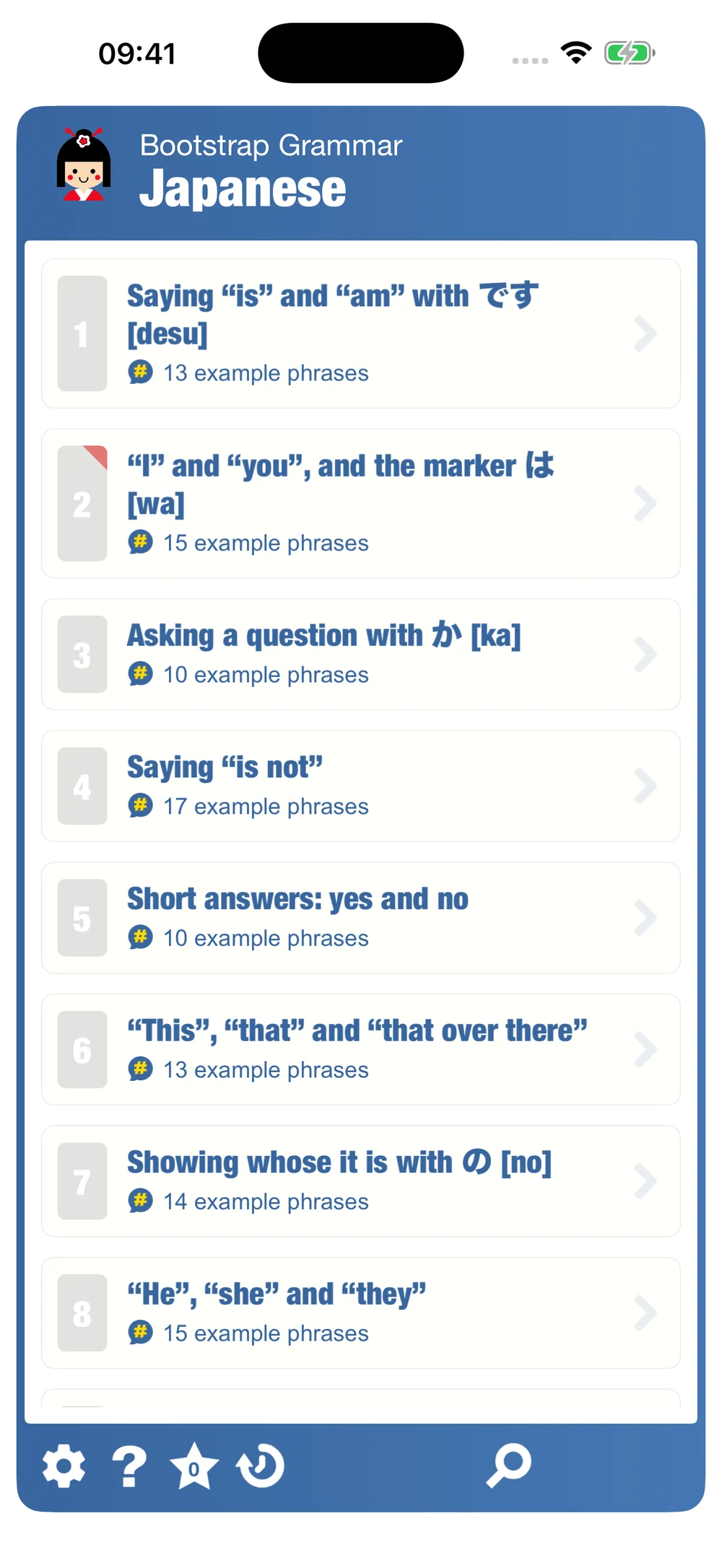
  • Choose your next topic in Bootstrap Japanese Grammar
    01

    Choose your next topic

    Follow a clear path through 250 topics, starting with your first Japanese sentences.
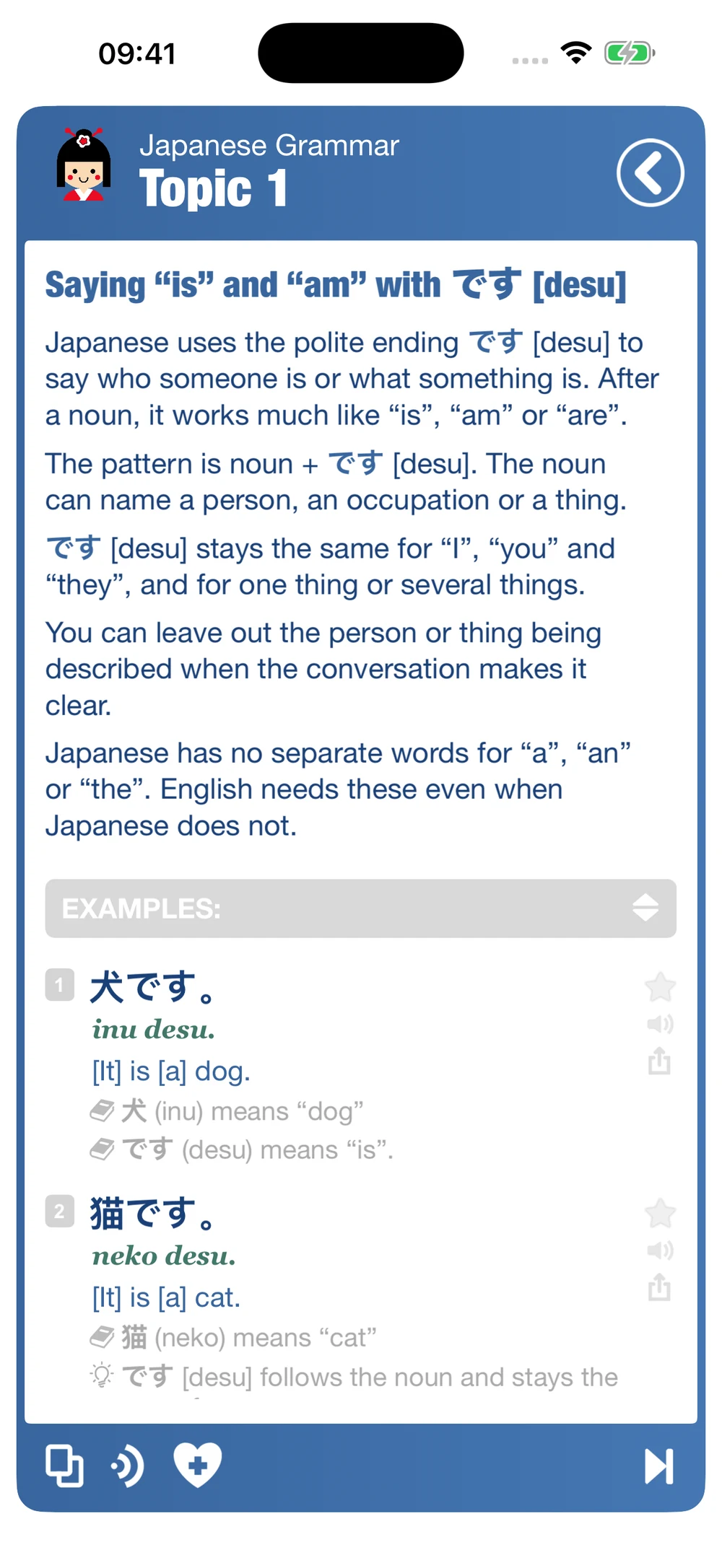
  • Start with the basics in Bootstrap Japanese Grammar
    02

    Start with the basics

    Topic 1 explains です (desu), with short sentences, romaji and English translations.
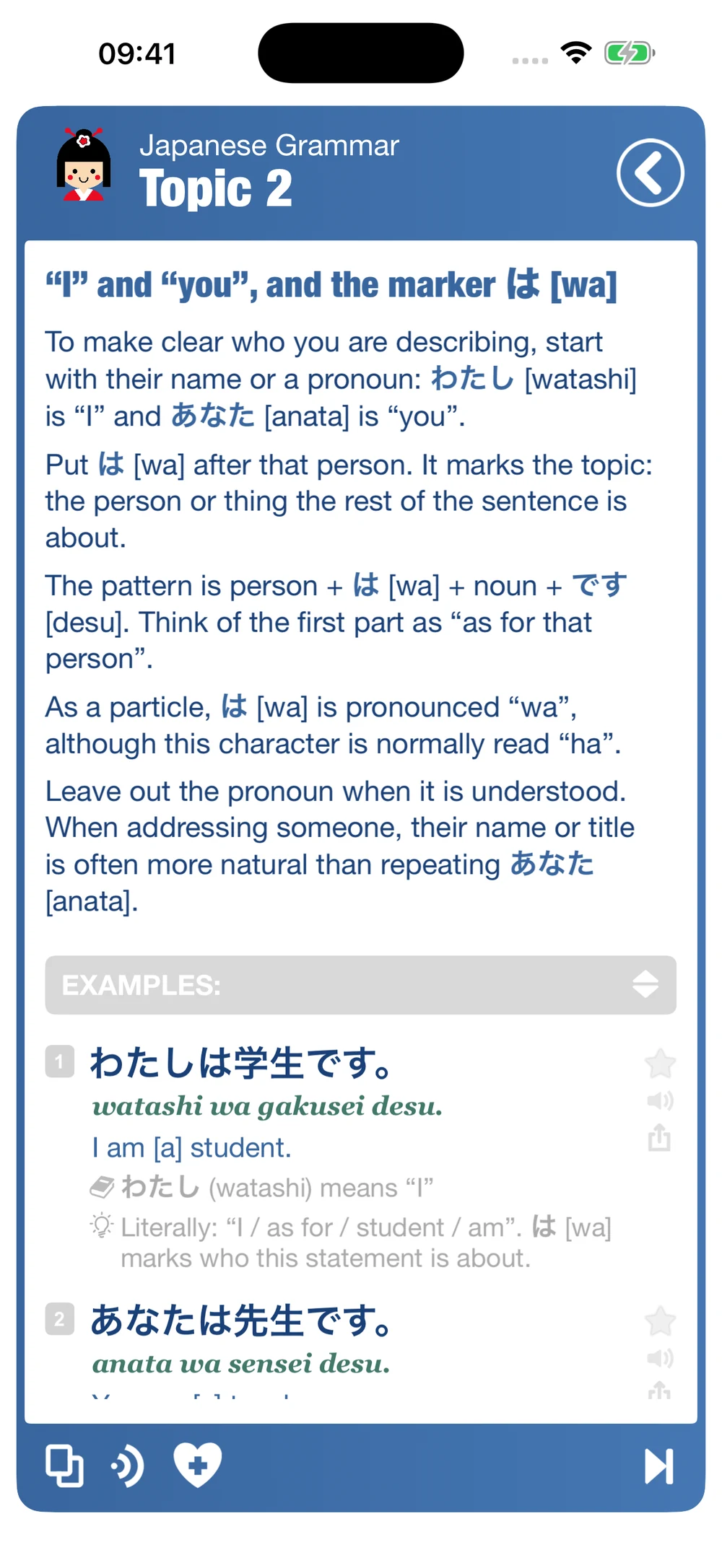
  • Understand the rule in Bootstrap Japanese Grammar
    03

    Understand the rule

    Topic 2 introduces “I”, “you” and は (wa), showing how the topic marker fits into a sentence.
  • Read with support in Bootstrap Japanese Grammar
    04

    Read with support

    See Japanese, romaji and English together, with notes explaining the grammar and new words.
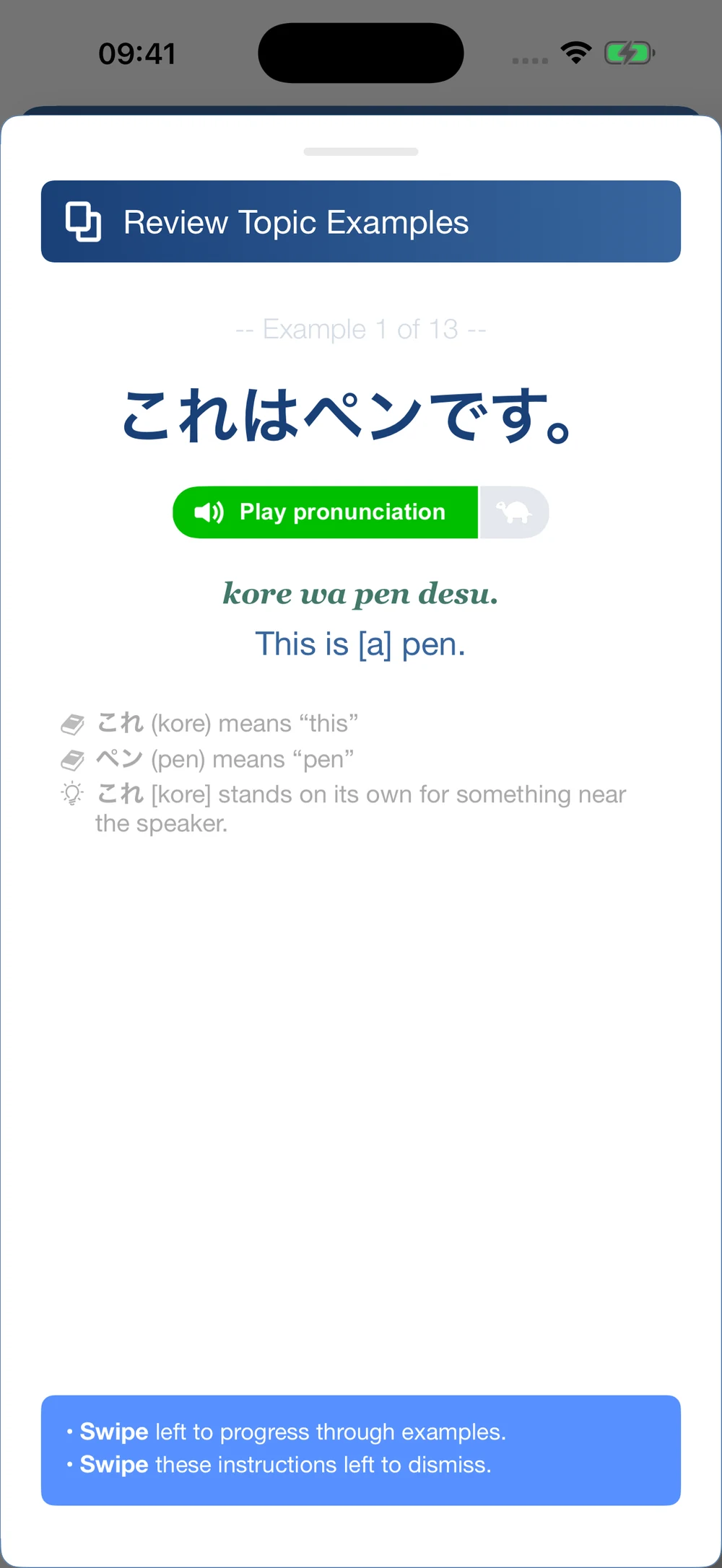
  • Hear every example in Bootstrap Japanese Grammar
    05

    Hear every example

    Play the example, read its meaning and connect the written Japanese with its sound.
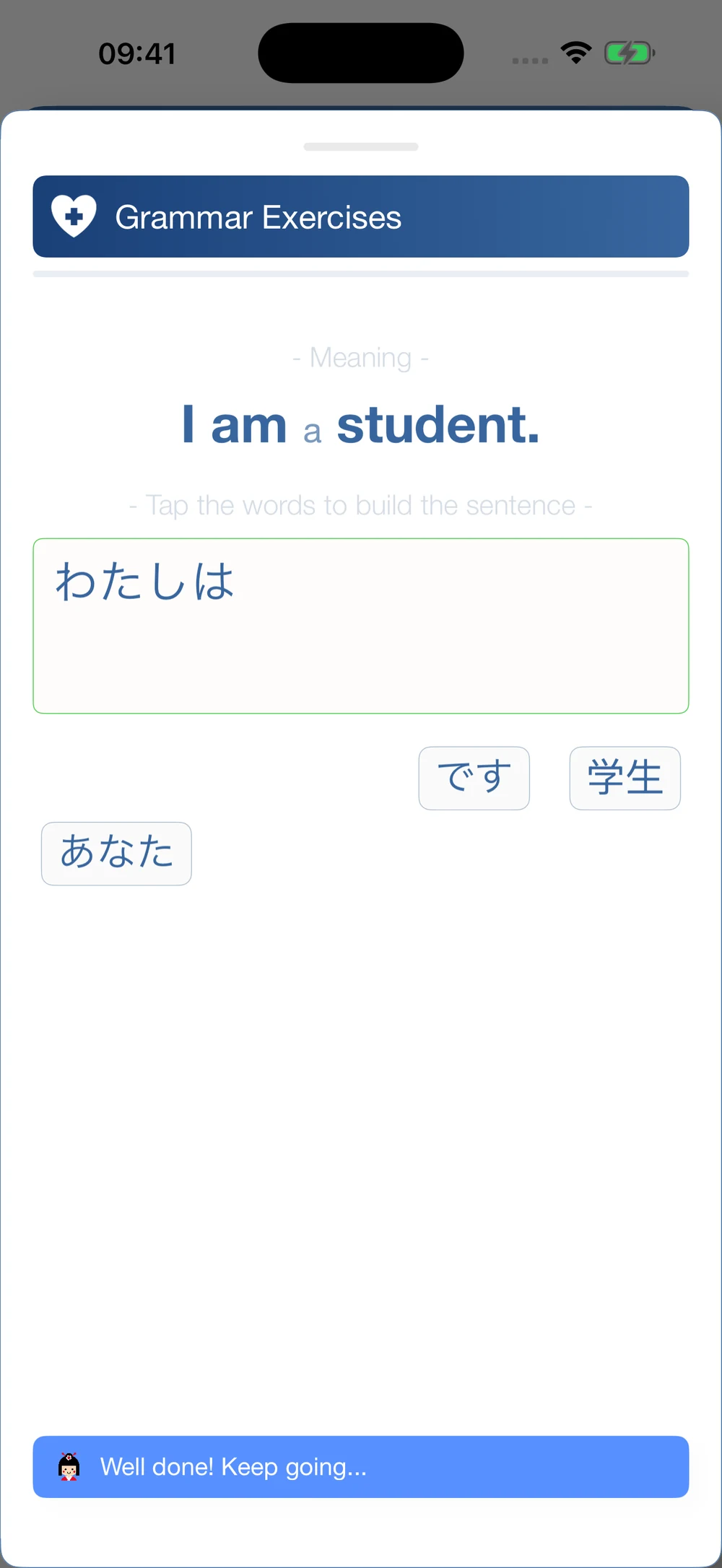
  • Build a Japanese sentence in Bootstrap Japanese Grammar
    06

    Build a Japanese sentence

    Arrange word tiles to practise word order and grammatical patterns without typing Japanese.
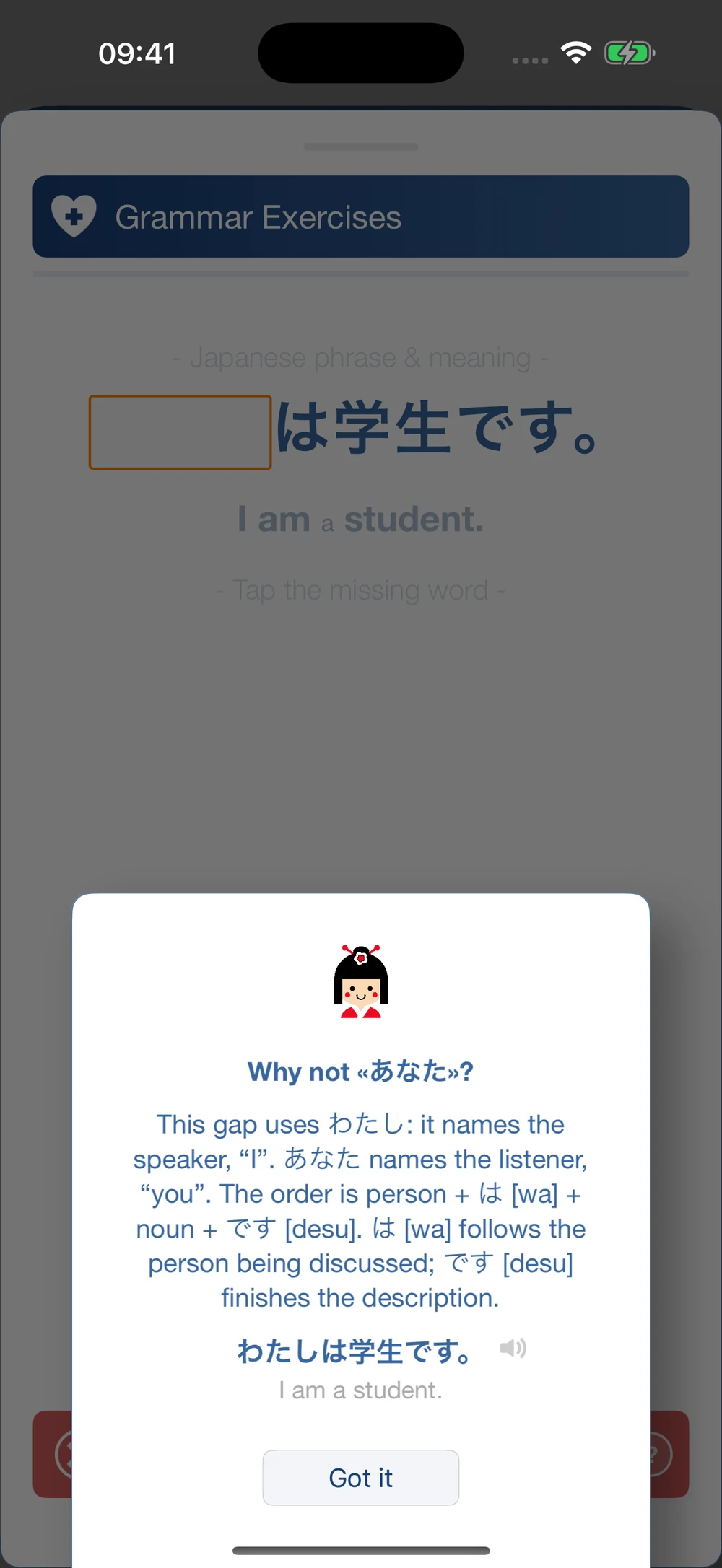
  • Understand why in Bootstrap Japanese Grammar
    07

    Understand why

    Grammar-focused feedback explains why a choice does not fit and shows the corrected sentence.
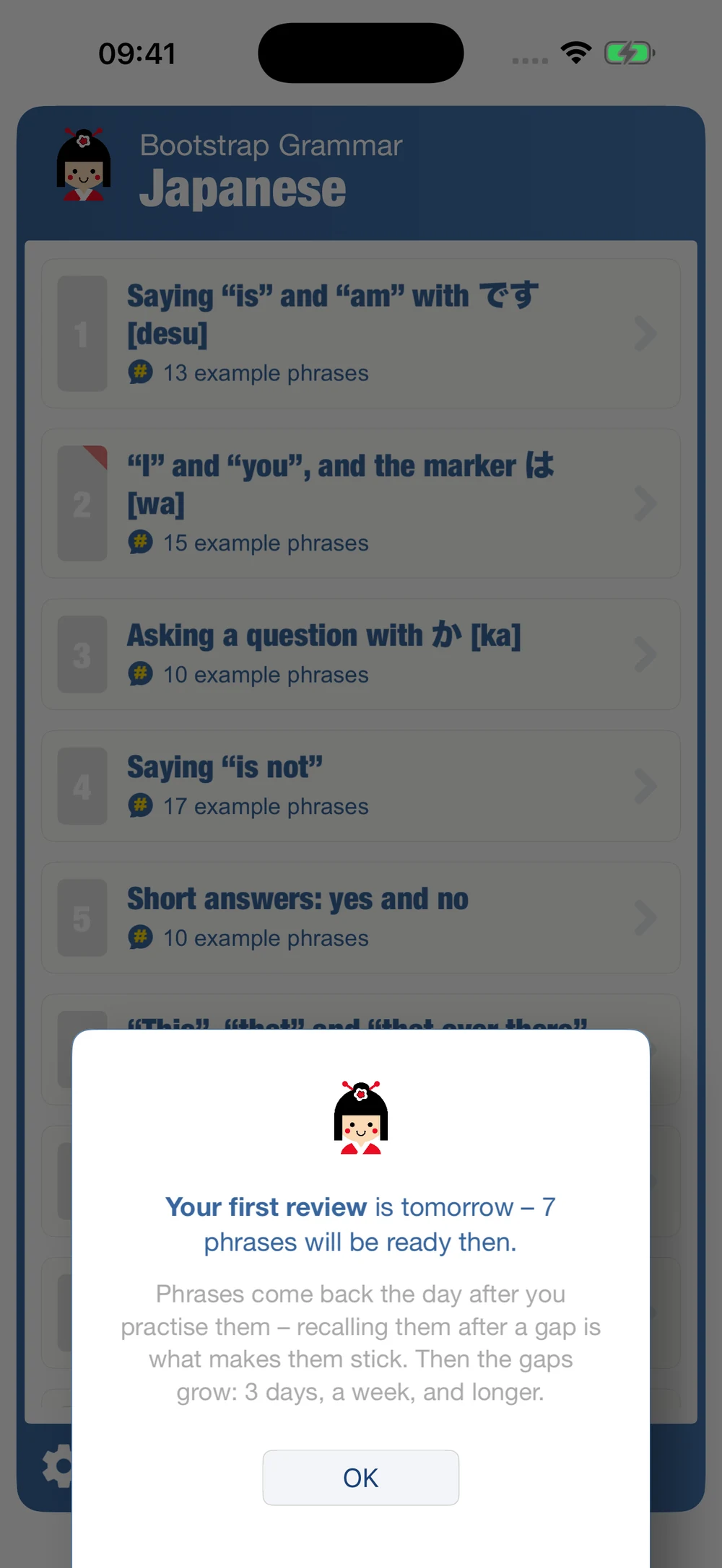
  • Keep it fresh in Bootstrap Japanese Grammar
    08

    Keep it fresh

    Phrases you practise return for spaced repetition, helping you revisit earlier learning.

Understand your mistakes

Grammar-focused “Why?” explanations help you understand a choice that does not fit. See the corrected sentence and the rule behind the answer.

Keep earlier grammar fresh

Use spaced repetition to revisit phrases at increasing intervals. Keep practising earlier patterns as you work through new topics.

Your own Study List

Star examples you want to keep and gather them in your personal Study List. Focus your review on useful phrases and the grammar you want to practise again.

Start with 10 complete topics

Start free
Keep going when you’re ready

No subscription
Compare free Japanese grammar topics with the full course
What’s includedFreeGet startedFull courseLifetime access
Grammar topicsFirst 10 topicsFirst sentences, particles, questions and word orderAll 250 topicsThrough verb forms, conditionals, passive and causative patterns, honorifics and idioms
Examples & audioExamples, audio, romaji and English for the first 10 topics4,094 example phrasesWith audio, romaji and English translations
Exercises & reviewFor the first 10 topicsFor the full course
PaymentFree to downloadNo account requiredOne lifetime purchaseUnlock topics 11–250. No recurring fees.

Your path through Japanese grammar

Particles, verb forms
and the patterns that connect them

Start with 10 free topics, explore key patterns or search all 250 topics. Follow the course in order, or revisit a point from your class or reading.

250 topics to explore

1–10First 10 topics FreeFirst sentences, particles, questions and word order
  1. Saying “is” and “am” with です [desu]
  2. “I” and “you”, and the marker は [wa]
  3. Asking a question with か [ka]
  4. Saying “is not”
  5. Short answers: yes and no
  6. “This”, “that” and “that over there”
  7. Showing whose it is with の [no]
  8. “He”, “she” and “they”
  9. Verbs typically come last
  10. “There is” and “[I] have”

Key topics

Select a pattern to find it in the course

Show all 250 topicsHide the full topic list
11–38Places, descriptions and polite verbsLocation, adjectives, verb groups and useful particles
  1. Saying where something is: に [ni]
  2. “There isn't” and “[I] don't have”
  3. Saying what is in a place and where something is
  4. This and that
  5. Describing things with い [i]-adjectives
  6. Using い [i]-adjectives for weather and feelings
  7. Making い [i]-adjectives negative
  8. Forming negative descriptions with くない [ku nai]
  9. Negative descriptions of people and things
  10. “Good” and “not good”
  11. Polite verbs: the る [ru]-verb group
  12. Changing more る [ru]-verbs to the polite form
  13. Put the object before the verb: を [o]
  14. Polite verbs: the う [u]-verb group
  15. More polite forms of う [u]-verbs
  16. Two irregular verbs: する [suru] and 来る [kuru]
  17. Asking “what?”: なん [nan] and なに [nani]
  18. Choosing は [wa] or が [ga]
  19. Using polite う [u]-verbs in sentences
  20. Asking “where?”: どこ [doko]
  21. “Here”, “there” and “over there”
  22. “Who?”, “when?”, “how?” and “which?”
  23. “On”, “under”, “inside”, “in front” and “behind”
  24. Where you do something: で [de]
  25. Joining things with “and”: と [to]
  26. “Also” and “too”: も [mo]
  27. Describing things with な [na]-adjectives
  28. Making な [na]-adjectives negative
39–64Time, past forms and everyday meaningNegatives, past tense, numbers, preferences and invitations
  1. “[I] don't eat”: the ending ません [masen]
  2. “[I] ate”: the ending ました [mashita]
  3. “[I] didn't eat”: ませんでした [masen deshita]
  4. Contrasting things with は [wa]
  5. “[It] was” and “[it] wasn't”
  6. “[It] was cold”: past い [i]-adjectives
  7. “[It] wasn't cold”: past negative adjectives
  8. Doing something “with” someone: と [to]
  9. Saying what you use: で [de]
  10. Using で [de] to say how you travel
  11. Going “to” a place: へ [e]
  12. Contrasting places with には [ni wa] and では [de wa]
  13. “From” and “to”: から [kara] and まで [made]
  14. Numbers from one to ten
  15. Telling the time
  16. Minutes, half past and “what time?”
  17. Days of the week
  18. “Around five”: approximate times with ごろ [goro]
  19. “Often”, “sometimes” and “always”
  20. Expressing likes and dislikes
  21. Describing what someone is good or bad at
  22. Talking about your family and someone else's
  23. Saying what you want: 欲しい [hoshii]
  24. Saying what you want to do: たい [tai]
  25. Making suggestions and invitations
  26. Going somewhere to do something
65–90The te-form and casual languageLink actions, make requests and explore plain forms
  1. Linking actions: the て [te]-form
  2. The て [te]-form: endings that become って [tte]
  3. The て [te]-form: endings that become んで [nde]
  4. The て [te]-form: く [ku], ぐ [gu], す [su] and irregular verbs
  5. “Please do this”: てください [te kudasai]
  6. “After doing this, [I] will do that”: てから [te kara]
  7. “[I] am doing it now”: ています [te imasu]
  8. “[I] was doing it”: ていました [te imashita]
  9. Describing a continuing state with ています [te imasu]
  10. “May [I]?”: てもいいですか [te mo ii desu ka]
  11. “[You] mustn't”: てはいけません [te wa ikemasen]
  12. “[I] will try it”: てみます [te mimasu]
  13. Getting ready in advance: ておきます [te okimasu]
  14. Expressing completion or regret with てしまいます [te shimaimasu]
  15. Using plain verb forms in casual sentences
  16. Plain negatives: ない [nai]
  17. Plain past forms: “[I] ate”
  18. Plain past negatives: “[I] didn't eat”
  19. Starting an action with 始める [hajimeru]
  20. Continuing an action with 続ける [tsuzukeru]
  21. Finishing an action with 終わる [owaru]
  22. An action starting suddenly: 出す [dasu]
  23. “Already” and “not yet”
  24. “Still” and “no longer”
  25. Plain descriptions with だ [da]
  26. Asking a question in casual conversation
91–121Reasons, experience and abilityReported speech, time clauses, giving, receiving and obligations
  1. Giving a reason: “because”
  2. Saying “but”: けど [kedo]
  3. Expressing an opinion with と思います [to omoimasu]
  4. Reporting what someone says with と [to]
  5. Talking about your plans: つもりです [tsumori desu]
  6. Before something happens: 前に [mae ni]
  7. After something happens: 後で [ato de]
  8. “By Friday”: deadlines with までに [made ni]
  9. Saying “when”: とき [toki]
  10. Throughout a period: 間 [aida]
  11. An event within a period: 間に [aida ni]
  12. Doing something before the chance passes: うちに [uchi ni]
  13. “The book [I] bought”: describing a noun
  14. Describing nouns with present, past and negative verbs
  15. Choosing the verb tense before とき [toki]
  16. Talking about an activity with こと [koto]
  17. “[I] can do it”: ことができます [koto ga dekimasu]
  18. Forming “can” with る [ru]-verbs: られる [rareru]
  19. The “can” form for う [u]-verbs
  20. “Have [you] ever?”: talking about experience
  21. “[I] do things like...”: たり [tari]
  22. Giving with あげる [ageru] and くれる [kureru]
  23. Receiving a gift: もらいます [moraimasu]
  24. “[They] did it for me”: てくれます [te kuremasu]
  25. “[I] will do it for them”: てあげる [te ageru]
  26. “[I] had [someone] help me”: てもらいます [te moraimasu]
  27. “[I] have to”: なければなりません [nakereba narimasen]
  28. A shorter “have to”: なきゃ [nakya]
  29. “[You] don't have to”: なくてもいいです [nakute mo ii desu]
  30. “Please don't”: ないでください [nai de kudasai]
  31. A casual “Don't do that”
122–150Comparisons and connectionsConditionals, explanations, linking descriptions and sentence endings
  1. Comparing two things: より [yori]
  2. “This one is better”: のほうが [no hou ga]
  3. “The best” or “the most”: 一番 [ichiban]
  4. “[It] is getting warmer”: なります [narimasu]
  5. “If” and “when”: たら [tara]
  6. “When [you] do this, [that] happens”: と [to]
  7. The route you take: を [o]
  8. “[You] should”: ほうがいいです [hou ga ii desu]
  9. “[It] looks delicious”: そうです [sou desu]
  10. “[It] looks like [it] will happen”: verb + そう [sou]
  11. “[I] hear that...”: そうです [sou desu]
  12. Giving and asking for explanations: んです [n desu]
  13. Casual explanations: んだ [n da] and の [no]
  14. Introducing a request with んですけど [n desu kedo]
  15. “In order to”: ために [tame ni]
  16. “Big and bright”: joining descriptions
  17. “Quiet and convenient”: linking with で [de]
  18. Using adjectives to describe how an action is done
  19. Doing two things at once: ながら [nagara]
  20. Leaving things as they are: まま [mama]
  21. “The small one” and “mine”: の [no]
  22. “Things like A and B”: や [ya] and など [nado]
  23. Casual lists with とか [toka]
  24. A friendly suggestion: たらどう [tara dou]
  25. “Someone”, “something” and “somewhere”
  26. “Nobody”, “nothing” and “nowhere”
  27. “Anyone”, “anything” and “anywhere”
  28. Sentence endings: ね [ne], よ [yo] and よね [yo ne]
  29. Expressing “[I] wonder” with かな [kana]
151–180Numbers, reasons and changing situationsCounters, dates, embedded questions, reasons and changes
  1. Larger numbers and prices
  2. Counting objects with つ [tsu] and 個 [ko]
  3. Counting people and small animals
  4. Counting flat and long objects: 枚 [mai] and 本 [hon]
  5. “Two each” and “a little at a time”: ずつ [zutsu]
  6. Counting books and vehicles
  7. Saying how long and how often an action happens
  8. “About this much”: くらい [kurai]
  9. Months and dates
  10. Saying how old someone is
  11. “First”, “second” and “next”
  12. “[I] know where [it] is”: a question inside a sentence
  13. “About this subject”: について [ni tsuite]
  14. “Whether or not”: かどうか [ka dou ka]
  15. Another “because”: ので [node]
  16. “Even though”: のに [noni]
  17. “For one thing...”: listing reasons with し [shi]
  18. Talking about an action with の [no]
  19. Giving a negative reason with なくて [nakute]
  20. Saying what is visible or audible: 見える [mieru] and 聞こえる [kikoeru]
  21. Verbs with and without an object: transitive and intransitive verbs
  22. “[It] has been put there ready”: てある [te aru]
  23. Movement with て行く [te iku] and て来る [te kuru]
  24. Change over time with てくる [te kuru] and ていく [te iku]
  25. Changing something or making a choice with する [suru]
  26. “As a teacher”: roles with として [to shite]
  27. “[I] have decided to”: ことにする [koto ni suru]
  28. “[It] has been decided”: ことになる [koto ni naru]
  29. “[I] make a point of”: ようにする [you ni suru]
  30. Changes in ability and habits: ようになる [you ni naru]
181–208More possibilities and polite languageConditionals, intentions, commands, passive, causative and honorific forms
  1. “So that [I] can”: ように [you ni]
  2. “If [that] is the case”: なら [nara]
  3. Another way to say “if”: ば [ba]
  4. “If [it] is cheap”: adjective and noun conditions
  5. “What should [I] do?”: ばいい [ba ii]
  6. “[I] should have...”: ばよかった [ba yokatta]
  7. “Even if”: ても [te mo]
  8. Choosing between と [to], たら [tara], なら [nara] and ば [ba]
  9. A casual “Let's”: the volitional form
  10. Expressing intentions with the volitional form
  11. What someone thinks: と思っている [to omotte iru]
  12. Describing an attempt: volitional form + とする [to suru]
  13. “[I] want [you] to”: てほしい [te hoshii]
  14. Passing on an instruction: ように言う [you ni iu]
  15. Asking someone to do something for you
  16. Forming direct commands
  17. Firm instructions with な [na] and なさい [nasai]
  18. “[I] was praised”: the passive of る [ru]-verbs
  19. The passive of う [u]-verbs
  20. Irregular passive forms and unwelcome events
  21. Making or letting someone act: る [ru]-verbs
  22. Making or letting someone act: う [u]-verbs and irregular verbs
  23. Asking for and receiving permission with causative forms
  24. Being made to do something: the causative-passive form
  25. Respectful verbs for other people's actions
  26. Humble verbs for your own actions
  27. Respectful patterns with お [o] and ご [go]
  28. Making a more respectful request
209–235Nuance and everyday expressionQuoting, probability, limits, comparisons and stages of an action
  1. Common contractions in casual speech
  2. A casual way to quote: って [tte]
  3. “[It] is called...”: という [to iu]
  4. “Maybe”: かもしれません [kamoshiremasen]
  5. “Probably”: でしょう [deshou] and だろう [darou]
  6. “[It] should be...”: はずです [hazu desu]
  7. “[You] ought to”: べき [beki]
  8. “Only” and “just”: だけ [dake]
  9. “Only this much”: しか [shika]
  10. “All [you] do is...”: ばかり [bakari]
  11. “Too much”: すぎる [sugiru]
  12. Comparing degrees with ほど [hodo]
  13. Turning adjectives into nouns with さ [sa]
  14. “[It] looks like...”: よう [you] and みたい [mitai]
  15. “Apparently” and “just like”: らしい [rashii]
  16. Describing qualities with っぽい [ppoi]
  17. “How to do it”: 方 [kata]
  18. “According to” and “depending on”
  19. “Easy to” and “hard to”: やすい [yasui] and にくい [nikui]
  20. “Without doing”: ないで [nai de] and ずに [zu ni]
  21. Drawing conclusions with わけ [wake]
  22. “[I] can't just do that”: わけにはいかない [wake ni wa ikanai]
  23. “Suppose that...”: としたら [to shitara]
  24. “[I] have just done it”: たばかり [ta bakari]
  25. Describing the stage of an action with ところ [tokoro]
  26. “Just as [I] did it...”: とたん [totan]
  27. Leaving an action or state unchanged: っぱなし [ppanashi]
236–250Advanced patterns and idiomsFormal language, finer distinctions and 20 everyday idioms
  1. Formal written endings and ways to link actions
  2. “Even” and “not even”: さえ [sae]
  3. Combining two purposes with がてら [gatera]
  4. Describing other people's feelings and wishes with がる [garu]
  5. “[I] have no choice but to”: ざるを得ない [zaru o enai]
  6. A formal “[We] can't”: かねます [kanemasu]
  7. “[It] tends to happen”: がち [gachi]
  8. A change under way: つつある [tsutsu aru]
  9. Expressing a firm intention not to act: まい [mai]
  10. “Full of”: だらけ [darake], まみれ [mamire] and ずくめ [zukume]
  11. One event immediately after another: が早いか [ga hayai ka] and や否や [ya inaya]
  12. Repeated events that undo an action: そばから [soba kara]
  13. Contrasting expectations with the result: と思いきや [to omoikiya]
  14. An unwelcome result after much effort: あげく [ageku]
  15. 20 everyday Japanese idioms

A few useful answers

About the app
and the course

What can I try for free?

The first 10 topics include full explanations, audio, romaji, English translations and exercises. No account is required. One purchase unlocks the remaining 240 topics for lifetime access.

Is there a subscription?

No. A single in-app purchase unlocks the full 250-topic course. Your App Store shows the current price in your currency.

Can I start as a beginner?

Yes. Start with です (desu), simple sentences, particles and word order. The course builds up in small steps, with English explanations, romaji and audio to support you.

Do I need to know hiragana, katakana and kanji?

Examples include romaji and English translations, so you can follow the grammar while becoming familiar with Japanese writing. Learning hiragana and katakana alongside the course will help you rely less on romaji. ReadWrite Japanese Kana teaches those two scripts with stroke guides, listening and practice.

Do I have to type Japanese for the exercises?

No. The Japanese exercises use word tiles and multiple choice. Practise word order and grammatical forms without typing Japanese characters.

Which Japanese grammar topics does the app cover?

The 250 topics cover particles, word order, adjectives, polite and plain verb forms, tenses, the te-form, requests, comparisons, conditionals, passive and causative forms, respectful and humble language, advanced patterns and 20 everyday idioms. Explore the full topic list above.

How do the “Why?” explanations work?

Grammar-focused explanations help you understand why a selected answer does not fit the current topic. They show the correct sentence and the relevant pattern; they are not intended to explain every unrelated vocabulary mistake.

How does spaced repetition work?

Phrases you practise return for review at increasing intervals. Revisit earlier material as you progress through the course, and save useful examples in your personal Study List.

Can I use it with another app or a class?

Yes. Follow the course in sequence or use it to revisit grammar from your lessons. Declan Words can help you build Japanese vocabulary, while Phrases provides everyday expressions to listen to.

Which devices can I use?

Bootstrap Japanese Grammar is for iPhone and iPad. Use the App Store link on this page for current device and operating-system requirements.

Your next small step

Make Japanese
start to make sense

Download free and explore the first 10 topics.
One purchase unlocks the rest. No subscription.

Inside the iPhone app

Bootstrap Japanese Grammar

Free to download

Try the explanations, audio, romaji and exercises. One lifetime purchase unlocks all 250 topics. No subscription. No account required.

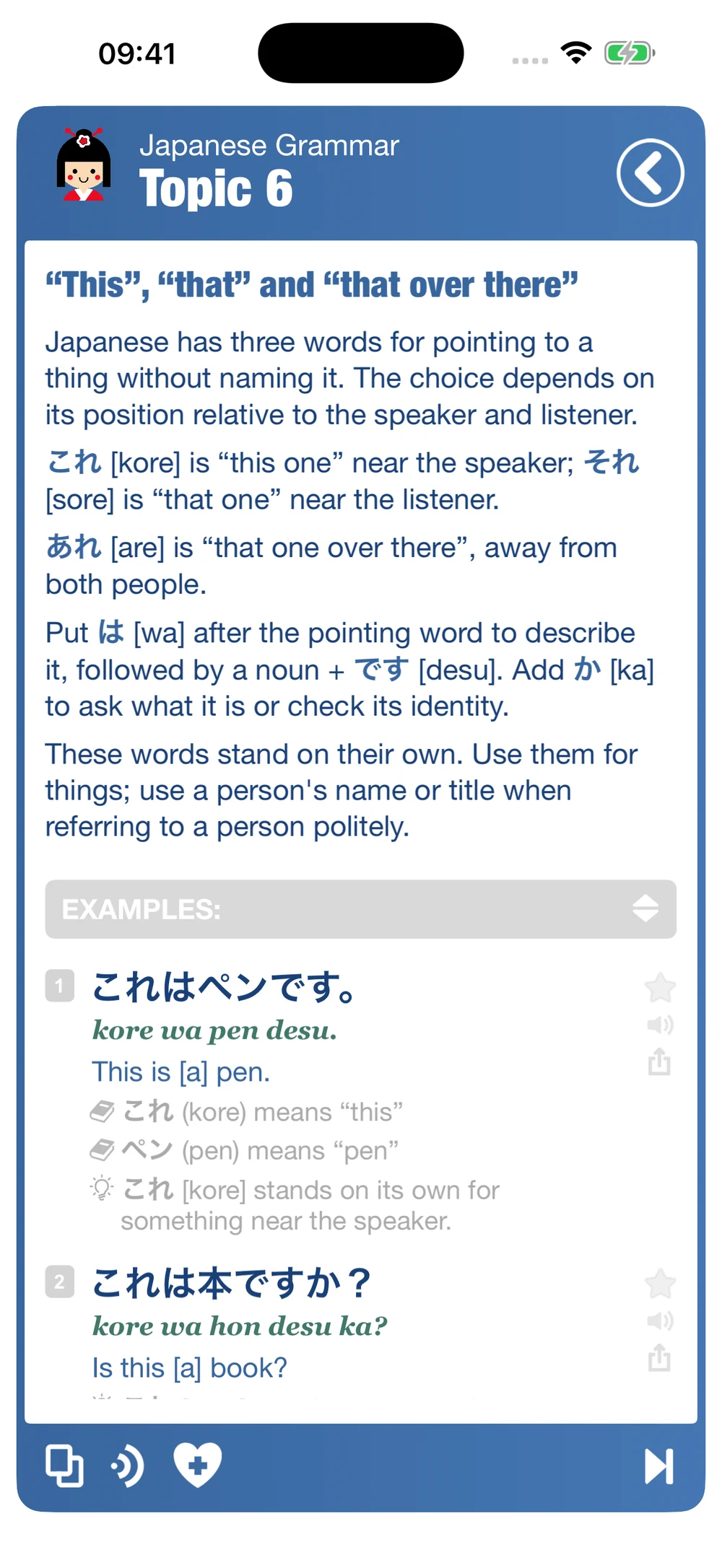
Interactive lesson · Topic 6

This, that
or that over there?