

Chinese grammar app

Chinese grammar
Now it clicks

Finally understand Mandarin grammar—one small step at a time. Connect sentence patterns, pinyin and native-speaker audio, then train your ear with Listening & Tones. For iPhone, iPad and Android.

Download free — try the first 10 topics with full audio & exercises

No account required · Unlock the rest anytime with a one-time purchase

Inside the appSee the rule · Use the rule
Chinese Topic 11 explaining 有 and 没有, with the example 我有一本书
Chinese grammar exercise asking for the missing 有 in 我有一本书 Explore the exercises

Real iPhone screenshots. Tap either preview to enlarge.

204step-by-step grammar topics
2,800+examples with audio
Listening & Tonestrain your ear in context
One purchaselifetime course access
Try it hereExample 1 / 3

Your first Chinese sentence

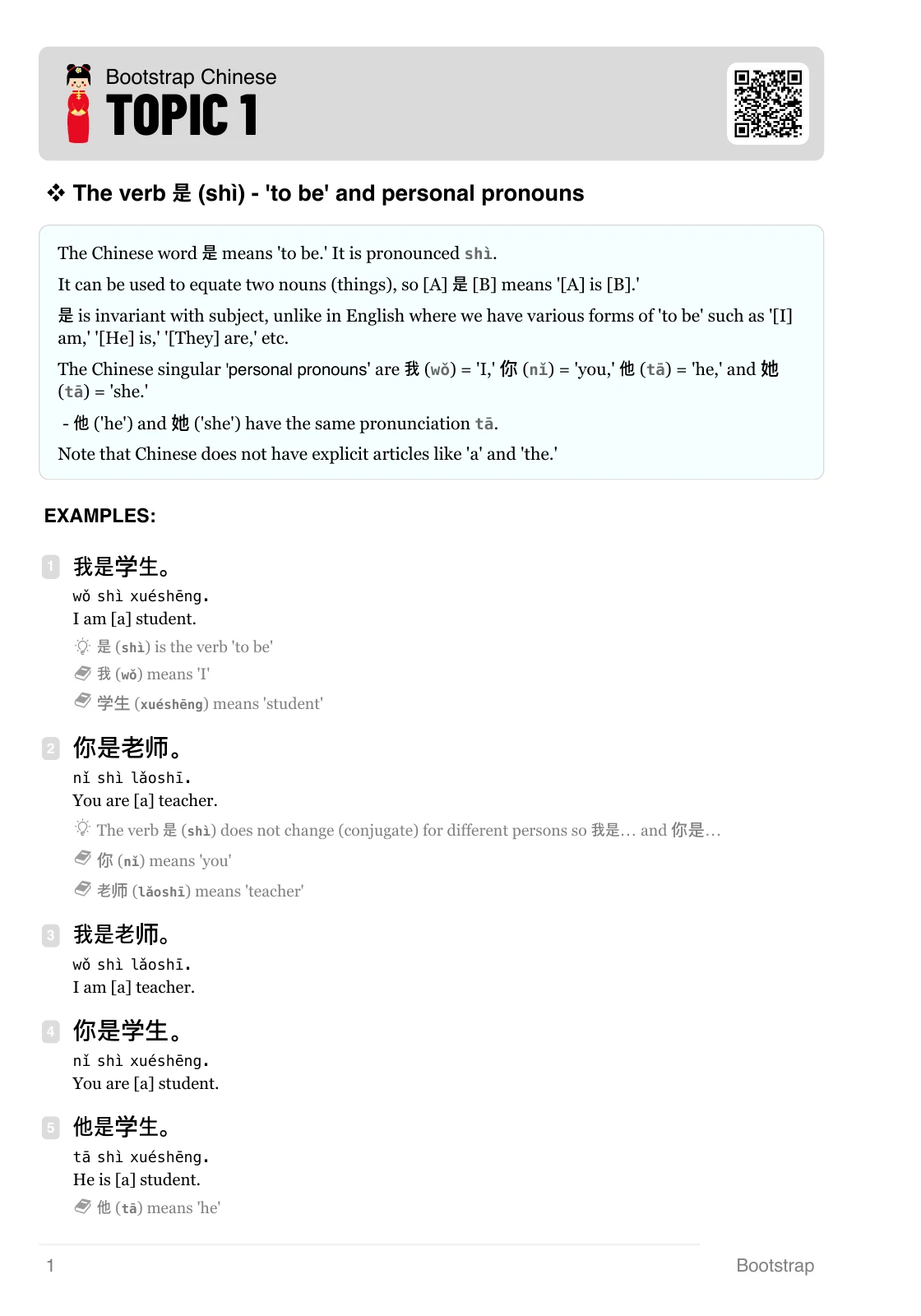
Topic 1 · The verb 是 (shì)

我是学生。

wǒ shì xuésheng

I am a student.

我 + 是 + 学生

我是学生 uses 是 (shì) to connect 我 (I) with 学生 (student). The pattern is person + 是 + noun.

Understand the pattern

A website lesson using real course examples. See the app ↗

Make the connection

Chinese grammar
one small step at a time

204 self-contained topics give you a clear path through the grammar. Start with your first Mandarin sentences, then build through word order, particles and aspect to comparisons, complements and idioms.

01 / UNDERSTAND

Build on what you know

Each topic explains one grammar point in plain English, then builds on what came before. Add new patterns in small, manageable steps and learn at your own pace.

02 / HEAR

Learn vocabulary in context

Explore 2,800+ annotated examples, each with native-speaker audio and an English translation. Notes explain how the grammar works and what new words mean, so your vocabulary grows alongside it.

03 / PRACTISE

Put each pattern into practice

Use interactive exercises to practise the Chinese grammar you have just learned. Choose the right form, build sentences and connect the explanation to an answer you can produce yourself.

Inside Bootstrap Chinese Grammar

See how the learning happens

Chinese app previews. Select a screen to take a closer look.
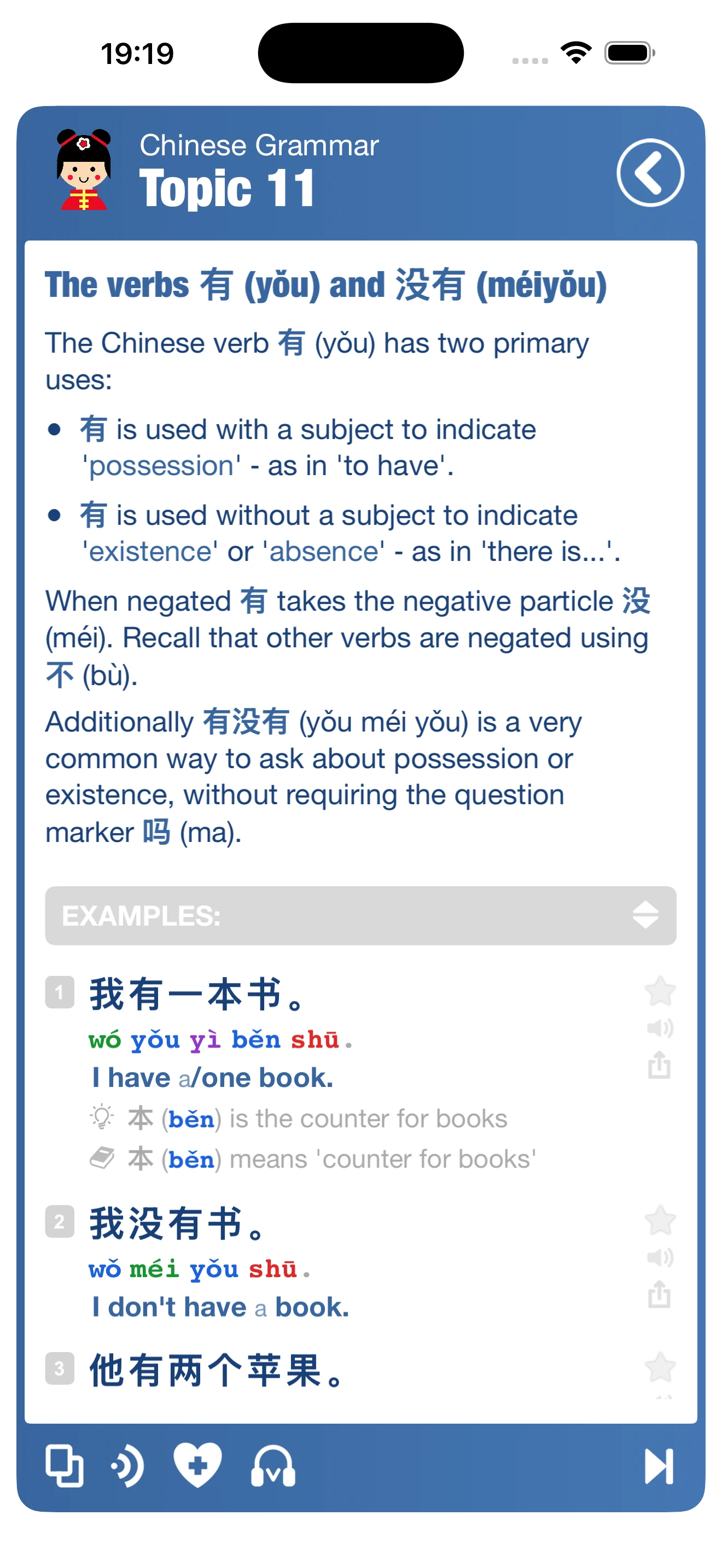
  • Chinese Topic 11 explaining 有 and 没有, with the example 我有一本书
    01

    Understand the rule

    Topic 11 explains 有 and 没有, with Chinese examples, pinyin, translations and grammar notes.
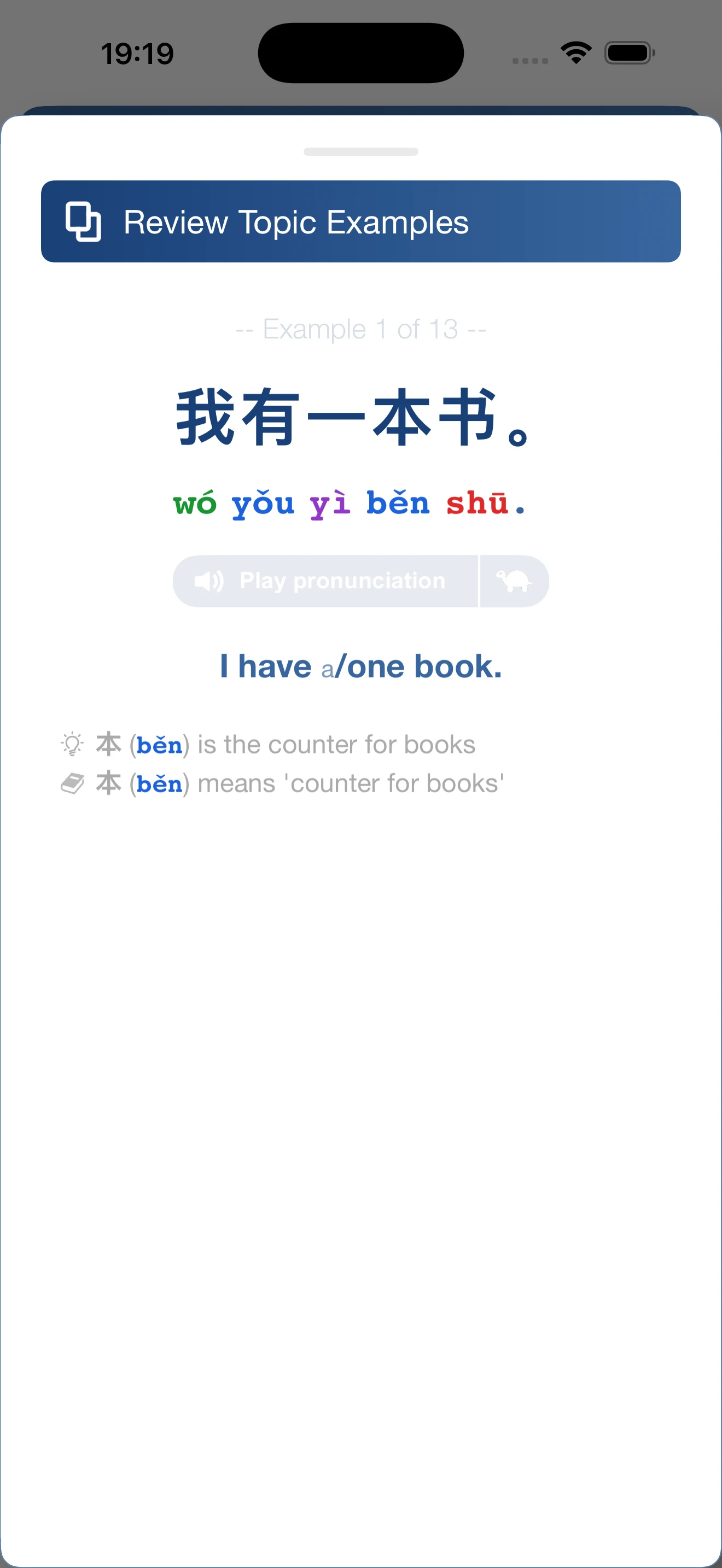
  • Chinese topic review with 我有一本书, pinyin, translation and notes
    02

    Review each example

    Hear the phrase, read its pinyin and check the translation and notes at your own pace.
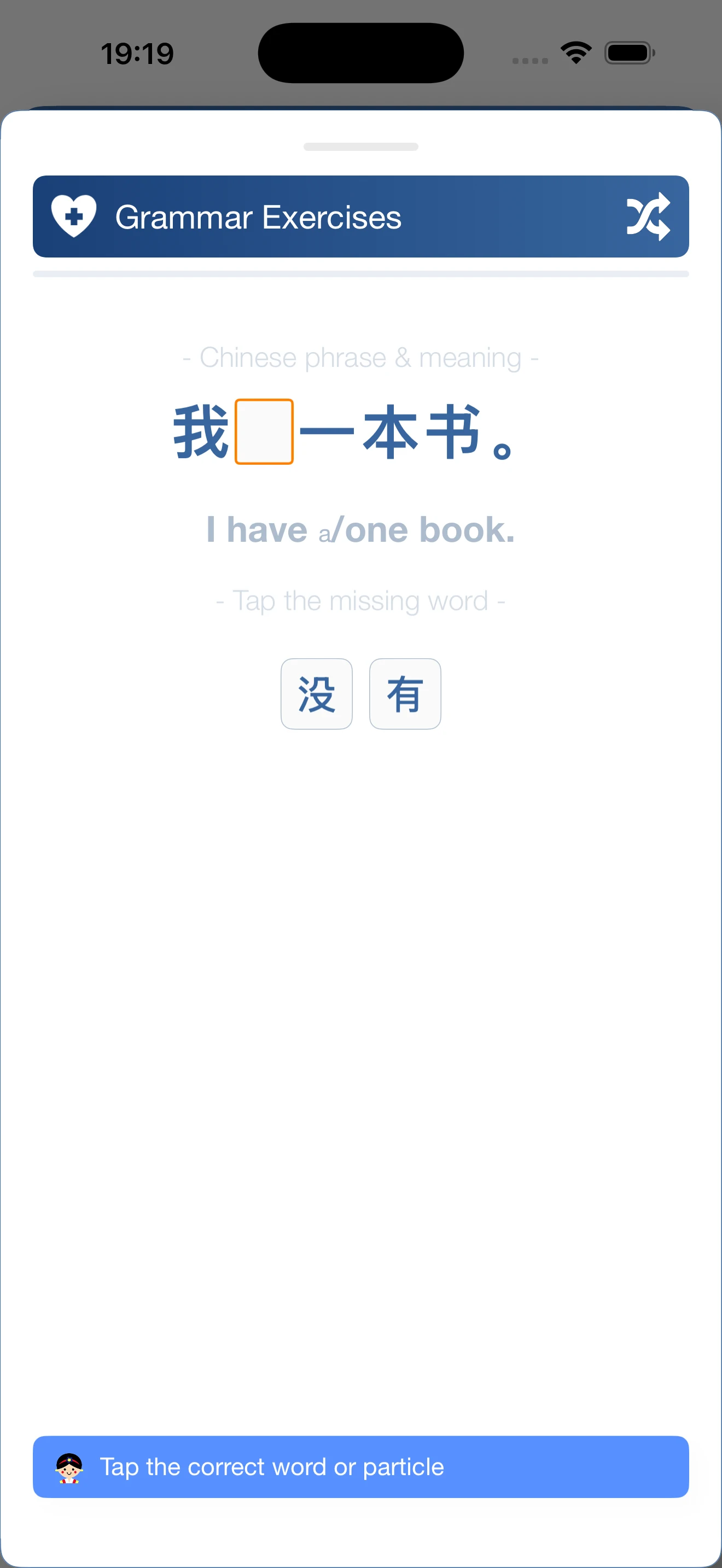
  • Chinese grammar exercise asking for the missing 有 in 我有一本书
    03

    Choose the missing word

    Complete a Chinese sentence by choosing the word that matches its meaning.
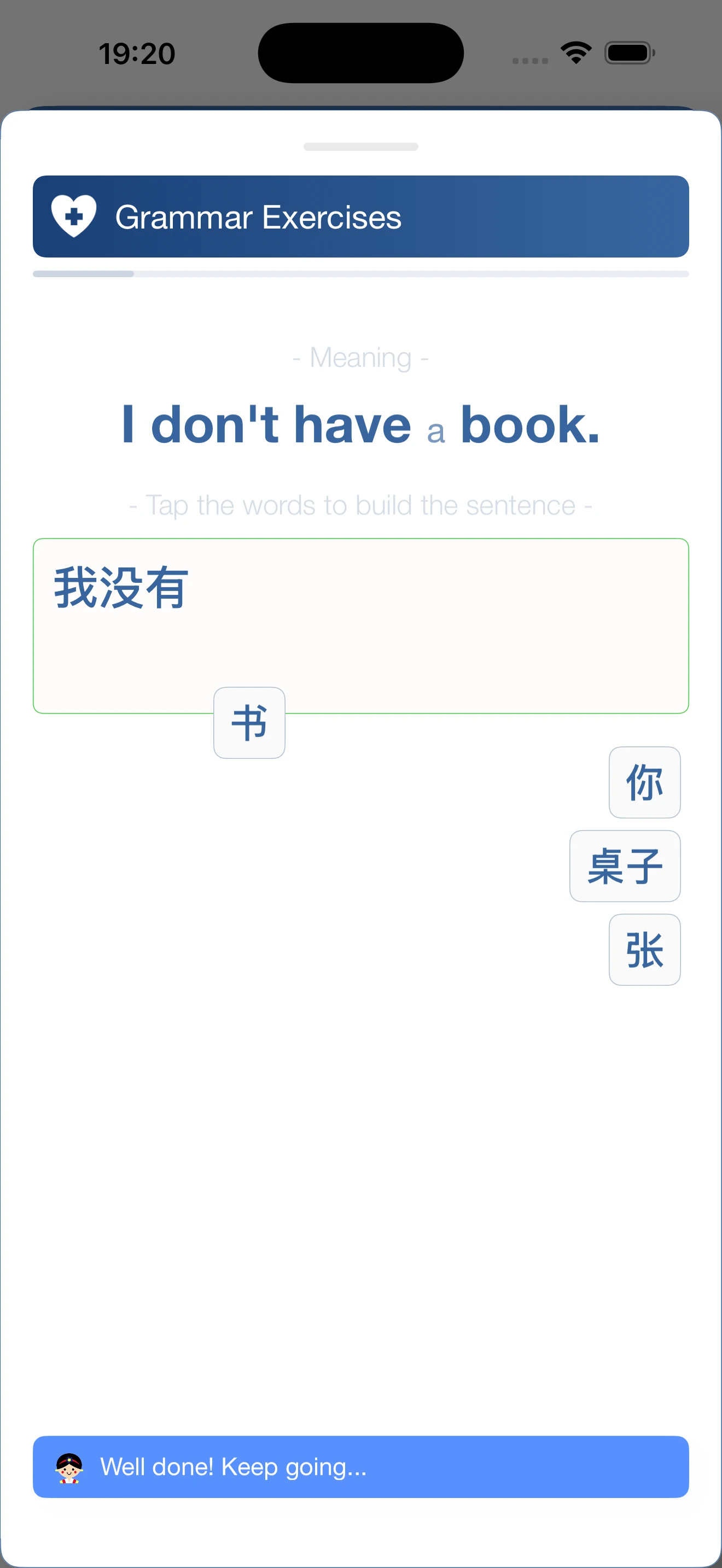
  • Chinese sentence-building exercise for I do not have a book
    04

    Build a Chinese sentence

    Tap the words in order to turn an English meaning into a Chinese sentence.
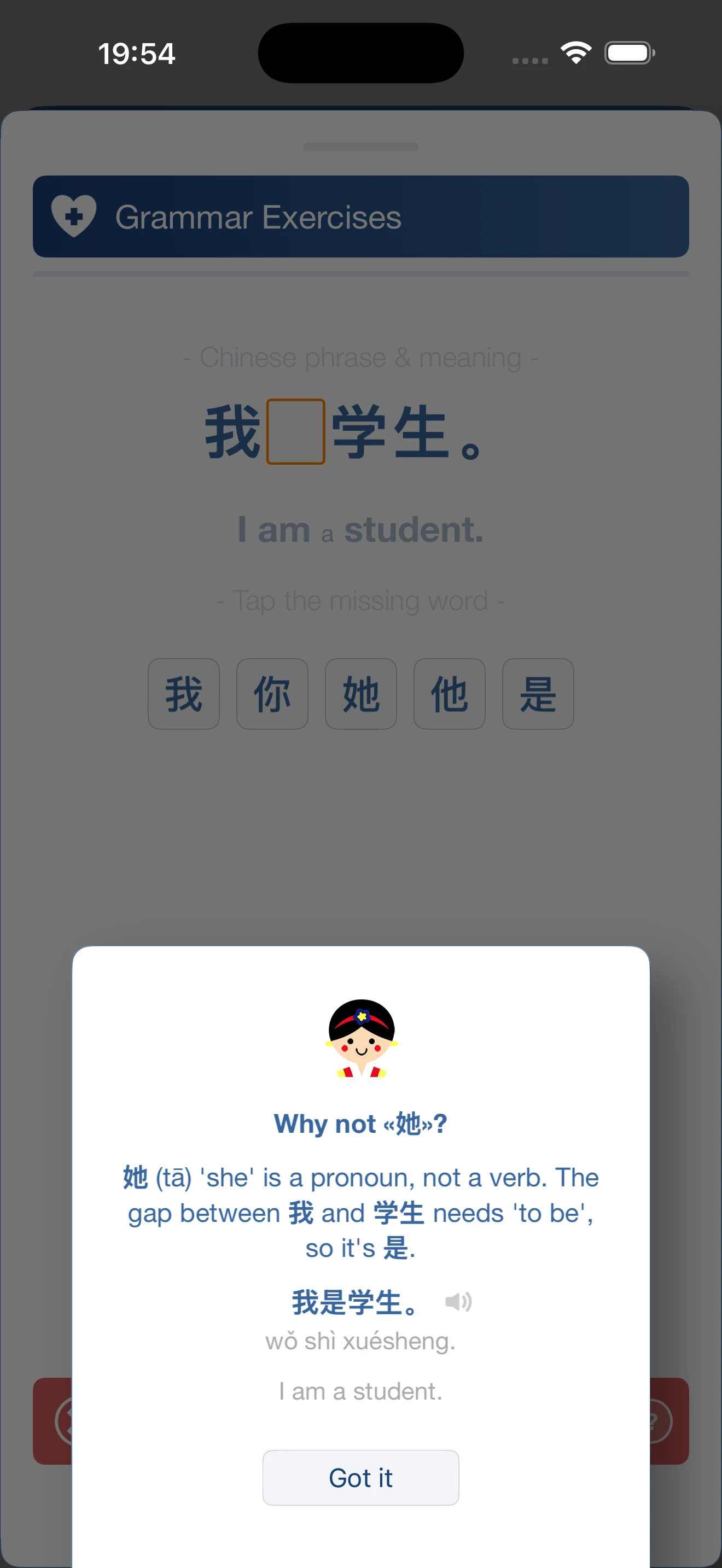
  • Why feedback explains why 是, not 她, completes 我是学生
    05

    Understand why

    The “Why?” explanation identifies the mistake, explains the rule and shows the corrected sentence.
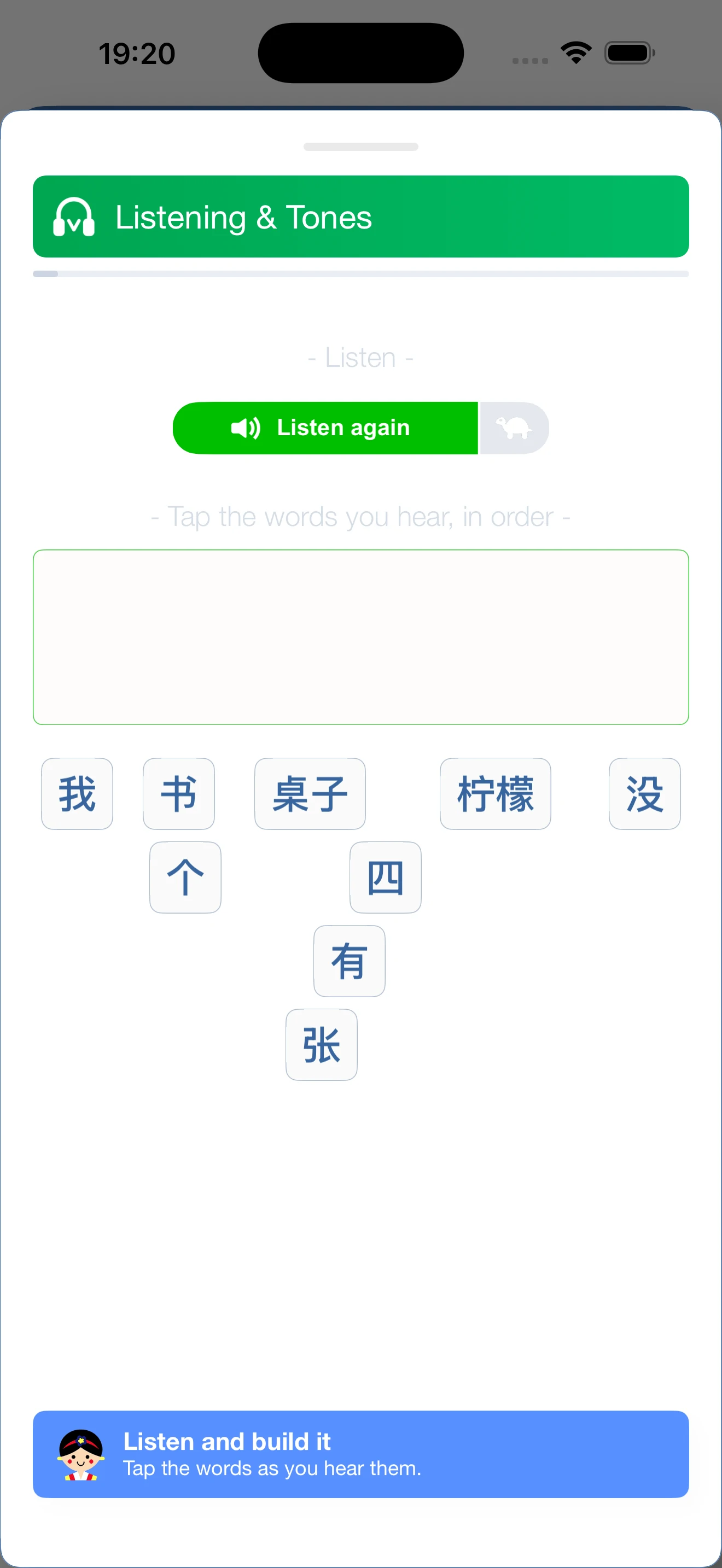
  • Listening and Tones exercise with Listen again, slow playback and Chinese word tiles
    06

    Build what you hear

    Listen to the native audio, then tap the words in the order you hear them. Replay the phrase or slow it down.
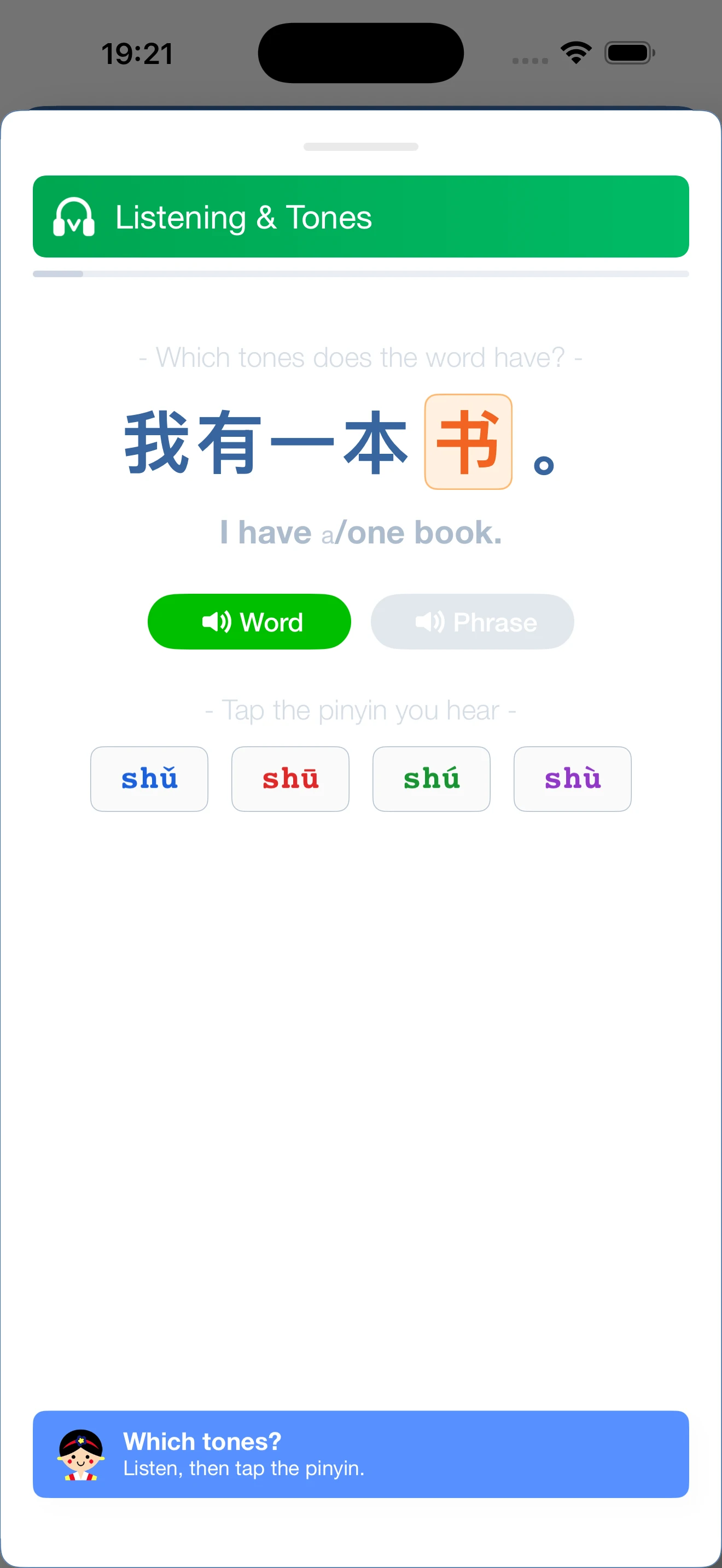
  • Listening and Tones exercise highlighting 书 and offering shū, shú, shǔ and shù
    07

    Hear the difference in tones

    Listen to a word and choose the matching pinyin. Hear it on its own, then listen again in the full phrase.
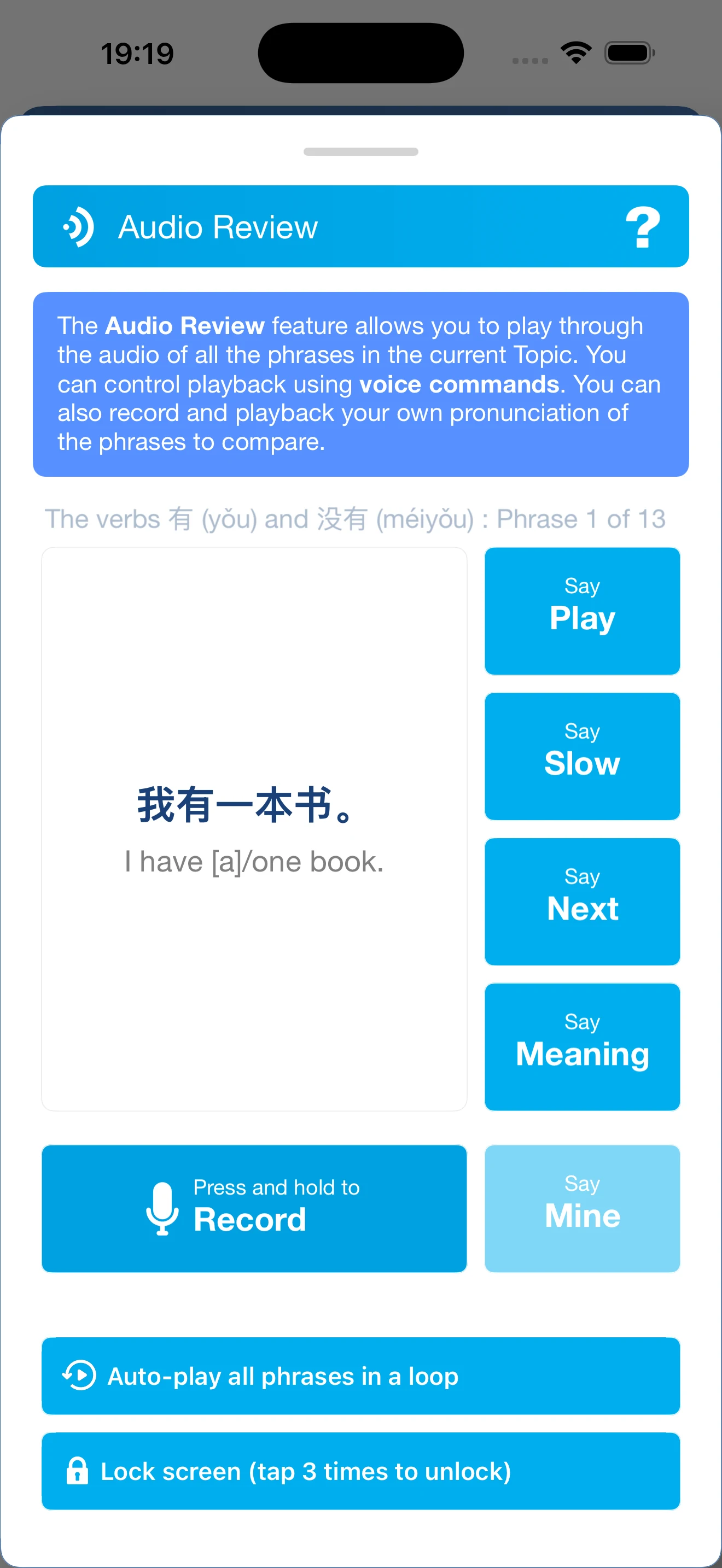
  • Chinese Audio Review with Play, Slow, Next, Meaning and Record controls
    08

    Listen and say it

    Play a phrase, slow it down or record your pronunciation to compare. Voice commands control the audio review.

Understand your mistakes

Make a mistake with the topic’s grammar? A short “Why?” explanation shows the correct answer and the rule behind it, so you know what to change next time.

Keep earlier grammar fresh

Use spaced repetition to revisit phrases at increasing intervals. Keep practising earlier patterns as you work through new topics.

Your own Study List

Star examples you want to keep and gather them in your personal Study List. Focus your review on useful phrases and the grammar you want to practise again.

Listening & Tones

Train your ear
One phrase at a time

Connect the grammar on the page with the Mandarin you hear. Practise listening and tones using the course’s own examples, on iOS and Android.

Listening and Tones exercise with Listen again, slow playback and Chinese word tilesTake a closer look ↗
01 / LISTEN

Listen, then build the sentence

Start with the sound. Tap the words in the order you hear them, with replay and slow playback when you need another listen.

Listening and Tones exercise highlighting 书 and offering shū, shú, shǔ and shùTake a closer look ↗
02 / TONES

Pick the tones you hear

Focus on one word inside a real sentence. Choose between pinyin spellings that differ only in tone, then compare the word with the full phrase.

Native-speaker audio · Replay and slow playback · Practice in context

Try the first 10 topics free ↗

From a Chinese learner

In our learners’ own words

I will achieve my goal

“Since I have bought this app I enjoy using it everyday. The given examples enhance my ability to understand Mandarin better.”

Polyglot10

Free vs Full

Start free Keep going when you’re ready

Try the first 10 topics, then unlock the complete Chinese grammar course in the same app.

No subscription
Compare the free Chinese grammar lessons with the full course.
What’s includedFreeGet startedFull courseLifetime access
Grammar topicsFirst 10 topicsFirst sentences, questions, pronouns, numbers & measure words.All 204 topicsWord order, particles, aspect, comparisons & more, including the first 10 topics.
Examples & audioExamples and audio for the first 10 topics.2,800+ examplesWith native-speaker audio throughout the course.
ExercisesPractise the first 10 topics.Practise every topic in the course.
Listening & TonesPractise with examples from the first 10 topics.Listening and tone practice across the course.
PaymentFree to downloadThe first 10 topics are free.One-time purchaseUnlock the full course in the app. No recurring payments.

Your path through Chinese grammar

Chinese word order, particles and more

Start with 10 free topics, explore key patterns or search the full 204-topic course. The book and app follow the same sequence.

204 topics to explore

Topics 1–10First 10 topics Free“To be”, negation, questions, pronouns, numbers and measure words
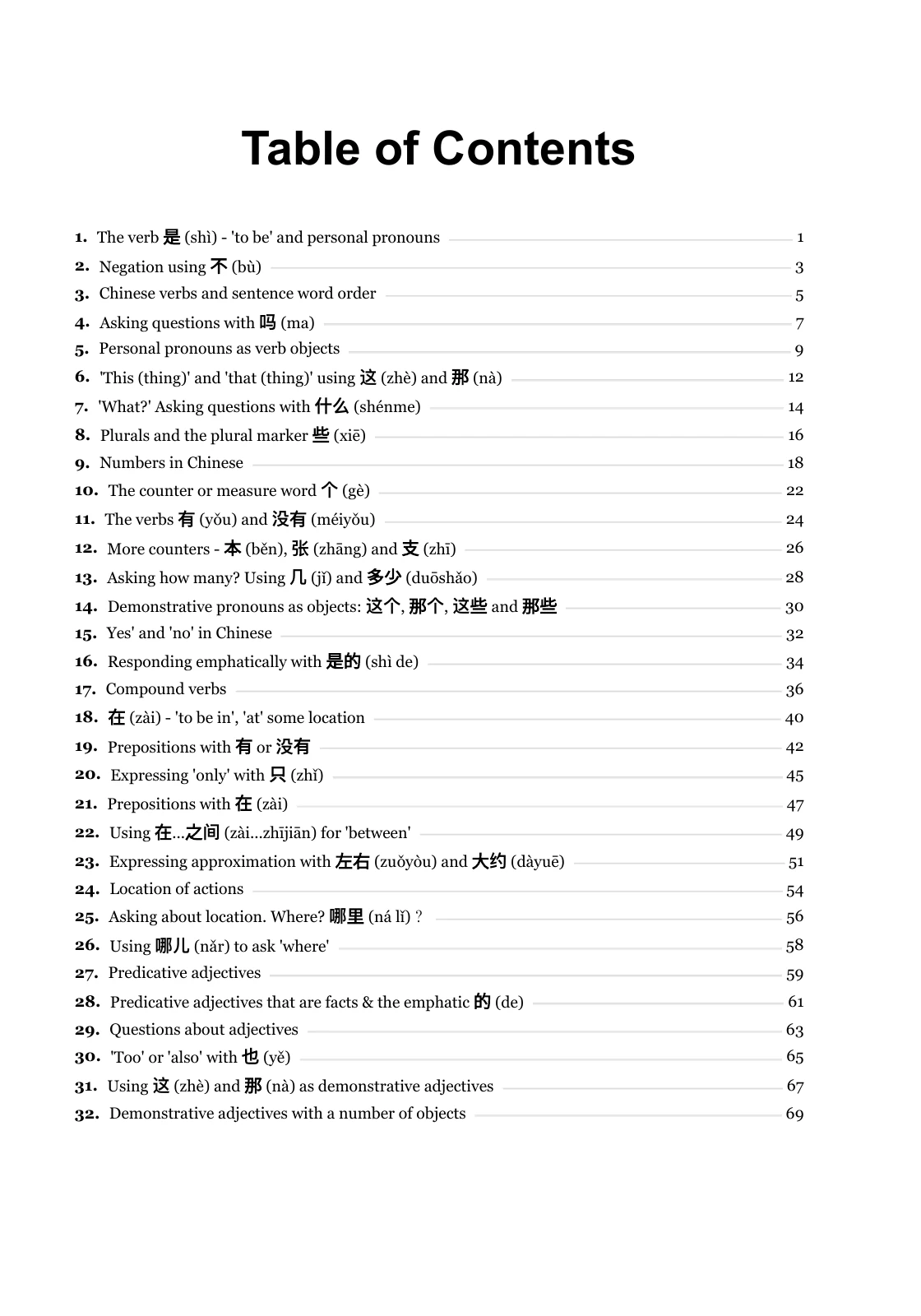
  1. The verb 是 (shì) - 'to be' and personal pronouns
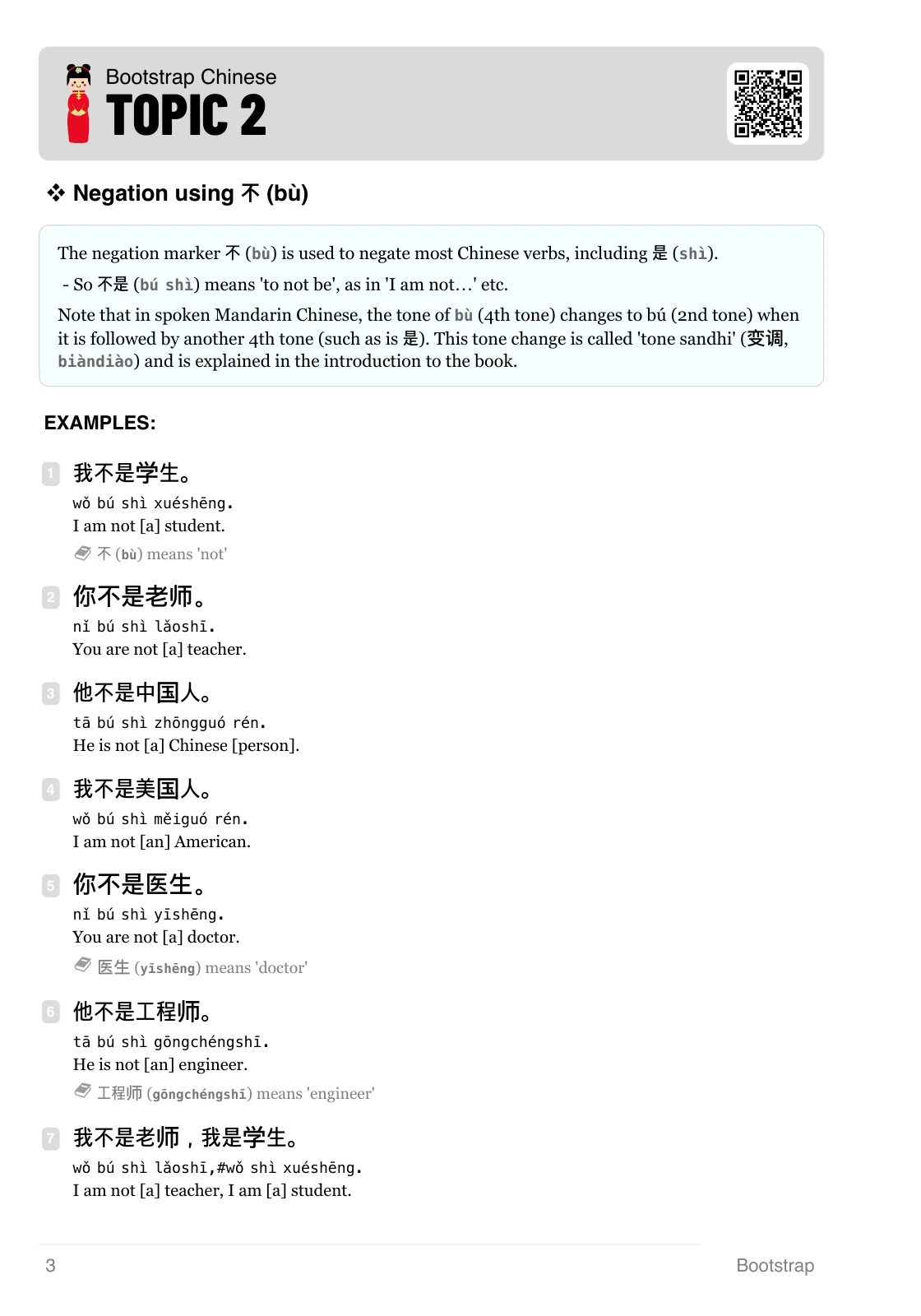
  2. Negation using 不 (bù)
  3. Chinese verbs and sentence word order
  4. Asking questions with 吗 (ma)
  5. Personal pronouns as verb objects
  6. 'This (thing)' and 'that (thing)' using 这 (zhè) and 那 (nà)
  7. 'What?' Asking questions with 什么 (shénme)
  8. Plurals and the plural marker 些 (xiē)
  9. Numbers in Chinese
  10. The counter or measure word 个 (gè)

Key topics

Select a pattern to find it in the course

Show all 204 topicsHide the full topic list
Topics 11–26Everyday sentences and placesHaving, counting, prepositions, locations and approximation
  1. The verbs 有 (yǒu) and 没有 (méiyǒu)
  2. More counters - 本 (běn), 张 (zhāng) and 支 (zhī)
  3. Asking how many? Using 几 (jǐ) and 多少 (duōshǎo)
  4. Demonstrative pronouns as objects: 这个, 那个, 这些 and 那些
  5. Yes' and 'no' in Chinese
  6. Responding emphatically with 是的 (shì de)
  7. Compound verbs
  8. 在 (zài) - 'to be in', 'at' some location
  9. Prepositions with 有 or 没有
  10. Expressing 'only' with 只 (zhǐ)
  11. Prepositions with 在 (zài)
  12. Using 在...之间 (zài...zhījiān) for 'between'
  13. Expressing approximation with 左右 (zuǒyòu) and 大约 (dàyuē)
  14. Location of actions
  15. Asking about location. Where? 哪里 (ná lǐ)?
  16. Using 哪儿 (nǎr) to ask 'where'
Topics 27–48Descriptions, wants and possessionAdjectives, pronouns, abilities, likes and 的
  1. Predicative adjectives
  2. Predicative adjectives that are facts & the emphatic 的 (de)
  3. Questions about adjectives
  4. 'Too' or 'also' with 也 (yě)
  5. Using 这 (zhè) and 那 (nà) as demonstrative adjectives
  6. Demonstrative adjectives with a number of objects
  7. Demonstrative adjectives with uncountable objects
  8. Stand-Alone Demonstrative pronouns - 'this one' or 'these ones'
  9. Asking about degree with 有多 (yǒu duō)
  10. Saying 'not very' using 不太 (bú tài)
  11. Reciprocal Questions with the particle 呢 (ne)
  12. To want - 要 (yào)
  13. Would like to - 想 (xiǎng)
  14. Plural pronouns with 们 (men) - we, you (plural) and they
  15. 'All' with 都 (dōu) and 所有的 (suǒyǒu de)
  16. Emphasizing quantity with 很多 (hěn duō)
  17. 'To be able to' - learned skills with 会 (huì)
  18. Attributive Adjectives
  19. Attributive Adjectives that require 的 (de)
  20. Using 很 (hěn) with adjectives. Or to intensify
  21. Expressing personal likes and dislikes with 喜欢 (xǐhuān) - 'to like'
  22. Possession using 的 (de)
Topics 49–76Connections, choices and reasonsComparisons, ability, movement, frequency and because
  1. 'And' with 和 (hé)
  2. Saying 'the same' or 'as' using 一样 (yíyàng)
  3. 'More or less the same' using 差不多 (chàbuduō)
  4. 'To be able to' or 'can' using 可以 (kéyǐ)
  5. Expressing physical ability with 能 (néng)
  6. To be unable' using 不可以 (bù kěyǐ) and 不/能 (bù néng)
  7. 'To be unable' by negating compound verbs
  8. Expressing Ability or Talent with 擅长 (shàncháng) - 'to be good at'
  9. The verb of motion 'to go to' - 去 (qù)
  10. The verb of motion 'to come to' - 来 (lái).
  11. 'From' using 从 (cóng)
  12. Compound verbs with 去 (qù) and 来 (lái)
  13. Using 一起 (yìqǐ) for 'together'
  14. 'Must' or 'have to' with 得 (děi)
  15. Common idiomatic uses of 不得 (bùdé)
  16. Describing habitual actions with 经常 (jīngcháng) and 常常 (chángcháng)
  17. Frequency words
  18. 'Or' using 或者 (huòzhě)
  19. Using 哪 (nǎ) for 'which' or 'which one'
  20. Offering choices using 还是 (háishì)
  21. Expressing Preferences with 更喜欢 (gèng xǐhuān) - 'prefer'
  22. People plurals with 们
  23. The question 'why?' using 为什么 (wèishénme)
  24. The reason 'because' using 因为 (yīnwèi)
  25. 'Because… so' using 因为 (yīnwèi)... 所以 (suóyǐ)
  26. 'To like' and 'to dislike' : 喜欢 (xǐhuān) and 不喜欢 (bù xǐhuān)
  27. 'Every' or 'each' with 每 (měi) and 都 (dōu)
  28. 'Every' or 'each' with 每 (měi) with time words
Topics 77–99Actions, time and experience了, past actions, complements, frequency and 过
  1. 'To become' - using 了 (le) to indicate change of state
  2. 'Not anymore' - using 不 (bù) with 了 (le)
  3. Past tense using the completed action marker 了 (le)
  4. Negating the past tense using 没 (méi) or 没有 (méiyǒu)
  5. Position of time words
  6. The past continuous tense
  7. Other tenses using time words
  8. Resultative Complements
  9. The completion complement 完 (wán) - to finish an action
  10. 'Already' using 已经⋯ ⋯了 (yǐjīng... le)
  11. Using 刚 (gāng) or 刚刚 (gānggāng) to indicate 'just'
  12. Using 才 (cái) and 刚才 (gāngcái) - 'just', 'just now' or 'only'
  13. Expressing surprise or discovery with 竟然 (jìngrán)
  14. Counting periods of time
  15. A time period 'ago' using 前 (qián)
  16. Expressing frequency using 次 (cì)
  17. 'Always' with 总是 (zǒngshì)
  18. Saying 'never' with 从不 (cóng bù) and 从来不 (cónglái bù)
  19. Expressing past experience with 过 (guò) - 'ever'
  20. 'Never have' with 从来没...过 (cónglái méi...guò)
  21. Using 差点 (chàdiǎn) for 'almost'
  22. Using 的 (de) to form a relative clause
  23. Intensify or emphasize using 这么 (zhème) - 'so'
Topics 100–126Questions, commands and possibilitiesHow and who, continuous actions, requests, conditionals and the future
  1. Describe the manner using 这么 (zhème) - 'like this'
  2. Asking 'how' or 'why' with 怎么 (zěnme)
  3. Asking 'who?' - 谁 (shéi)?
  4. Talking about Family Members
  5. Talking about money - 价格 (jiàgé), 块 (kuài) and 多少钱 (duōshǎo qián)
  6. 'To know' knowledge of information using 知道 (zhīdào)
  7. 'To know' people or places using 认识 (rènshi)
  8. 'Someone', 'anyone', 'everyone', and 'nobody'
  9. Causative Sentences with 让 (ràng), 叫 (jiào), and 使 (shǐ)
  10. Directional complements
  11. 'There's someone' and 'there's no one' using 有人 and 没有人
  12. Ellipsis - dropping parts of a sentence
  13. Present continuous with 在 (zài) and 正在 (zhèngzài)
  14. Ongoing states or actions with 'still' - 还 (hái)
  15. The Imperative
  16. Negative commands using 别 (bié) or 不要 (búyào).
  17. 'To' or 'for' using the dative particle 给 (gěi)
  18. Using 麻烦 (máfan) to express 'trouble' or 'bother'
  19. Sequence of actions with 先 (xiān)...再 (zài) : 'first…then'
  20. Using 如果 (rúguǒ) or 要是 (yàoshì) to say 'if'
  21. Emphasizing conditional outcomes with 就 (jiù) : 'then'
  22. Using 就 (jiù) for a sequence of actions, causality, or immediacy
  23. 'With' and 'without' using 跟 (gēn)
  24. The future tenses with 要 (yào) and 会 (huì)
  25. Asking 'when' using 什么时候 (shénme shíhou)
  26. Expressing probability with 可能 (kěnéng)
  27. Probable future actions or states with 可能会 (kěnéng huì)
Topics 127–148Comparisons and detailComparatives, superlatives, time, adverbs and idioms
  1. The Adverb of Degree - forming comparatives with 更 (gèng)
  2. Making comparisions with 比 (bǐ)
  3. Inexplicit comparisons using 比较 (bǐjiào) - 'relatively'
  4. Superlatives with 最 (zuì)
  5. Dropping the noun after the adjective + 的 (de)
  6. 'It' - the pronoun 它 (tā)
  7. Talking about time - 'o'clock'
  8. Parts of the Day
  9. Using 才 (cái) for emphasizing lateness - 'until'
  10. 'To' and 'from' using 从 (cóng) and 到 (dào)
  11. 'Some' or 'a few' using 一些 (yìxiē)
  12. Expressing need or requirement with 需要 (xūyào)
  13. Almost complete action with 差不多 (chàbuduō)
  14. Expressing similarity with 差不多 (chàbuduō)
  15. Using 再 (zài) for 'again' in future context
  16. Using 又 (yòu) for 'again' in the past
  17. Adverbs before the verb using 地 (de)
  18. Duplication
  19. Adverbs after the verb using 得 (de)
  20. Expressing outcomes using 得 (de)
  21. Must-know Idioms - Part I
  22. Must-know Idioms - Part II
Topics 149–176Sequences, ongoing actions and datesSimultaneous actions, 着, durations, dates and contrast
  1. 'As soon as' using 一...就... (yī...jiù...)
  2. Expressing 'although…but' with 虽然 (suīrán)...但是 (dànshì) or 可是 (kěshì)
  3. 'To seem' or 'to look like' using 看起来 (kàn qǐlái)
  4. Describing simultaneous actions with 并 (bìng) and 同时 (tóngshí)
  5. Using 一边 (yìbiān)...一边 (yìbiān) for simultaneous actions
  6. Ordinal numbers with 第
  7. Using 到 (dào) to indicate completion
  8. Using 一直 (yìzhí) to indicate continuity
  9. Saying 'when' with the particle 的时候 (de shíhou)
  10. Ongoing actions ('-ing') with 着 (zhe)
  11. Using 着 (zhe) for simultaneous actions ('while')
  12. Simultaneous actions ('while') with 在 or 当...的时候 (zài/dāng...de shíhou)
  13. 'During', 'when' or 'while' using 时 (shí)
  14. Using 也许 (yéxǔ) to express 'maybe'
  15. Using 对 (duì) to indicate a relationship or effect
  16. Expressing increasing degree with 越来越 (yuè lái yuè) - more and more
  17. Using 上 (shàng), 这 (zhè) and 下 (xià) for 'last', 'this' and 'next' time
  18. Talking About Dates in Chinese
  19. Talking About Days of the Week
  20. Span of time and distance with 从 (cóng)...到 (dào) - 'from' and 'to'
  21. Expressing time duration since with 以来 (yǐlái)
  22. 'To spend time' and 'money' - verb 花 (huā)
  23. Asking 'how long...?' with 要多长时间 (yào duō cháng shíjiān)
  24. 'It takes' or 'it needs' with 需要 (xūyào) and 只需 (zhǐ xū)
  25. Expressing 'even if' with 即使 (jíshǐ)...也 (yě)
  26. Expressing Contrast with 尽管 (jǐnguǎn)...还是 (háishì)
  27. 'How old are you?' using 岁 (suì)
  28. Simultaneous tasks with 一边 (yìbiān)
Topics 177–204Purpose, emphasis and idiomsPurpose and results, degree, hypotheticals and common expressions
  1. 'Like this' and 'like that' using 这样 (zhèyàng) and 那样 (nàyàng)
  2. Expressing extent with 连 (lián)...都 (dōu)
  3. Giving examples using 比如 (bǐrú)
  4. Emphasizing purpose or intent with 为了 (wèile)
  5. Using 看来 (kànlái) to indicate 'it seems'
  6. Using 忽然 (hūrán) to express suddenness
  7. Purpose or reason for an action with 为 (wèi)
  8. Expressing method or means with 通过 (tōngguò)
  9. Using 为了 (wèile) to motivate purpose
  10. Expressing purpose and result with 为了 (wèile) and 而 (ér)
  11. Expressing 'Both...and...' with 又 (yòu)...又 (yòu)
  12. Using 尽快 (jǐnkuài) - 'as soon as possible'
  13. Using 越 (yuè)...越 (yuè) for 'The more…the more…'
  14. 'Not only…but also..' using 不但 (búdàn)...而且 (érqiě)
  15. 'Not only…but also' with 不但 (búdàn)...也 (yě)
  16. Expressing a result with 结果 (jiéguǒ)
  17. Obligation or suggestion using 应该 (yīnggāi) - 'should'
  18. Using 以为 (yǐwéi) to express a false belief
  19. The use of 于是 (yúshì) for 'so' or 'therefore'
  20. Using 这么 (zhème) and 那么 (nàme) to express degree
  21. Expressing 'still' and 'yet' with 还 (hái) and 还没有 (háiméiyǒu)
  22. Expressing 'even' with 甚至 (shènzhì)
  23. Using 并 (bìng) to emphasize negation
  24. Expressing hypotheticals with 假如 (jiǎrú)
  25. Expressing consequences with 否则 (fǒuzé)
  26. Common onomatopoeia
  27. Ten idiomatic phrases and interjections
  28. Twenty commonly used Chinese idioms
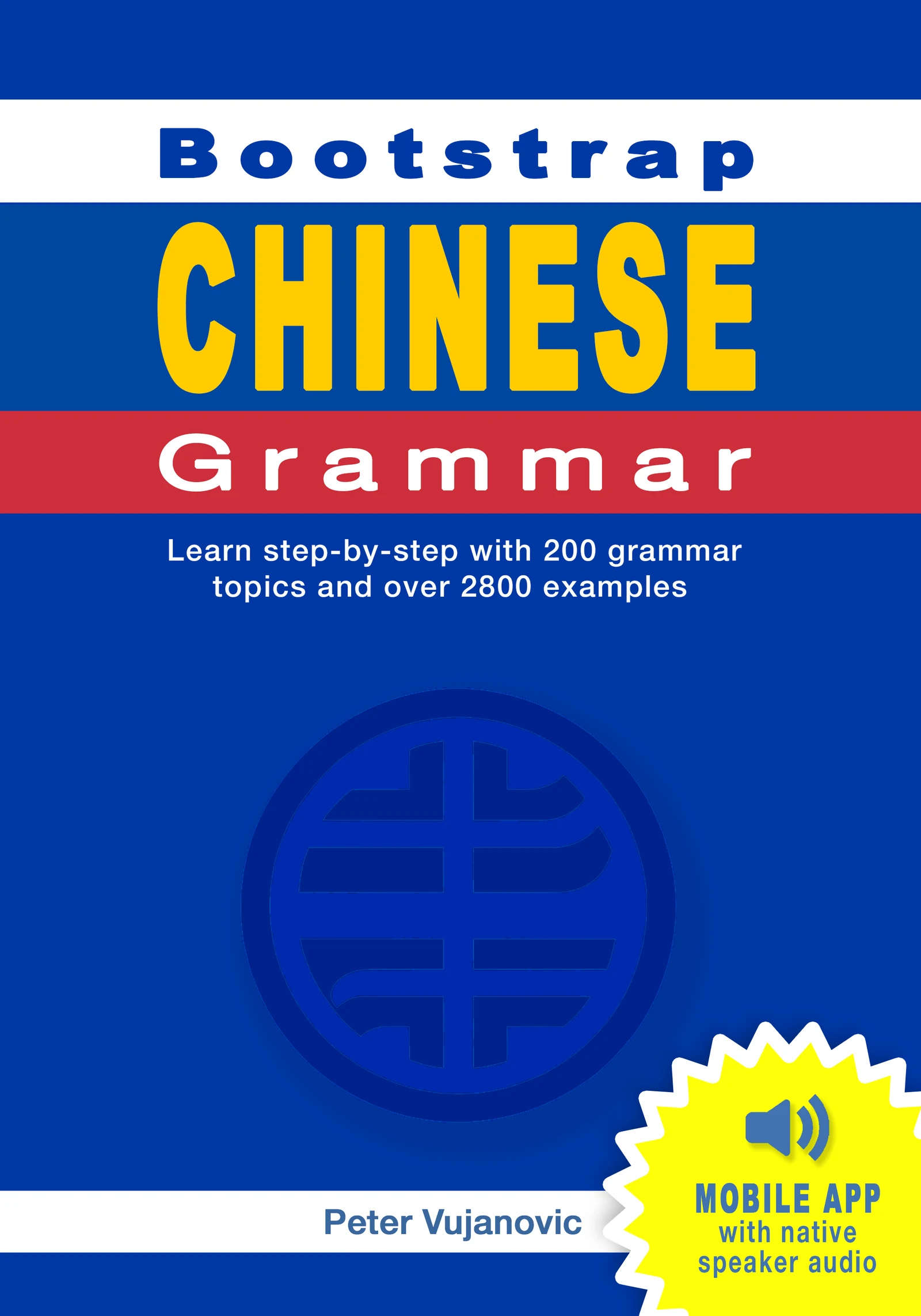
Bootstrap Chinese Grammar paperback with the companion Chinese app

The Bootstrap Chinese Grammar book

Chinese grammar
In your hands

Prefer to study on paper? The companion book brings together all 204 topics and 2,800+ annotated examples. Read the explanation in the book, then use the app to hear the matching phrases and practise the grammar.

494
pages
204
grammar topics
2,800+
annotated examples
Special introductory offer
Paperback + companion app

Buy the book Get the app free

Already have a copy?

Email us for the offer details

More than a list of rules

Your book, with matching audio

  1. Follow the same clear path

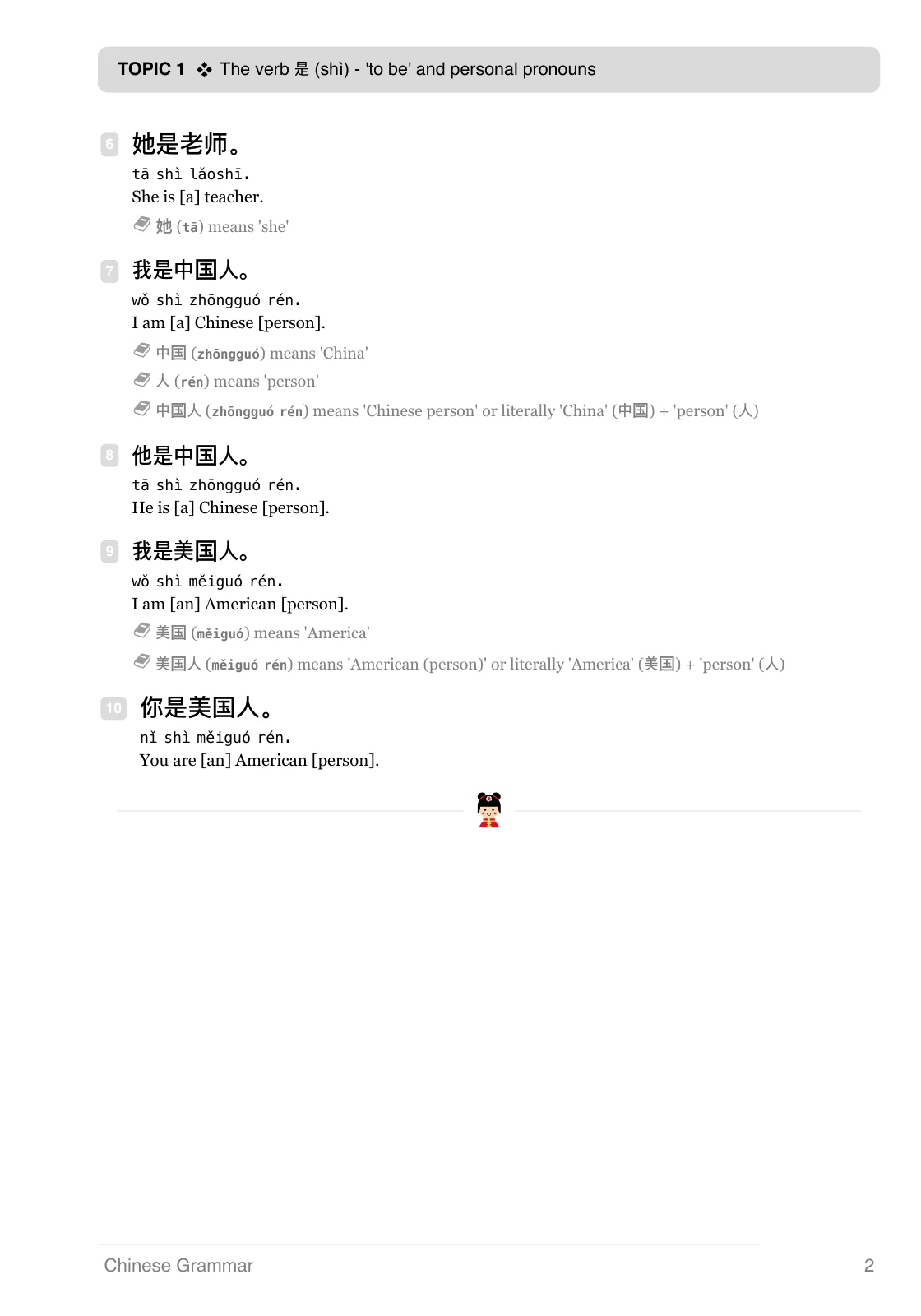
    The book and app follow the same 204-topic sequence. Work from the beginning or turn straight to the grammar point you need.

  2. Understand every example

    Chinese phrases come with English translations and notes on the grammar and new vocabulary. See how each pattern works in context.

  3. Go straight to the audio

    Scan the QR code at the start of a book topic with the companion app. It opens the matching topic, with native-speaker audio for the examples on the page.

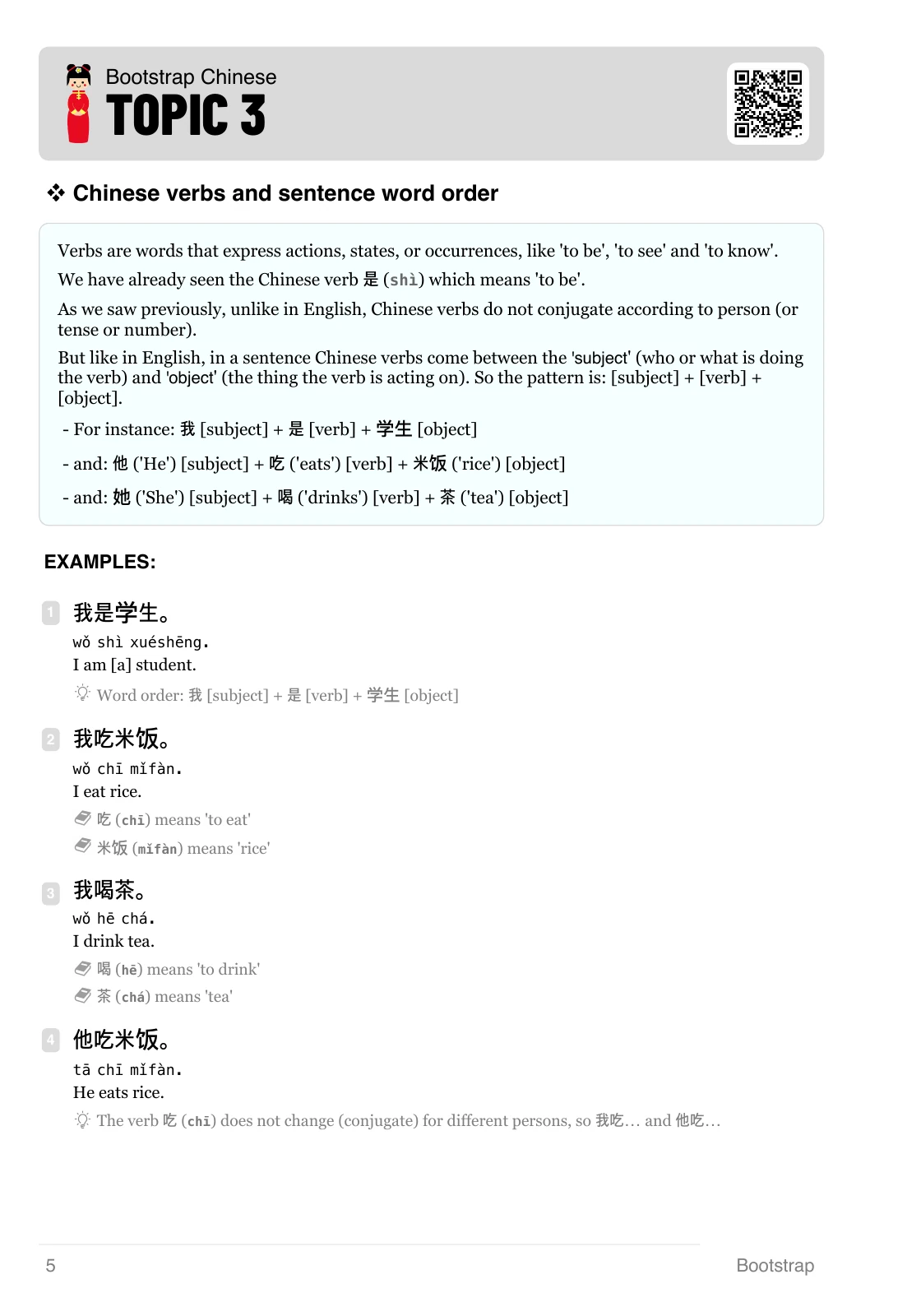
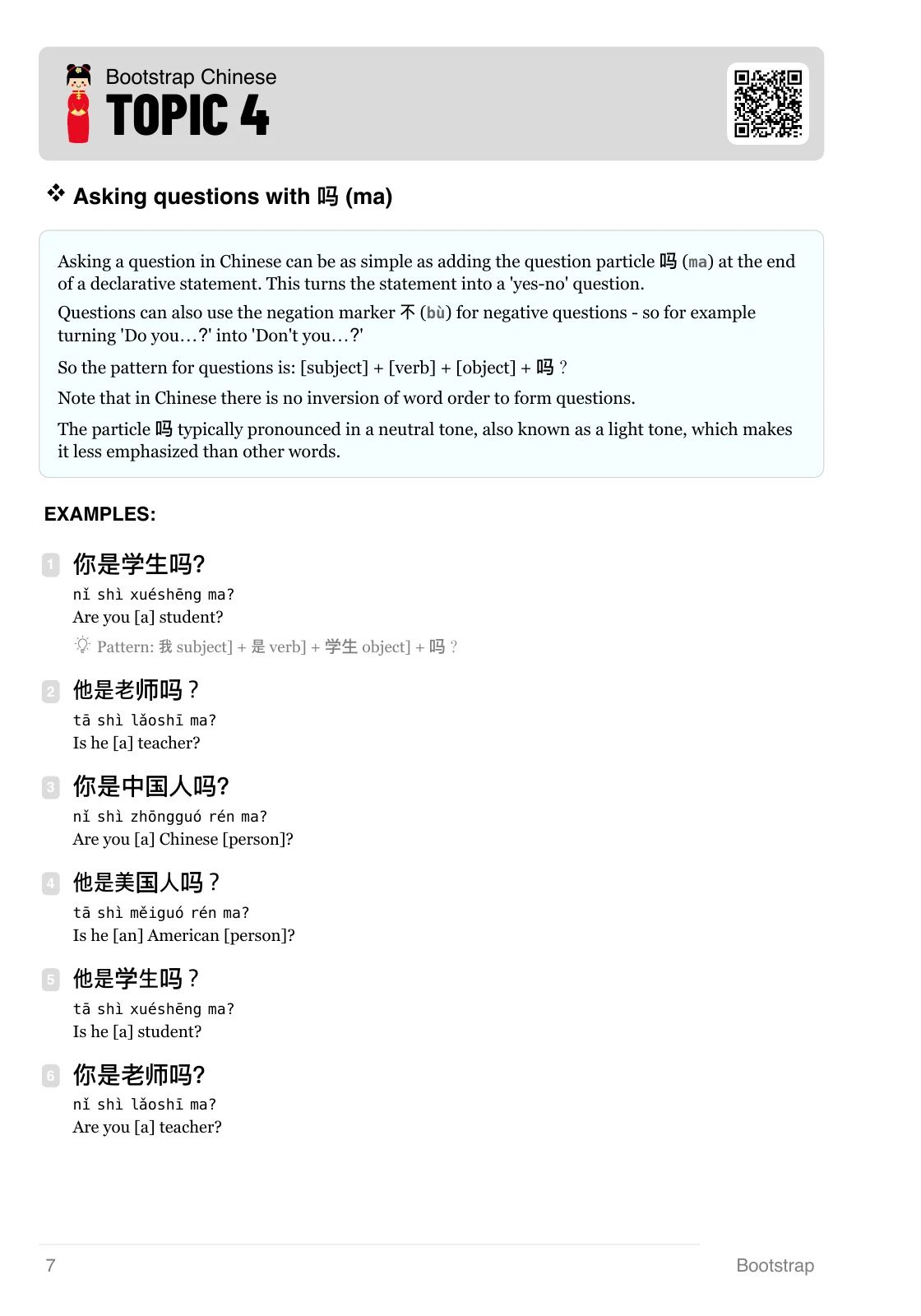
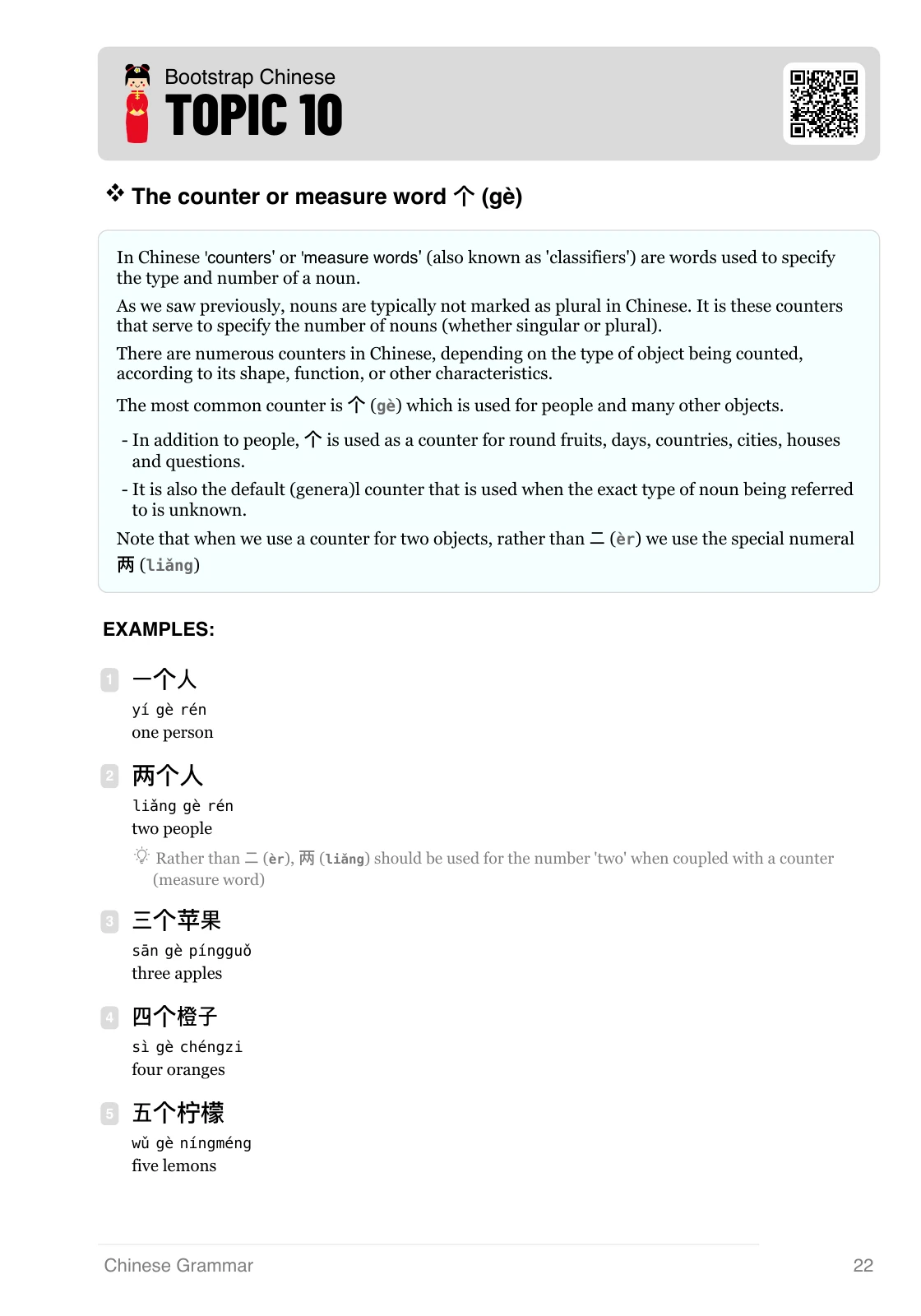
Take a look inside

Tap a page to open the preview. Close it to return here.
Peter Vujanovic

The people behind the course

Made for people who want to understand

I’m Peter Vujanovic, CEO and Chief Editor at Declan Software. I brought together Chinese language experts to create the explanations, examples and audio in Bootstrap Chinese Grammar.

Our aim is to make each pattern clear enough to understand, then give you plenty of examples to practise.

Meet the Chinese language contributors
  • Mei Yei and Zhang Wei — Chinese and English proofreading and advice on the grammar.
  • Chen Zhiyu — recordings of the Chinese example phrases.

Get in touch with Peter and the team →

Before you begin

About the app
and the course

What can I try for free?

The first 10 topics are completely free and include explanations, native-speaker audio and exercises, including Listening & Tones practice. You can use them without creating an account in the app. A one-time purchase unlocks all 204 topics with lifetime access — no subscription.

Is there a subscription?

No. You unlock the full Chinese course with one lifetime purchase, with no monthly fees. Your app store shows the exact price in your currency before you buy.

How is this different from free apps or websites?

Bootstrap Chinese Grammar gives you a structured path through 204 self-contained topics. Each one combines a plain-English explanation, annotated examples, native-speaker audio and exercises. New vocabulary appears in context, and “Why?” feedback helps you understand a mistake instead of guessing the answer again.

What is Listening & Tones?

It is a set of exercises built around the course examples. Listen and tap words to build the sentence you hear, or listen to a word and choose the correct tones from pinyin options. You can replay the audio and slow it down. Listening & Tones is available on both iOS and Android.

Do I need to buy the book?

No. The app is a complete course on its own. Choose the companion paperback if you prefer to study explanations and examples on paper. The book follows the same topic sequence, and its QR codes open the matching topics in the app so you can listen as you read.

Can I start as a beginner?

Yes. The course starts with 是 (shì), the verb “to be”, then introduces negation, questions, pronouns, word order and measure words. Examples use simplified Chinese characters, pinyin with tone marks, English translations and audio to help you get started.

Which Chinese grammar topics does the app cover?

The course covers sentence structure, questions, measure words, particles such as 的 and 了, aspect, comparisons, complements, conditionals and idioms. Browse the 204-topic syllabus above for the complete sequence.

Can I use it with a class or another app?

Yes. Follow the course in order or revisit a grammar point from your class or another app. Save useful examples in your Study List and use the exercises and audio for focused practice between lessons.

How does spaced repetition work?

Phrases you practise return for review at increasing intervals, helping you revisit earlier grammar as you learn new patterns. Use the review feature for ongoing practice. Spaced repetition and “Why?” explanations are available on both iOS and Android.

Is the app available on iPhone and Android?

Yes. Bootstrap Chinese Grammar is available for iPhone and iPad on the App Store, and Android on Google Play. Listening & Tones is included on both platforms. Check the relevant listing for current device requirements.

Start with one small step

Make your next Chinese sentence make sense

Try the first 10 topics free. Unlock the full course with one lifetime purchase when you’re ready.

Keep a little Chinese in your inbox

Occasional language-learning tips and resources from Declan Software, including Chinese study material.

Book preview

Take a look inside

Inside the iPhone app

Open full-size image ↗
Interactive lesson

Explore three Chinese examples. Learn the pattern, listen to the audio, and practise choosing the correct word.

Bootstrap Chinese Grammar

Free to download

Your first 10 lessons are free.

Which device do you use?

Scan with your phone’s camera, or use a download button.

One lifetime purchase unlocks all 204 topics.
No subscription.

First 10 topics freeNo subscription.

Try the app ↗